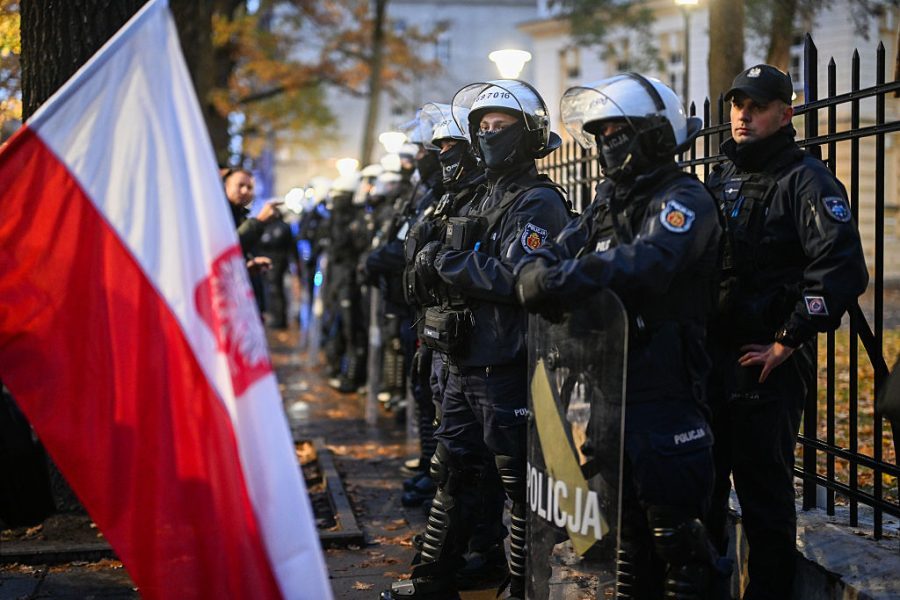
On Friday evening, policemen descended upon 12A Johann Christian Schuch Alley in Warsaw – the inconspicuous address of the constitutional tribunal, Poland’s chief judicial authority on constitutional law. Dressed in riot gear, they surrounded the tribunal to force through a solution to a constitutional crisis which has been unfolding since 2015. But far from solving it, this ham-fisted attempt to finally bring the situation to a close has only deepened it instead.
First, some context. Back in 2015, the governing coalition – which included current Prime Minister Donald Tusk’s party, Civic Platform – elected five judges to Poland’s constitutional tribunal when there were only openings for three. The opposition, led by the Law and Justice party, did not like this, so when it came to power a month later, it appointed its own five judges instead.
Since then, the two parties have been in constant disagreement about who is, in fact, a judge of the constitutional tribunal and who is not. Civic Platform, since rebranded as Civic Coalition, returned to power in 2023 but has struggled to appoint five further judges to the tribunal, since President Karol Nawrocki has refused to accept their oath of office.
It is no surprise that hopped-up commentators are talking about Poland being on the brink of a civil war
The whole farce is not to Tusk’s advantage, who was elected in 2023 largely on the promise of restoring a functioning constitutional tribunal. Next year’s parliamentary elections are now fast-approaching, and Tusk is under pressure to mobilize his base, which has reasons to be underwhelmed by the last three years of Civic Coalition rule.
I will not comment on who is in the right. But whoever is, Friday’s actions have only done more to destroy the tribunal’s legitimacy.
Despite the claims of the Warsaw police that they were merely acting to ensure the judges’ safety, Polish Foreign Secretary Radosław Sikorski was more direct. The following morning he tweeted:
The stand off around Poland’s constitutional tribunal is about restoring rule of law to an institution which had been politicized by the populist government which lost power in the election of 2023.
Tusk backed him up later that evening in a TV address, stating that “a democratic state has to be strong and capable of enforcing justice.”
In reality, what happened on Friday was far from de-politicizing. Instead, the political tension has been cranked up a notch. The police’s actions were hardly a coup d’état, contrary to the suggestions of some – the worst of the violence came to pushing and a few elderly protestors throwing things at the police – but it was enough to send the Polish opposition ballistic.
The mere image of squadrons of riot gear-clad police surrounding the tribunal and, indirectly or otherwise, interfering with its operations was poor. The tribunal’s official website then suddenly announced that two of the Law and Justice party-appointed judges were suspended, while the tribunal’s Twitter account tweeted that its website had been “illegally seized.”
The optics got even worse when Nawrocki, having turned back his plane mid-flight while traveling to Senegal, arrived at the tribunal. The President got into a pushing match with one of the judges elected to it but whose oath of office he refused to accept. The video showing the altercation is unclear, but it looks as though the judge was trying to block Nawrocki from entering the tribunal building, while the Polish head of state was pushing his way through in frustration. Everything unfolded on a Friday evening as many Poles were traveling to their family homes ahead of All Saints’ Day, a major feast in the Polish calendar – the perfect time for people to follow closely on their phones.
It is no surprise then that hopped-up commentators are talking about Poland being on the brink of a civil war. Top comments under Nawrocki’s Facebook posts from Friday evening are urging him to call in the army to deal with the police and to dissolve the government. Now-deleted comments were calling for Polish soldiers to shoot the government’s supporters.
Perhaps even more remarkably, the leaders of several Polish opposition parties who normally detest each other were recorded together in front of the constitutional tribunal, with the overtly anti-Semitic and very right-wing Grzegorz Braun of the Confederation of the Polish Crown party taking a selfie with Jarosław Kaczyński, the long-serving leader of Law and Justice. Kaczyński was also recorded inviting the former prime minister, Mateusz Morawiecki, to sit next to him “in unity” in front of the tribunal, even after the two had a drastic falling out in April which culminated in Morawiecki leaving Law and Justice to form his own party.
The truth is that the opposition will never accept the legitimacy of the Civic Coalition-appointed judges – and especially not after Friday’s actions. All that the police action achieved was to make Poland look like a banana republic. Any legitimacy of Polish national institutions to rule without resorting to the use of force seems to have disappeared. Tusk perhaps hoped to present the opposition with a fait accompli, expecting to catch Nawrocki off-guard as he was enroute to Senegal, but the opposition was quick to react and it was them who dominated the media narrative in the late hours of Friday. Even Szymon Hołownia – the leader of Poland 2050, a party which forms part of the ruling coalition – has criticized the events of that evening, comparing it to the finishing off of a sick patient.
This makes it all the more remarkable that the European Commission seems to have backed Tusk’s actions. Indeed, in 2022, the EU froze funds earmarked for the Polish government for failing to respect the rule of law – €137 billion ($153 billion) in total. Those funds were freed up in 2024, ostensibly on the grounds that Poland had achieved major milestones in restoring the rule of law. Now, it is clear that Tusk is not primarily interested in restoring the rule of law but rather in restoring his own government’s control of the tribunal, much as he decried the opposition for having done in 2015.
The only way to restore legitimacy to the tribunal would be a constitutional reset: a re-appointment of all of its judges following the drafting of a new constitutionally-binding process for their assignment. This should be a process which does not rely on party-political appointments but is rather built on party-political consensus. This sort of solution is supported by virtually everybody in the Polish political establishment, from the right-wing Confederation party, through the center-right Morawiecki and the center-left Batory Foundation, all the way to the left-wing populist Together party. If Tusk was genuinely interested in restoring the rule of law, he would follow suit.
The ball is currently in Nawrocki’s court, who is currently consulting with the leaders of different Polish political parties, presumably to try to work out a reform of the system – though there are obvious question marks over just how impartial any of Nawrocki’s proposals might prove to be. Tusk, however, is not interested. “Solving the conflict is simple and possible without constitutional amendments,” he tweeted this morning. Solving this crisis is anything but simple. A permanent solution will require the sort of humility from both sides of the dispute that is scarcely ever found in Polish politics.



Comments