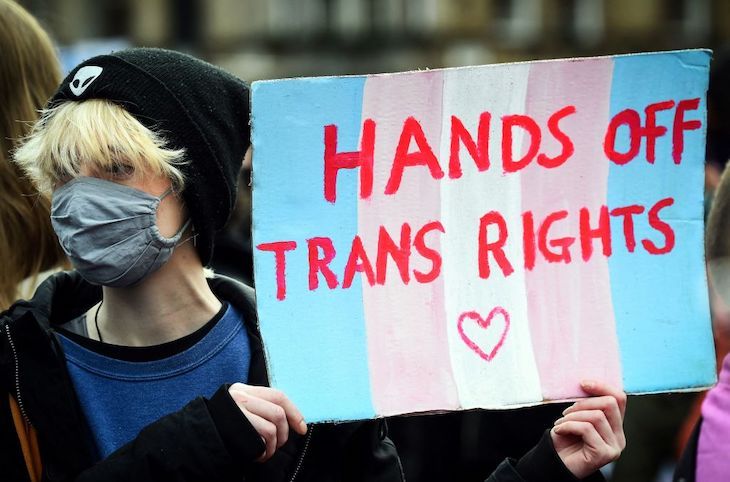
Tess Hackett, President of Active Watchful Waiting Australasia, keeps no records of the two or three telephone calls she receives every week from parents worried about their children adopting opposite sex identities. Most Australian states, and New Zealand, have laws against “conversion practices”, which Hackett thinks could be used to criminalise either her or the parents who approach her.
The Bill would give the criminal law a seat at the kitchen table just when family life is at its most challenging and the stakes are at their highest
These parents do not want to give their children electric shocks or subject them to compelled prayer healing to “correct” their identities. They simply question whether their children were really born in the wrong bodies. They are concerned about experimental puberty-blocking medication and a pathway towards irreversible cross-sex hormones and surgical removal of genitals or breasts. Some believe that their children would grow up to be healthy lesbians or gay men without these interventions. They are afraid to speak to therapists, in case they are reported to the police. For the same reason, many therapists will not deal with gender issues at all.
This June the UK government introduced a draft Conversion Practices Bill which will bring these well-founded fears to British families if it is passed into law. It is currently going through pre-legislative scrutiny. In a Policy Exchange report published today, Baroness Falkner and I argue that the draft Bill is not fit for purpose and will harm those it is supposed to protect.
The government says the Bill will fill gaps in the existing criminal law. But these gaps have not been identified. There is no question that the sorts of practices which are usually understood as “conversion therapy” are already criminal, such as corrective rape, physical assault or child cruelty. At best, there is a miniscule lacuna relating to non-physical, non-violent conduct in limited contexts, of which nobody has yet given an example. The astonishingly poor evidence base for the Bill cannot be taken seriously: it says 10 per cent of gay people and 30 per cent of transgender people have been subjected to exorcism.
In any case, the Bill is not designed to close that possible small gap. Instead, it would cast a net of criminality over interactions with which the coercive powers of the State should have nothing to do. It would criminalise any conduct intended to cause a person not to have a transgender identity if that conduct is inadvertently “abusive” and, again unintentionally, causes “serious alarm or distress”. Economic, psychological or emotional “pressure” would be enough to amount to abuse. So would “controlling or coercive words or behaviour”. These are low thresholds. Any parent who has removed a mobile phone from an adolescent will have behaved “abusively” on this definition, and will know all about serious alarm or distress.
The idea that “transgender identity” is a stable, innate characteristic like sexual orientation is baked into the Bill. But the two are not the same. As the increasing numbers of detransitioners will attest, a mistaken belief about transgender identity can lead to devastating physical and emotional harm. Moreover, same-sex attracted young people are disproportionately represented amongst those who identify as transgender, as are autistic children and those with mental health comorbidities.
If the Bill becomes law, a mother who withholds pocket money to prevent her lesbian daughter buying a breast binder is risking five years in jail. So too is a father who removes his autistic son’s internet access to prevent him researching puberty suppression. These are difficult, sensitive decisions. The Bill would give the criminal law a seat at the kitchen table just when family life is at its most challenging and the stakes are at their highest.
And it is not just parents. Teachers, social workers, religious leaders, family members, colleagues, school friends – anybody over the age of ten – would be at risk of punishment for well-meaning conversations which fall short of “affirming” a person’s transgender identity.
The only carve-out is for healthcare providers, but it does not apply if they fall “far below the standards reasonably expected”. But the question of what is a reasonable standard for “gender affirming care” is a heavily contested issue. Any doctor or therapist entering this terrain would be doing so at their own considerable peril.
In recent years the transgender rights movement has suffered catastrophic legal and political defeats. Maya Forstater’s 2021 case means that trans activists can no longer get people with gender critical opinions sacked from their jobs. The 2024 Cass Report resulted in the overhaul of gender services for children and young people and the banning of puberty blockers. The 2025 Supreme Court judgment in For Women Scotland stopped gender self-ID in single-sex services and sports.
The draft Conversion Practices Bill is an attempt to override all those developments with the bluntest and heaviest tool available: the criminal law. Without even getting started on the Bill’s incompatibility with human rights law, it is clear that it is quite unsuitable. The government must think again.





Comments