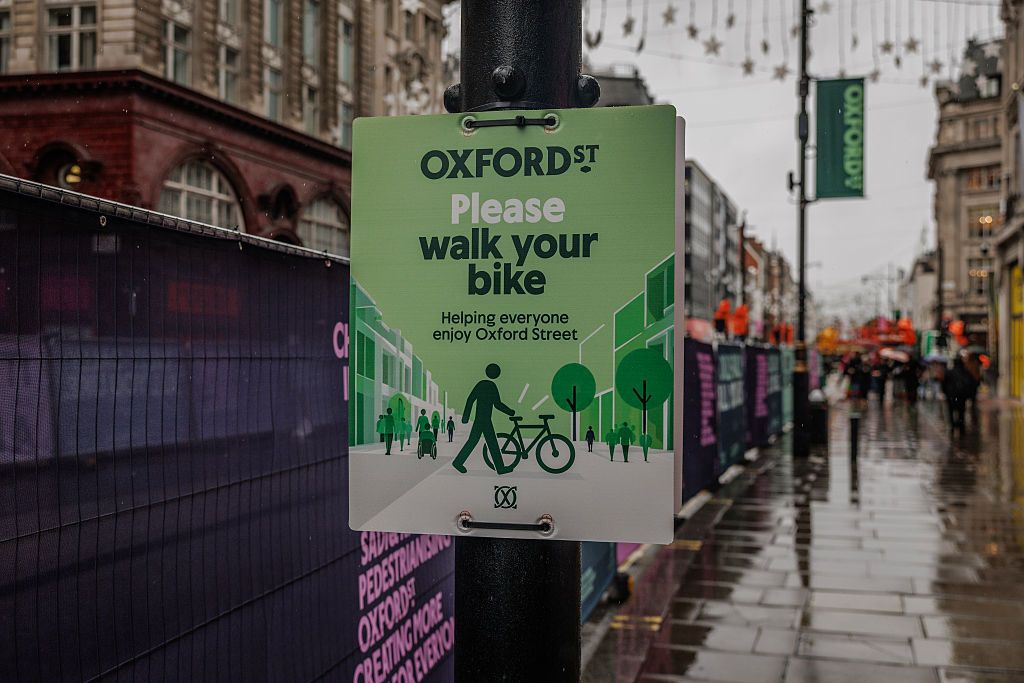
There’s been plenty of outrage against cyclists recently. Last week, after Oxford Street in London was pedestrianised, a small number of people broke the rules by cycling down the traffic-free sections. Cue headlines about cyclists ‘running amok’, ‘nightmare around Oxford Street’ and ‘pedestrianisation chaos’.
Meanwhile, in The Spectator, Ross Clark took aim at cyclists riding on the pavement and said my call for police to prioritise enforcing driving offences, given the greater danger drivers pose to people on the road, was akin to letting cyclists off the hook. His inference is wrong; I agree that people cycling illegally should be challenged. I also think we can do better than demonising a group of people in this way.
The dogged determination of some to turn how people travel into a tribal identity they can rally against is absurd.
We all want the same things when it comes to road safety. I want my grandchildren to be able to walk to school safely. I want my father, who’s not quite as quick on his feet as he once was, to get to the shops without feeling like he’s going to be knocked over. I want to walk my dogs to the café without any stress or hassle.
We should condemn cyclists who speed past pedestrians on the pavement. It’s at best selfish, and at worst, it’s dangerous. Making others feel unsafe is unacceptable. The law should apply to everyone equally.
But there’s an important difference between condemning the behaviour of individuals, and because of their behaviour, condemning an entire group of people. We don’t for example infer boy racers represent all drivers. The dogged determination of some to turn how people travel into a tribal identity they can rally against is absurd.
None of us use just one form of transport. We might walk our children to school, cycle to work, drive our elderly parents to the supermarket and finish the day by walking to the pub. People riding bikes are simply going about their lives. They’re parents, children, neighbours and colleagues, trying to save money, stay healthy or just get somewhere they need to be. They’re us.
We all, reluctantly, understand that the police can’t pursue everyone who breaks the law. They simply don’t have the resources, so difficult choices must be made about which offences they should prioritise. I want those choices to be guided by the evidence about where the greatest danger lies.
And that evidence is clear. Nearly 30,000 people were killed or seriously injured on Britain’s roads last year – around one person every 17 minutes. Behind each number is a person, with a family. My mother was one of the people featured in those statistics. She was crushed to death by a driver who had been texting. So, when I talk about road danger, I’m not making an abstract argument. It’s painfully personal for me.
This doesn’t excuse someone cycling dangerously, but it does mean that when the police have to choose between focusing on speeding, texting drivers or people riding a bicycle on the pavement, I want them to look first at the things which have the potential to cause the most harm to others. Cars are 100 times heaver and twice as fast as a bicycle. That’s not, as Ross Clark implied, favouritism, it’s physics.
I’d much rather the police didn’t have to choose which offences to enforce. But while we often have to make difficult decisions about resources, we might not have to in this instance.
Research by the College of Policing has found that speed cameras reduce speeding by more than half and collisions by around a fifth. Given this, you would think that we’d be falling over ourselves to celebrate speed cameras and roll them out even further. Instead, speed limits have become one of the great controversies of modern British life. It seems the freedom to break the law without being caught is something we are rather attached to. Personally, I think railing against the measures that save lives and saves families from grief, is what we should be outraged about.
More effective camera enforcement – as just one example – could free up police time to tackle intimidating behaviour by cyclists on our pavements.
Commentators who demand tougher action against cyclists, while ignoring the practical actions we could take elsewhere to tackle far greater risks, are in my view, part of the problem. If we did as some journalists suggested and diverted scarce police resources away from things that kill and seriously injure the most people, we will make our roads less safe and see more lives devastated by crashes. Outrage makes headlines. It doesn’t, if wrongly focused, improve public safety.
I have no interest in defending dangerous or inconsiderate cycling. I want it challenged and the law enforced. But I also want the police to focus their resources on the things that actually make our streets safer. Our ambition should be making all travel safer for everyone. We already have the tools to do this, if we are prepared to use them.



Comments