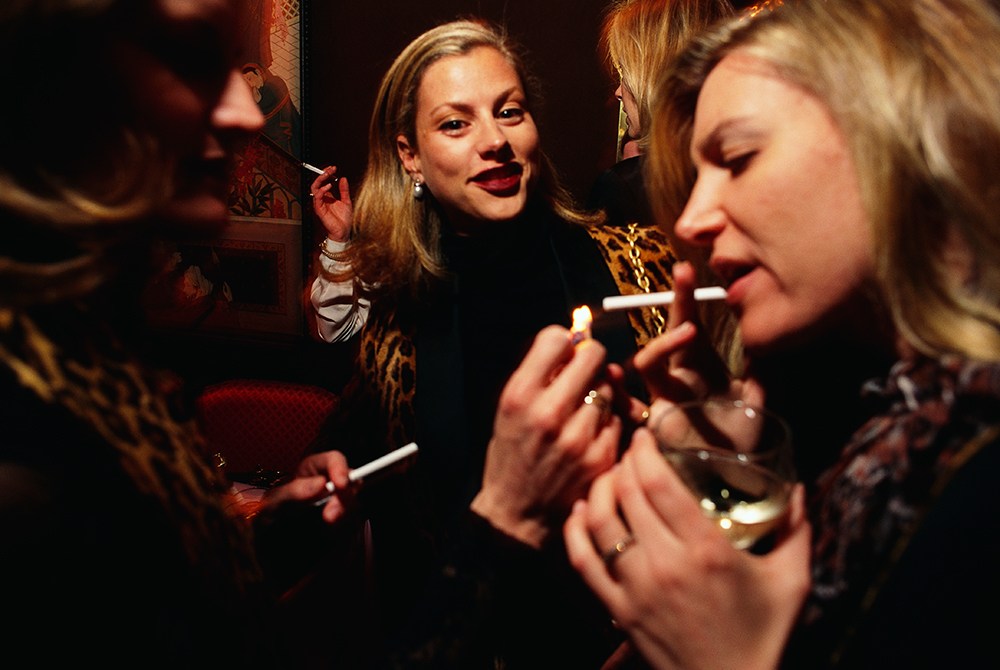

DC is often maligned for being swagless. This is a perception I have struggled in vain to correct in the pages of this magazine, in my weekly culture newsletter, in my own life, by emphasizing the subtler currents of intrigue at play in the capital city. But every week it seems some new horror emerges to beset my efforts, some arch little triumph over the joy of spontaneity, a dead-eyed child of Yog-Sothoth in the form of an infantilizing $35 “Adult Happy Meal” or now, La Merna’s espresso martini special, which comes with an added cigarette for $3 or the whole pack for $30! “I’m LIVING for this,” tweets an algorithm zombie to 600 likes. It really gets to a point. At no time in history has a little espresso and a cigarette on a European street charmed itself into your life via $9.99 branding and tap-to-pay ease. A knowing gaze doesn’t announce itself. Chemistry does not come with a user guide. A cigarette after a drink only has the sheen of vice if it is allowed to remain ambiguously bad, the hallmark of a person whose life overflows with bewitching depravity.
This same hollowing-out impulse has its fingerprints all over hospitality, not just in dining but in the experience of hosting itself. I find myself scrolling through reel after endless reel of unforgettable themed dinner parties; beautiful, elaborate evenings planned, designed and curated ostensibly for the benefit of the guests, but also (perhaps primarily) for the benefit of me, the viewer.
A cigarette after a drink only has the sheen of vice if it is allowed to remain ambiguously bad
Hand-painted place cards, color-matched napkins, sumac and black garlic and heritage masa galettes. At first I thought these events seemed aspirational. I’ve always loved hosting and drama and excess. My grandpa, the chef, used to make detailed sushi platters in the shape of octopi; he taught me how to flambé and carve an apple into a swan. “Presentation is everything,” he used to say, and I took that to heart. For most of my life, a fancy dinner party felt like a creative act in his spirit, a way to delight my friends and hone the art of hospitality. But something about these specific dinner parties strikes me as sterile. The guests seem like an afterthought, the curation less like the generous overflow of a naturally convivial life and more like the anxiety of an empty one. “Here,” says the hand-painted menu, “is an experience for you to recognize! Now will you love me?”
As real-life interaction becomes scarce, its actual manifestations become fraught and self-aware. In a recent viral essay, Derek Thompson reports that frequent hosting in America has declined by 70 percent since 1975. Thompson points to the increasing demands of involved parenting and I wonder whether these constraints have caused us to stop thinking of hospitality as an ordinary part of life. The less often we have people over, the more of an event it becomes and the more preparation it requires. It’s poignant. We crave something warm and good, but as it becomes scarcer, we doubt that we can have it without our own deliberate over-orchestration. We think if we can work harder and arrange the ingredients of spontaneity correctly, then the feeling will emerge. But in our efforts to pin it down, it vanishes.
My friends in DC – a married couple – have hosted the most wonderful gatherings by just opening their doors and welcoming our friends as they are. A big pot of stew on the stove, a loaf of bread contributed by somebody else, fruit and chocolate for dessert and, “Oh! Paul made Jell-O; does anyone want some?” Friends coming in and out all day. My grandfather, for all his love of elaborate hosting, knew how to make the simplest meals special for his grandchildren – crisping up the edges of his famous silver-dollar pancakes, putting peas into macaroni, dipping hazelnuts in chocolate.
I think too of my grandmother in Mexico, whose open door still welcomes countless neighbors, family and friends at any time of day or night. Tortillas heating up on the comal with a little cheese melted on top. A tomato and a chile and half an onion turned into salsa. Sitting with my aunts and uncles on the sidewalk in plastic chairs as the night stretches into early morning, gazing at the stars, talking and talking as a bottle of red wine slowly dwindles away. I could buy plastic chairs and mold an elaborate Jell-O and perfect my grandpa’s crispy-edged pancakes, but none of these elements by themselves would ever reproduce the feeling of any of my memories.
The good in each of them overflows from a hospitable spirit, from love for one’s neighbor and the pleasure of laughing in good company. It is from a spirit of worldly insouciance that a cigarette becomes more than a cigarette, that a cigarette and an espresso martini together become a symbol of delicious decadence. And it is from love itself that a sushi platter shaped like an octopus or a six-course themed dinner can become a delight.






Comments