
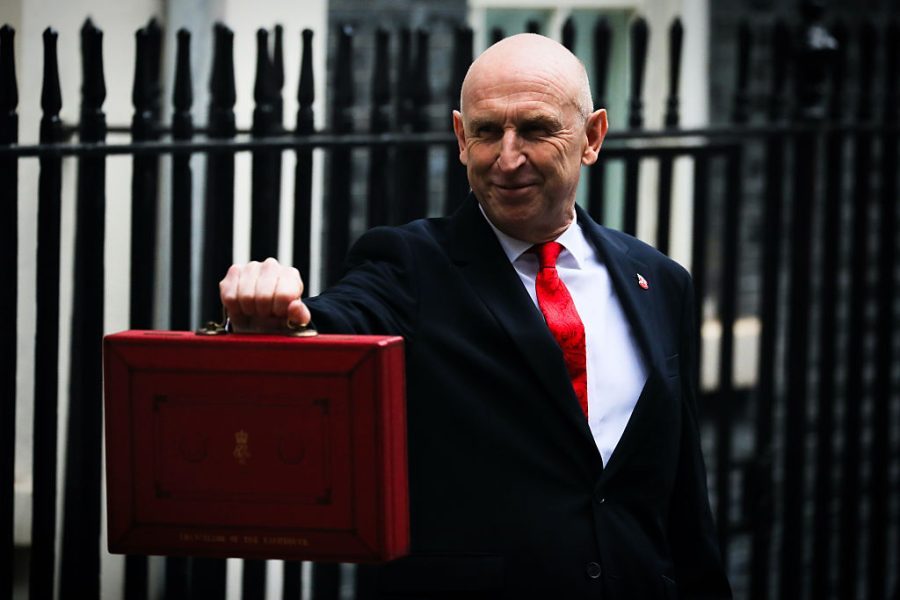
Politics can be a rollercoaster. When Andy Burnham chose John Healey as the new Chancellor of the Exchequer in July, there were pricklings of hope that Healey might begin to extricate the government from its hazy morass of misdirection, inaction and false promises on defence spending. He had, after all, resigned from Sir Keir Starmer’s cabinet less than six weeks previously on exactly that issue. And he had done so with painful candour, his resignation letter providing a brutal punch to the embattled prime minister:
You have been unable, and the Treasury has been unwilling, to commit the resources that the nation needs to defend the country at this time of rising threats.
The two specific matters which caused Healey to depart were the failure to provide full funding for the government’s Defence Investment Plan (DIP) and Starmer’s refusal to set ‘a headmark date for [spending] 3 per cent of GDP on defence in 2030’. Unwittingly, Healey was setting the criteria for assessing his own Budget four months later.
Healey will not know – or will not reveal – for another year where he will find this money
On the DIP, Healey seems to be delivering. The woeful and faint-hearted settlement proposed by Starmer and then chancellor Rachel Reeves amounted to £10.3 billion of an overall cost of £15 billion. Healey told the House of Commons that it would in fact be fully funded, ‘including through capital reprioritisation across Whitehall’. In layman’s terms, other departments will have to cut back to find the additional £4.7 billion to fund the DIP completely. Expect some full and frank exchanges of views between ministers, interviews without coffee and walls wiped down for arterial spray.
The target of spending 3 per cent of GDP on defence by 2030 is more nuanced. This is not a formal external commitment: the UK agreed with Nato allies at last year’s alliance summit in The Hague to spend 3.5 per cent of GDP on core defence capabilities, with another 1.5 per cent to:
Inter alia, protect our critical infrastructure, defend our networks, ensure our civil preparedness and resilience, unleash innovation, and strengthen our defence industrial base.

Healey’s view during Starmer’s premiership was that the UK needed to set its own independent target of 3 per cent by 2030. This was partly to flatten the curve of the necessary increased spending and partly to indicate to Nato allies as well as adversaries that the UK is serious about defence and about meeting its commitments to allied military capabilities and posture.
This is not idle anxiety: we are already behind the curve and would be badly exposed in the event of a full-scale conflict; a recent House of Commons Defence Committee report revealed that the UK is 31st among Nato countries in meeting rearmament promises. Nato has 32 members; Iceland has no armed forces. The UK is also committed to providing two divisions to the Allied Rapid Reaction Corps, but even the Ministry of Defence acknowledges that 1 (UK) Division and 3 (UK) Division are not deployable at full strength.
The Chancellor pledged to meet this interim target – sort of. His exact words in the House of Commons are worth examining:
At the spending review next year, I confirm that I will set out the details of how we will meet our Nato commitment to spend 3.5 per cent of GDP on defence by 2035, with a target date for 3 per cent in 2030. Today, I am getting work under way to get there in a fiscally sustainable way. That will include looking hard at public spending… I am also determined to use more innovative financing, alongside the private sector and our international allies.
Take a deep breath. What Healey is saying is that he is now thinking about how he will set out a plan for reaching those targets, and that the plan for achieving them will be announced next autumn at the Spending Review. The dog has not eaten his homework; it is only now beginning to look at the menu.
There is a long way to go. Current defence expenditure is 2.56 per cent, on a generous reading of ‘defence’; for example, this includes the Single Intelligence Account, which funds MI5, SIS and GCHQ. The Institute for Fiscal Studies calculates that the MoD will need an additional £11 billion every year until 2030 to meet that milestone, but Healey will not know – or will not reveal – for another year where he will find this money. It is inconceivable that other departments will not be required to cut their spending.
In 1910, the Prime Minister, H.H. Asquith, was asked by one of his East Fife constituents if he would tell the public what his government would do if the House of Lords rejected what became the Parliament Act 1911. His reply was sniffily superior: ‘No, I will not. We shall wait and see.’
That is the headline of this week’s Budget in terms of increasing the amount of money we spend on the defence of the realm: wait and see. Will our adversaries around the world – Russia, Iran, China – have the courtesy to wait with us? Would you, in their position?






Comments