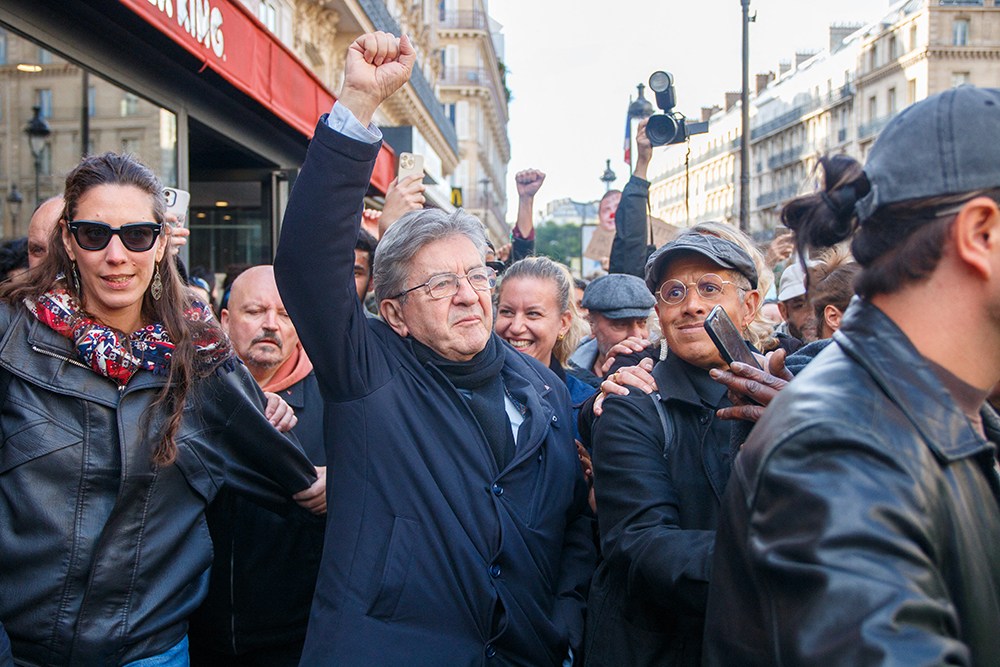
Jean-Luc Mélenchon, the riots’ chief instigator and leader of the far-left La France Insoumise (LFI), is currently ranked second in most presidential polls. Marine Le Pen remains the favourite despite her continuing legal problems.
But the polls do not reveal Mélenchon’s strategy, his organisation, his coherence or his ruthlessness. It has become fashionable to dismiss his chances. He is too radical, they say, too inflammatory. As if that has not benefited other modern underdogs.
Born in Tangier in 1951, the former socialist schoolteacher became a senator at 35 and briefly served as a minister under the former PM Lionel Jospin. Mélenchon has spent the past 18 years building a party in his own image. This is his fourth presidential run, and there has been steady progress: in 2022 he came within a point and a half of the second round.
Mélenchon is quite obviously brilliant. Contrary to most other French politicians, who have the literacy of dried oysters, he is well-read and can speak well. He can cite Victor Hugo, whose parliamentary speeches he reveres as much as Les Misérables, as well as Robespierre and Michelet’s history of the Revolution. He is what the French call a tribun, a tribune, an orator, who regularly summons countless minions. His rally in June in Saint-Denis united tens of thousands of people.
Mélenchon has built a formidable political machine. It is hierarchical and motivated, possibly more so than any other party’s. In France, the trained ear can spot when his circle has held one of its internal strategy meetings: rumours start spreading, all using the same turns of phrase.
His team has adapted old-school Red methods to the modern world. Woe betide the victim of their online legions, who will barrage you with threats and insults for days. I was turned into a target after I allegedly argued for the expulsion of Algerian diplomats and the burning of their Paris embassy, following the incarceration of the writer Boualem Sansal.

Mélenchon’s lieutenants owe him every-thing and are quite ready to die for him. They are his Red Guard. First among equals is Manuel Bompard – doctor of applied mathematics, campaign director in 2017 and 2022, elected to his boss’s old seat in Marseille. He is the brains. Next comes Mathilde Panot. An international relations graduate from Sciences Po university, and now president of the parliamentary group, she is the enforcer, a woman who could credibly pass as a territorial and domineering 14th-century tavern keeper. Then there is Sophia Chik-irou, communications director and almost certainly in a relationship with Mélenchon (the leader of the Communist party has called LFI a sect under the spell of a couple).
Add to that the lower rungs, peopled with creatures of marsupial intelligence: National Assembly member Sébastien Delogu, the barely literate Marseille taxi driver whose only qualification is his cab licence; European Parliament member Rima Hassan, born in a Syrian refugee camp and turned ambassador to Gaza, who went on trial this week for glorifying terrorism; Raphaël Arnault, also in the National Assembly, who sits on a state security watchlist and co-founded the Jeune Garde. This is the outfit whose militants are under investigation for the death of 23-year-old Quentin Deranque, bludgeoned to oblivion in a Lyon street in February. Two of those charged with involvement were Arnault’s own parliamentary assistants.
Mélenchon has purged the party of any-one who isn’t deathly loyal. A number of old-timers, some of whom co-founded LFI with him, were ruthlessly cast out and blacklisted after an attempted modern leftist version of a marshals’ mutiny just before the snap election of 2024. The rebels told Mélenchon he was too tainted to be the party’s presidential nominee and should step aside. Five days later, most had official LFI candidates running against them, and their names were no longer mentioned by many former colleagues.
The rebels included my friend Alexis Corbière, an old companion of Mélenchon’s, who, despite the purge, managed to hold on to his seat in the Assembly. His experience featured prominently in a book on the brutality of LFI’s Stalinist tactics, entitled La Meute (‘The Pack’), which enjoyed considerable commercial success.
These lovely characters built LFI’s think-tank: the Institut la Boétie, founded in October 2019 by Bernard Pignerol, a councillor of state and an old friend of the boss. (Étienne de La Boétie wrote Discourse on Voluntary Servitude, a 16th-century essay explaining why whole peoples consent to serve one man…) It’s a facility with impressive political output – a stream of graduates from ten-weekend courses – financed by a million-euro grant from the party and tax-deductible donations which have been referred to the Treasury for scrutiny.
Woe betide the victim of their online legions, who will barrage you with threats and insults for days
Out of the Institut’s orbit come blue-haired ideologues and, far more dangerous, the sleeper agents: some 80 senior civil servants calling themselves the Phrygians, formed in May this year. They meet each month, co-ordinate by Telegram, and embed themselves at the finance ministry, the foreign ministry, the Banque de France and the European Commission. Their handler is the beautiful Clémence Guetté, who co-chairs the Institut with Mélenchon and runs the programme.
No other political family or faction in modern France is as well organised as LFI. This is one hell of a tight ship. I would willingly grant that their presidential prospects are poor for this cycle. But I would not be so bold as to dismiss their chances entirely.
LFI has something no other party seems able to hold on to: a disciplined strategy for attaining and keeping power. They have bet everything on Islam and its representatives, abandoning the workers of old in favour of immigrants and their descendants.
Sixty-nine per cent of French Muslims voted for Mélenchon in the first round of 2022. It is a bloc more cohesive than any other group voting for anyone, anywhere (he scored 88 per cent in some areas). If demographic curves are to be believed – which they are – this is bound to be a winning strategy, if not next year, then soon.
But Mélenchon would also be wise not to trust in his own invincibility. He may yet be consumed by his new friends, who have proven, on more than one occasion, perfectly willing to devour their own.





Comments