Donald Trump, who has decided not to allow the televising of the spectacle of a soldier being executed by firing squad, has clearly been reading Seneca the Younger, as he would. After all, Seneca was one of Nero’s advisors.
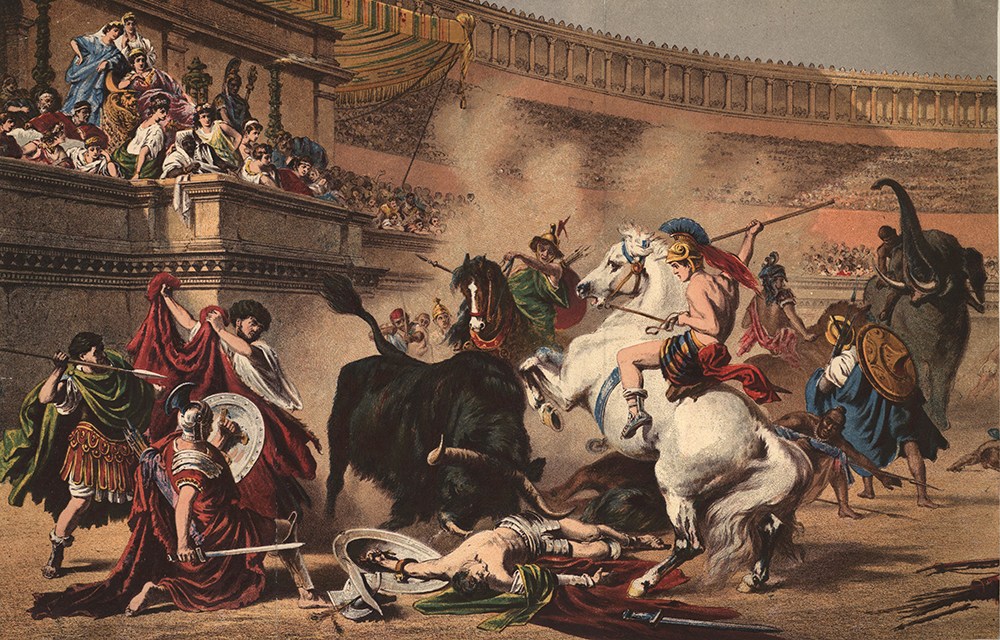
In a letter to his friend Lucilius, to which the modern title ‘On Crowds’ has been added, Seneca gives an account of his day at the gladiatorial games. In between the slaughter of animals (in the morning) and of other gladiators (in the afternoon), there was a midday interval which Seneca decided to attend in the hope of finding amusing and witty entertainment of some sort. Far from it. What he saw were condemned criminals, with no armour, fighting each other to the death and being urged on enthusiastically by the crowd. Not that the winner was released. He fought on until he, too, was killed.
It is the psychological effect of such an experience that concerns Seneca. Any contact with a mob risks one returning back home with a dehumanising disease, in the case of the games ‘feeling greedier, more desirous of glory, more licentious, more cruel and inhuman – because I have been mixing with humans’.
Granted, a criminal pays the price for his crimes but ‘what price have you paid for watching this spectacle?’ he reflects, going on to point out that even the behaviour of individual neighbours can have morally destructive effects upon us. But imagine what the consequences will be for us as humans when we are assaulted on all sides by the behaviour of mobs like that.
Further, Seneca goes on, while you should not copy the bad simply because there are so many of them, nor should you hate the many because they are not like you. ‘Withdraw into yourself in as far as you can. Mix with those who can make you better men. Welcome those whom you can improve. Men learn while they teach.’
But then, who has ever doubted that Mr Trump, faced with a howling mob, will do anything other than send them home a wiser, kinder and more thoughtful mob?






Comments