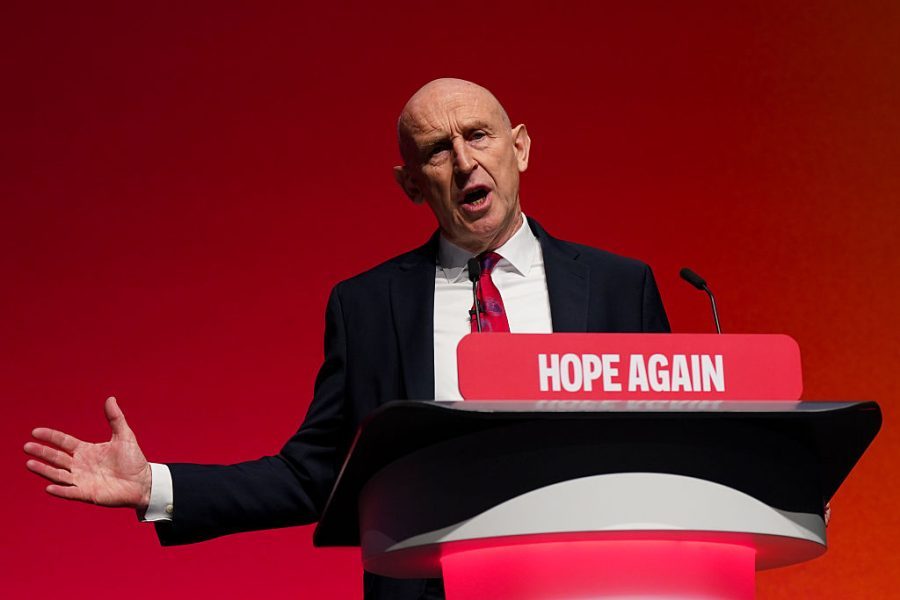
We already know that Andy Burnham, with his talk of public ownership and ending ‘neoliberalism’, wants to take the county back to the 1970s. But now it turns out that his Chancellor John Healey plans to go one better: he wants to take us back to the 1950s. In his speech to the Labour party conference today he has pledged to put shipbuilding at the heart of his plans to reindustrialise the British economy. But is shipbuilding really the industry of the future?
It at least made a change from ministers blathering on about AI or the opportunities in space. When he addressed the Labour party faithful in Liverpool, the Chancellor offered something that he clearly thinks will prove more substantial. He promised ‘a new age of industrialisation’. This didn’t include a pledge to re-open the coal mines, but he did promise to remake industry ‘for a modern age’.
The Chancellor has pledged that three new floating docks will be constructed at Faslane in Scotland – home to the UK’s nuclear deterrent – to build new equipment for the Royal Navy instead of the contracts being put out to tender. The yards will re-open and there will be lots of well-paid, unionised, blue-collar jobs.
It is very hard to see us ever competing with China or South Korea in the realm of shipbuilding
That all sounds well and good. But it is very hard to see Britain becoming a major force in shipbuilding again. With huge companies such as Harland & Woolf and massive yards in Glasgow and on the Tyne, we might have been a great shipbuilding nation in the 19th and early 20th centuries. But the industry went into a relentless decline after the second world war, and we lost the top slot to Japan way back in 1964.
The top three counties for shipbuilding today are China, South Korea and Japan. Meanwhile, we are not even in the top 30, with a global market share of less than 0.1 per cent. It is not even a terribly profitable industry anyway. Civil demand is sluggish, and while there may be some pick up in military orders as Europe rearms, Britain is not likely to benefit from that, especially as France and Italy are fiercely protective of their maritime defence industries. With Britain’s sky-high energy costs and rising taxes on labour, it is very hard to see us ever competing with China or South Korea in the realm of shipbuilding, never mind with rivals, such as Italy, that are still in the top ten.
If the Chancellor genuinely wanted to ‘reindustrialise’ the UK, it might be better to start with some of the industries that are still operating. He could start tackling industrial energy prices that are twice those of France and four times those of the United States. He could start rolling back the green levies and regulations that have crippled industries such as petrochemicals. Or he could reverse the rises in business taxes that have made it very hard to invest.
The nostalgics for heavy industry at the Labour party conference may lap it up with the ‘return of shipbuilding’. But it is hardly a credible industrial strategy.






Comments