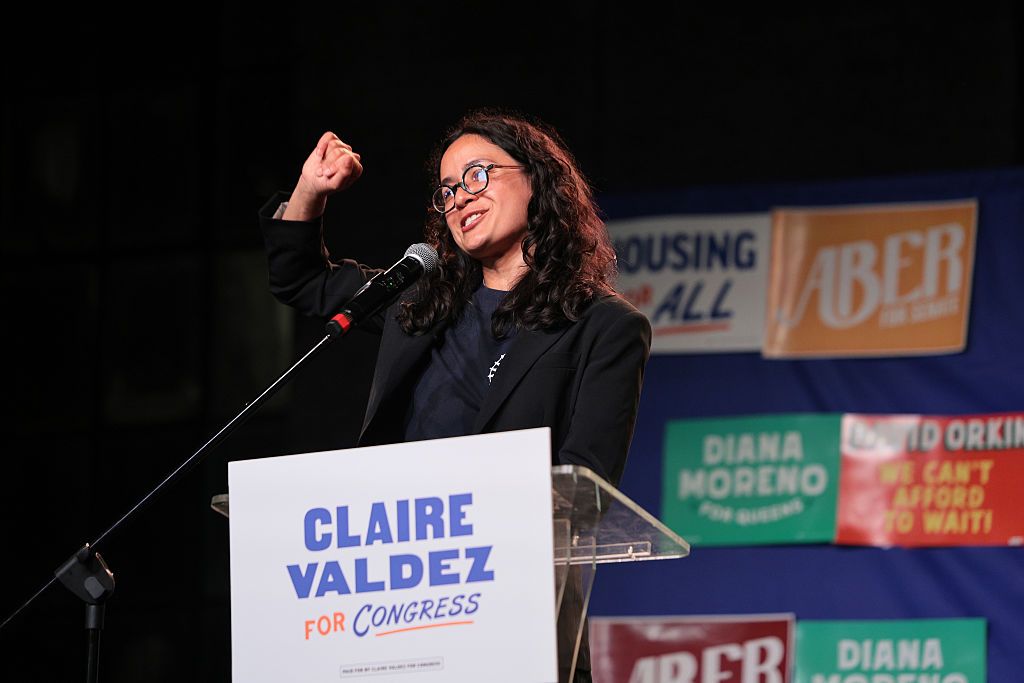
Like most evenings recently, I was scrolling X to fill some idle time. Within seconds, I came across a rather rage-inducing post by New York State assembly member and congressional candidate Claire Valdez. Invoking Mexico’s struggle against “empire,” she promised to carry that struggle into Congress. Her framing, focused around the thinly veiled disdain for “empire,” raises an obvious question. What role does America assume in this story? Is the American political community one that she, alongside her DSA comrades, wants to improve, or is it an adversary to be dismantled from within?
To call these politicians un-American, without substantiating the claim, is a losing proposition
Six-score and five years ago, socialist activist Eugene Debs delivered an Independence Day address. Unlike the latest generation of prominent socialists, Debs left little ambiguity about his view of the American project. He frankly expresses his disdain for the stars and stripes, and declared that a triumphant socialism would haul down the flag alongside every other symbol of capitalist rule. The underlying premise survives to this day within the modern DSA. American institutions and national symbols are disposable to the socialist, because they embody a social order that the movement despises. Make no mistake: this hostility is not the recent corruption of an otherwise well-intentioned and patriotic doctrine. Debs was already supplying its language and ethos over a century ago.
Identifying a nation entirely with its injustices is, to adopt the language of the left, “problematic.” It abolishes the separation between reforming institutions to better serve the populace and the repudiation of the national project altogether. Constitutional rights and democratic checks and balances, the procedures that enable reform – all fall to sweeping verdict of illegitimacy. In any case, these institutions remain guilty by their association to the country that produced them.

The DSA themselves gave this worldview explicit credibility in a resolution adopted in 2021, declaring that the United States “has never been and will never be a force for liberation.” Opposition to particular American actions can, of course, be justified. Yet, the declaration that America can never and has never advanced liberation forecloses the possibility of improvement, and dismisses everything that it has achieved. In the eyes of the socialist, redemption is discounted entirely. What could Americans possibly change to satisfy a group that has already adjudicated its entire past, present, and future? American wrongdoing, in this instance, is an immutable national characteristic.
There is, of course, selective permissibility over who is allowed to maintain a sense of national pride. In her Fourth of July post, Valdez explicitly mentioned Puerto Rico, Palestine, and a fight for the “world we deserve.” America itself was not even mentioned. When celebrating Mexican independence, however, Valdez hailed her Mexican heritage and the history of the Mexican people as a source of dignity and political purpose. The contrast in these messages raises an important point: does her worldview entitle Americans to a similar sense of pride or attachment to their own nation? Furthermore, why is national pride a source of inspiration abroad, but an object of suspicion domestically?
If the right wants to defeat the DSA, it must relentlessly expose this contradiction. To call these politicians un-American, without substantiating the claim, is a losing proposition. Forcing them to reconcile their ambitions to govern Americans with their movement’s declared belief that it will never be a force for good is the better argument. When DSA candidates promise cheaper groceries or frozen rents, we must make them answer for the broader ambitions of their movement. Ask less about what they wish to tear down. Ask instead what they believe is worth preserving about the country they seek to govern.






Comments