In the early years of the English civil war John Milton turned his mind from the poetic arts and committed himself to writing some of the most searing pamphlet polemic of the 1640s. With the nation convulsed by violence, he set about finding causal explanations for the revolutionary ferment, and saw its roots in the 1530s and the unfinished nature of the Protestant Reformation. Only by completing the work of Reformation, Milton thought, would the English come closer to God and lasting peace.
Such arguments had domestic as well as national urgency for Milton, much in need of peace himself, as he tried to extricate himself from his stupendously misguided marriage to Mary Powell, half his age and from a royalist family. These struggles led the republican and future regicide apologist to write the first of several scandalising, sometimes bracingly misogynistic, pamphlets in favour of divorce, featuring an unlikely monarchical hero: ‘Harry VIII’.
Evangelical protestantism, rapacity and, above all, the promotion of family characterised both men
The Doctrine and Discipline of Divorce (1643) exulted in Henry VIII’s conduct in the Great Matter of his divorce, since it revealed ‘all the tyranny of Rome by discovering this which they exercised over divorce, and to make [Henry] the beginner of a reformation to this whole kingdome by asserting… the right of just divorce’. Heroic, rational divorce, in Milton’s telling, was the Reformation in its purest, butchest guise, a liberation from the deathly constrictions of Roman Catholic custom. That English ecclesiastical law had not been sufficiently updated, and still forbade divorce except in extreme situations, was a gross betrayal of Reformation first principles which had left the nation in tatters and Milton in a mess.
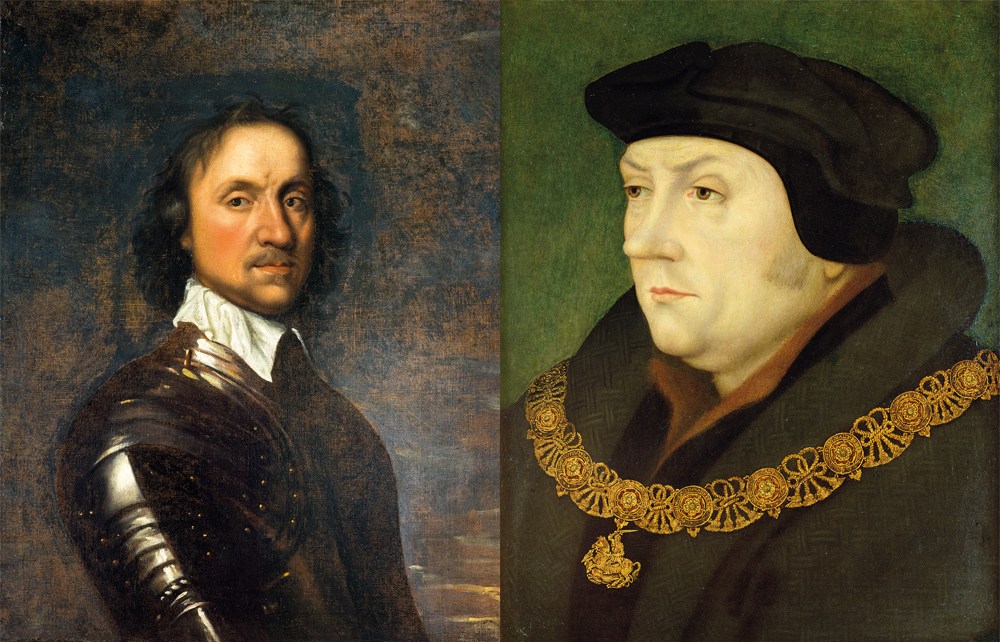
The radioactive half-life of the Reformation, the persistence of figures and ideas from the 1530s into the 1640s and beyond, is a vital aspect of Miranda Malins’s captivating and brilliantly researched biographical study of the Cromwell family. The book is framed by connecting history’s two most famous Cromwells with each other: Thomas Cromwell (1485-1540), the administrator, architect and enforcer of the Henrician Reformation, and his great-great-great-nephew Oliver Cromwell (1599-1658), the parliamentarian military commander and Lord Protector of Great Britain and Ireland.
Even if Malins presents no evidence that the Lord Protector ever discussed his illustrious forebear in public, she compellingly emphasises the congenial outlooks and preoccupations of both men: evangelical Protestantism, self-consciousness about modest upbringings, rapacity, and, chiefly, the promotion of family. Her central contention is that they were part of an early modern dynasty whose reach has been dismissed or occluded by hostile contemporaries or members of the family themselves, some of whom were keen to distance themselves from associations with their controversial relatives.
It was Thomas who, rich with the spoils from the dissolution of the monasteries, established this dynasty with two scions: the Launde Cromwells in Leicestershire (via his son Gregory) and the Huntingdonshire branch (through his nephew Richard). The former were always steadfast royalists in political outlook, whereas the Huntingdonshire line, from which Oliver sprang, was divided when civil war came in the 17th century. In 1642 Oliver fined one uncle for taking up arms for the royal cause and, with a menacing army regiment in tow, threatened to torch the entire market town of Ramsey in Cambridgeshire if he refused payment. The £1,000 was eventually surrendered and Ramsey was spared.
While readers of Diarmaid MacCulloch’s magnificent Thomas Cromwell: A Life (2018) will be familiar with much of the ground that Malins covers in her account of the Tudor Cromwells, her meticulous excavation of the family life of Oliver, especially the experiences of his female relatives as their fortunes waxed and waned, is a wonderful, long-overdue counterpoint to androcentric analyses of his military career and participation in international politics. In her treatment of the Commonwealth and Protectorate periods of Cromwell’s life – carefully depicted as a period of cultural and scientific flourishing – she shows how Cromwell’s wife Elizabeth and their daughters, as eminent members of the nation’s new first family, were the subject of intense scrutiny as well as hostility in public.
If the patronage of Elizabeth and Bridget Cromwell was sought by radical millenarian writers such as Mary Cary, who dedicated visionary tracts to them, there were other hostile commentators, such as the Puritan poet and memoirist Lucy Hutchinson, who were appalled by their sudden celebrity and finery, which suited them, Hutchinson claimed, ‘no better… than scarlet on the ape’. Whenever they took a turn in St James’s Park, they were pursued by admirers and detractors alike.
Oliver Cromwell’s wife and daughters, as the nation’s new first family, were the subject of intense scrutiny and hostility
Most affectingly of all, Malins recounts Bridget’s experience after the Restoration, when, confronted with the exhumation of the corpses of her father and her first husband Henry Ireton (posthumous punishments for their involvement in the regicide), she also had to endure the prospect of the bodies of her mother, sister and infant daughter Ann being dug up and thrown into a pit in a neighbouring cemetery rather than being left to rest where they were in Westminster Abbey.
Malins’s dynastic reading of the nation’s political vicissitudes through this eminent family’s ups and downs is salutary. It makes the 1650s seem less an aberrant, non-monarchical nightmare than part of a process of dynasty formation and collapse that was constitutive of both the medieval and early modern periods. Successive monarchical regimes, be they Tudor or Stuart, after all, survived or fell to the extent that they were able to advance the broadest range of discrete family interests.
But the emphasis on Oliver Cromwell as a family guy, devoted to his wife and children, will not be welcomed by everybody. While it does much to explain the gradual re-evaluation of Cromwell’s achievements after the Restoration – the moral vacuum of Stuart libertinism at the court of Charles II could look like a profoundly wrong turn when compared with Cromwellian uxoriousness and paternalism – it doesn’t explain other characteristics that brought him fame and notoriety, and placed him high for a while in Milton’s estimation: religious hatred (especially of Roman Catholics and the Irish) and ruthless military violence.






Comments