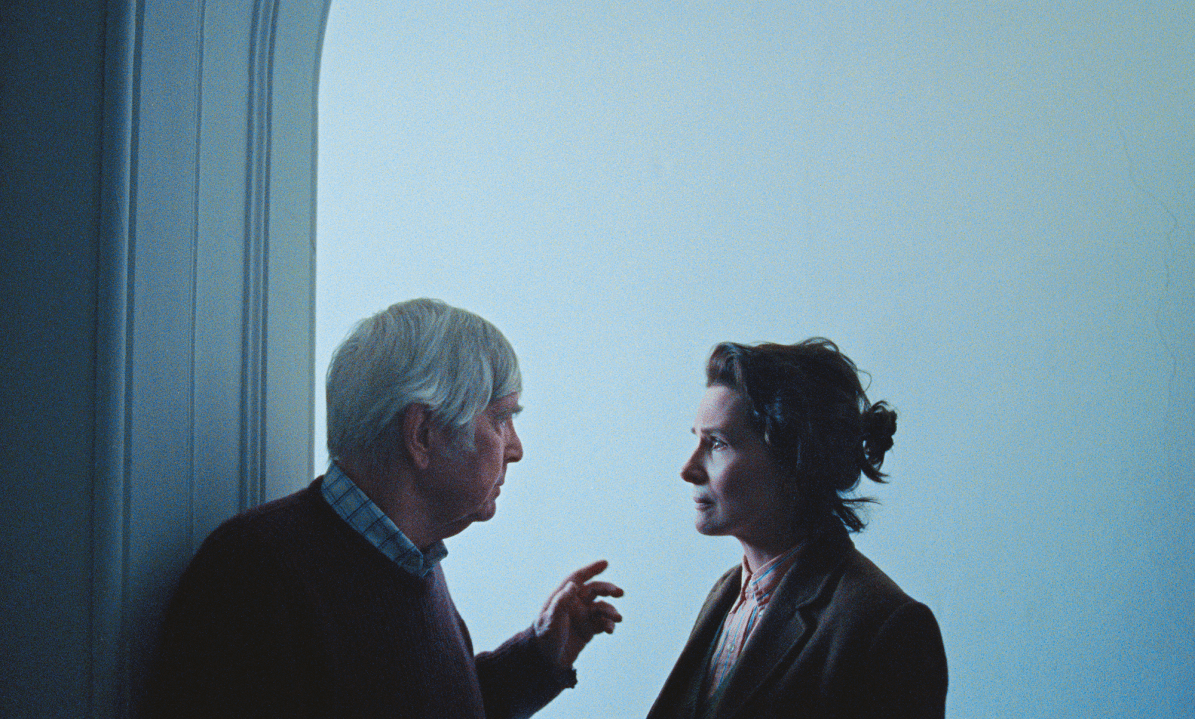

‘Old age’, Bette Davis once reportedly remarked, ‘ain’t no place for sissies’ and neither is Queen at Sea. It’s a film that unflinchingly explores dementia, intimacy, consent, which is basically everything your average sissy wants to run a mile from. (I’m your average sissy and wanted to run a mile from just the synopsis.) But while it’s a tough watch, and a shattering watch, it’s also tender and affecting and the cast – Tom Courtenay, Anna Calder-Marshall, Juliette Binoche – are outstanding. It’s one of those films to file under: ‘Glad I’ve seen – never again.’
It’s directed by Lance Hammer, whose Ballast (2008) was an indie phenomenon but who then stayed quiet for 16 years. (Hollywood, he said, tried to manoeuvre him towards ‘bankable’ scripts while he chose to wait for a meaningful project that wasn’t all about the box office.) Here, Courtenay and Calder-Marshall play Martin and Leslie who have shared a great love, have been married for 18 years, and live in a big north London house where he cares for her devotedly now she has advanced Alzheimer’s. Leslie’s daughter Amanda (Binoche) has taken a sabbatical from her job at Newcastle University to move to London for a year with her teenage daughter Sarah (Florence Hunt). She wanted to be nearer her mother. She visits one morning to discover her stepfather having sex with her. (Not for sissies, remember. Also, Amanda should learn to knock on bedroom doors.) She is distressed and furious. They have, it turns out, been here before and he has ignored her insistence to stop. Impulsively, she calls the police.

If this were a Ken Loach film the state would prove intrusive, insensitive, bullying and make a difficult situation worse. But it isn’t a Ken Loach film and while the rape examination has to be horrific, because rape examinations are always horrific, the police and social workers and nurses are generally kind and caring as they try to work out what’s best for Leslie. To be clear, there are no bad actors here. Amanda knows Martin to be an excellent husband but feels she must protect her mother. Martin insists Leslie is comforted by sex and even initiates it, which may be so, but what if that’s because her dementia has led to disinhibition? If that’s the case, can you say it’s what she wants? This is so emotionally and morally knotty even the knots have knots.
The cast strip themselves of anything showy or starry, delivering performances in which every glance conveys how deeply they care and how painful it all is. Calder-Marshall’s Leslie – an almost wordless performance – is somehow both there and not there. Martin is a stubborn man, angry at all the interference, but Courtenay imbues him with such a tenderness you will feel only compassion. You will also wonder: is Martin in denial about how much of Leslie has already been lost? Binoche, meanwhile, captures the back and forth of someone who never quite knows if they’ve done the right thing.
The one misstep is the subplot concerning Sarah and her first romance. While I get that it allows the narrative to mirror itself – sex at the beginning of life; sex at the end – it’s not youthful passion we’re here for, and I could not find it interesting.
The film is based on exhaustive research, and feels authentic. One of the carers is even played by the actual carer whom Hammer happened to meet. She’s lovely; I want to book her for when my time comes.
What we see, in sum, is a deeply committed love that is fighting a losing battle. A love that will not, cannot give up. Glad I’ve seen it – never again.






Comments