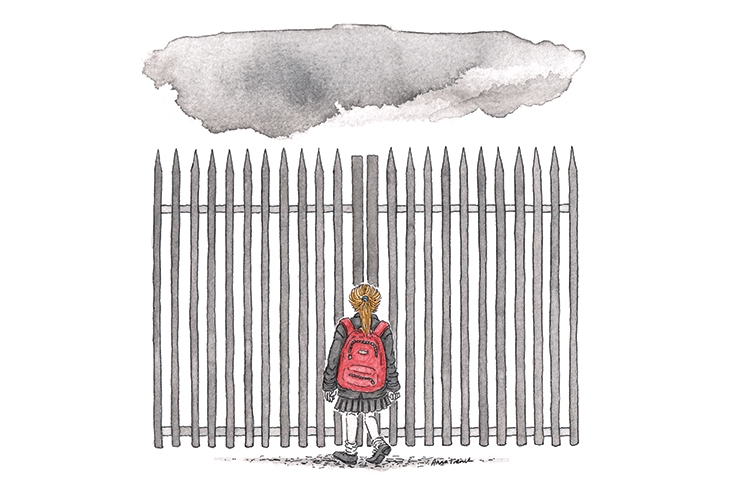
White British students have become a minority in England’s grammar schools. In 2026, white British children made up just 44 per cent of grammar-school pupils, compared to 66 per cent in 2016.
Some cultures appear to have a different attitude towards education than some white British families
This story, based on data from the DfE, has been reported on in various forms since June this year, but has now been picked up again by the press, and reposted by various people online, like Restore leader Rupert Lowe.
What though is going on? Why has the proportion of white British students dropped so much? Having experienced grammar-schools both as a pupil and as a teacher, I feel I am well positioned to talk about this subject.
My secondary education was at Lawrence Sheriff in Rugby, a free state grammar for boys. When I left in 2016, the school was 74 per cent white British, today that figure is around 34 per cent.
The same is true for Reading School, where I taught from 2020-23. Data on school applications show the proportion of white British children falling from 49 per cent to 7 per cent in 2024, before recovering slightly to 15 per cent this year.
The headmaster, Dr Chris Evans, described the demographic change as ‘spectacular’ in a Daily Mail article, and Reading School has been exploring ways to funnel a more diverse range of children towards applying to the school, particularly focusing on areas of socio-economic depravation. This, notably, has included workshops and outreach in primary schools so that children from all backgrounds see that they can apply to the academically rigorous school.
More significantly a new entrance exam, trailed during my time there, has yielded positive results in promoting a more diverse uptake.

When I sat the 11+ in year six, I had little ‘tutoring’ beyond some free sessions with a family friend and the 11+ preparation workbooks sold by WH Smiths. Once at grammar school, however, it quickly became apparent who had been heavily tutored and who had got there on natural ability. Reading School appears to have observed the same problem. Namely, the extent to which intensive preparation can influence performance in an entrance examination.
Many families are putting considerable time and money into tutoring their children. The pressure placed on some of these children is intense, and only continues through GCSEs, A-Levels, and university applications. And that is where I think the story becomes more interesting.
Grammar-school figures have largely been discussed through the language of immigration and replacement. But whilst population change will inevitably affect the ethnic makeup of schools, I do not think immigration is the primary explanation here.
I, and others working in the education sector, have sometimes acknowledged, quietly and cautiously, that some cultures appear to have a different attitude towards education than some white British families.
This is certainly not true of every non-British culture, nor are all white British families academically apathetic. But there was often a noticeable difference in the importance attached to academic success and the willingness to invest time, money, and effort into achieving it – something many notable Asian comedians, for example, have often themselves jokingly pointed out.
Sometimes that pressure goes too far – something I saw this first-hand at Sheriff in a constantly tired and stressed friend of Indian heritage – but it is often motivated by the understandable desire to give one’s child the best possible chance in life.
The irony is that this creates a rather strange situation for the grammar-school system. Grammar schools were, in large part, founded as a means of social mobility. A child of ability, regardless of their family’s wealth or social position, could pass an examination, receive an excellent education, go to university, and thereby change the course of their life.
My late grandfather was an example of precisely this. Born in 1930, he was the first in my family to go to university. He came from a poor Yorkshire mining town, and although his father had the slightly elevated position of being a pit foreman, he nevertheless did not come from an affluent or well-educated home.
His way up in the world was through his own hard work and the encouragement from his parents. He gained a scholarship to grammar school and then went on to the University of Manchester, where he obtained his degree and master’s. He eventually became a senior aeronautics engineer and manager at Rolls-Royce, retiring in a quite different position and lifestyle from the one into which he had been born.
His story is not unique. For generations, grammar schools helped working-class children enter universities and professions which otherwise would have been difficult to access.
The uncomfortable question then, is why white working-class families of today are increasingly less represented in that system?
Recent data shows that white children, particularly working-class boys, are performing at significantly lower rates than we might expect. Sir Hamed Patel, chair of the inquiry into these outcomes, was right to say that ‘we should be far more ambitious for these young people’, but at the moment, we’re not.
There are undoubtedly many reasons for this. Socioeconomic circumstances, family structure, geography, school quality, changes in the labour market, the decline of traditional industries, and attitudes towards academic education will all play some part. The steady decline of support for the grammar-school model as elitist, and the overt value placed on equality of opportunity also play a role.
But I wonder whether there is another less obvious factor: the welfare state. Could a substantial safety net affect how a society thinks about education?
My grandfather’s generation understood educational failure differently. For a boy from a poor mining family, education could mean the difference between remaining in the circumstances into which he was born, and escaping them.
The same may be true, in a different way, for families who have arrived from countries such as India and Pakistan. Where meaningful welfare states are less extensive, the consequences of educational failure are more severe.
The result may be a powerful cultural emphasis on education; the career prospects it offers, the security it provides, and the increased ability to invest in the next generation. Those parents will pay for tutoring and make sacrifices to do so, encourage application to selective schools, and push their children towards university and professional careers.
This is why the grammar-school statistics should concern us. Not because some children are succeeding, but because the success of one group may partly reveal the increasing academic apathy of the other.
My grandfather’s generation understood the value of education as one of the greatest ways for ordinary families to change its’ circumstances – in many respects, that is precisely why grammar-schools existed in the first place.
If more white British children, particularly those from working-class backgrounds, are to benefit from selective education, we need to reaffirm the ambition and confidence that once made grammar schools powerful engines of social mobility.
It would be a sad state of affairs if the children from backgrounds that grammar schools were intended to provide opportunities for became increasingly absent from them. Not primarily because of immigration as some have suggested, but because they had failed to embrace the opportunities that other families now recognise grammar schools provide.






Comments