Scottish politics has all the dynamism of day-old porridge. Nothing ever changes, except for the worse. The latest results from the Programme for International Student Assessment (PISA), covering educational performance among 15-year-olds across 91 developed countries and territories, place England in the top ten for maths, science and reading. Scotland is not in the top ten for any of the three.
In maths, the nation of John Napier lags England by 25 points. In science, the country that gave the world James Clerk Maxwell trails England, again, by 25 points. Reading is the runaway success story, where Walter Scott’s homeland is a mere nine points behind its southern brethren.
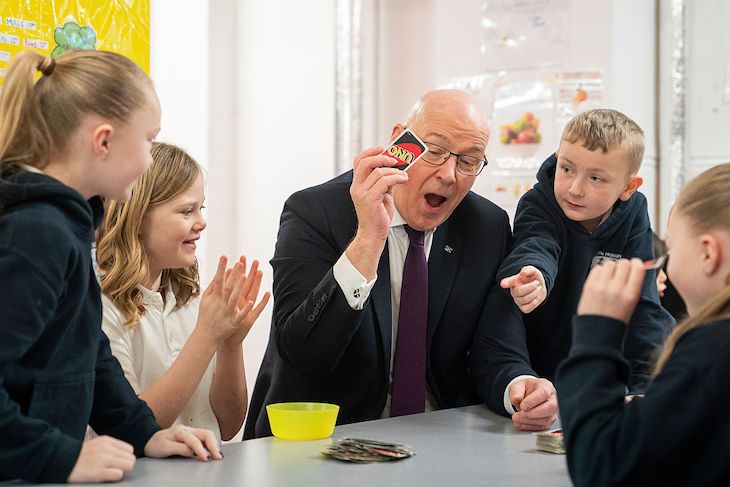
The SNP has been in control of the devolved Scottish Government in Edinburgh and, therefore all aspects of education expenditure and policy, since 2007. How has it responded to the PISA findings? Party leader and first minister John Swinney told the Scottish Parliament on Tuesday:
‘The results that PISA has announced this morning indicate essentially a stable position in relation to Scotland’s performance, but the government is determined to focus on improvement.’
It’s true. Scotland’s ratings haven’t changed all that much since the last report, in 2022; but, then, the 2022 report was just as grim, which is why we have to look at the long-term trend. The long-term trend makes ‘grim’ sound almost Pollyannish.
When Scotland’s maths performance first began being assessed in 2003, its average score was 524 points. This fell to 499 in 2009, 491 in 2015, and 471 in 2022. The latest score, 467, is the lowest ever.
Ratings for science began in 2006, when Scotland was accorded 515 points, which remained steady at 513 in 2012, but dipped to 490 in 2018. The latest score, 491, is actually an improvement on the 483 points awarded in 2022, but still ties with the 2018 score for second-worst performance on record.
Meanwhile, reading scores stood at 526 points in 2000, were down to 499 by 2006, up to 506 in 2012, and down slightly to 504 by 2018. The latest score, 488, is the lowest ever.
It’s a wonder the SNP has continued to participate in PISA assessments. Two previous educational rating systems, Trends in International Mathematics and Science and Progress in International Reading Literacy studies, were ditched in 2010 on cost grounds, the SNP being famed for its exacting fiscal prudence.
For more than a decade, the SNP government cited education as its top priority and its chief indicator of progress was its ‘commitment to substantially eliminate the poverty-related attainment gap by 2026’. This differential between the education performance of children from the most- and least-deprived families was the totemic issue of Scottish politics from the mid-2010s through the mid-2020s. So determined was the Scottish Government to be rid of this gap that it bankrolled the Attainment Scotland Fund to the tune of £1.75 billion.
The SNP has been in control of the devolved Scottish Government in Edinburgh and, therefore all aspects of education expenditure and policy, since 2007
Its champion, media darling and occasional first minister Nicola Sturgeon, even staked her reputation on it, saying: ‘Let me be clear: I want to be judged on this. If you are not, as First Minister, prepared to put your neck on the line on the education of our young people then what are you prepared to.’ It’s a wonder she can put her neck on anything given it’s made of solid brass.
We’ve reached the target date of 2026. Has the attainment gap between the richest and poorest children been ‘substantially eliminated’? The gap among third-year high school pupils achieving level three or above – the Scottish Government’s preferred metric – has gone from 13.6 to 10.8 in literacy and from 14.9 to 11.6 in numeracy. After ten years and the best part of £2 billion in public expenditure, the gap has been closed by just one-fifth. Not eliminated. Not even halved. Eighty per cent of it remains.
Ah, but Covid! Indeed, but tell that to Sturgeon, who was still repeating the ten-year timescale in March 2023, three years after Covid hit. Well, you can hardly blame this other chap – ‘Swinney’, you say? – for a predecessor’s failings. Unfortunately for him, though more so for deprived children in Scotland, Swinney has been at the very top of the Scottish Government for 18 of the past 19 years, as finance secretary (2007-2016), deputy first minister (2014-2023), education secretary (2016-2021), and first minister (2024-present).
I say ‘unfortunately’ but what misfortune has Swinney suffered? He is one of the guilty men who degraded a Scottish education, a thing once spoken of in hallowed terms for its rigour, excellence, and egalitarian spirit. For generations uncounted, at the centre of Scottish schooling stood the lad o’ pairts, the boy born into abject poverty who, provided he was a bright and diligent scholar, could rise to the pinnacle of law, finance, government, religion, or industry thanks to the exacting instruction of Scotland’s class-blind classrooms.
Yet, just four months ago, Swinney led his party to its fifth electoral victory in a row, and it wasn’t even close. The anti-independence parties are as implacably divided at Holyrood as the Conservatives, Reform and Restore are at Westminster. The SNP will remain in power until the 2031 election, which it will win, followed by another five years, and most likely another election victory. Reward failure if you have a taste for it. Scotland’s appetite seems insatiable.
Some observers point to PISA improvements in England and credit them to a former education secretary who has since gone into the magazine trade. That’s a non-starter. The SNP will not copy English education policies, especially not those devised by a Tory. If it seems petty and spiteful to preside over the decline of Scottish education rather than admit England got something right, this is in part a reflection of the nationalist mindset but also a function of devolution. After a quarter century of political and monetary investment in the Scottish Parliament experiment, you can’t very well come out and say, ‘Actually, we’ll just do what England’s doing.’
Things will not get better because Holyrood is not a making-things-better parliament
This is why you should take with a pinch of salt all the mewling and handwringing from the SNP’s critics. They are every bit the constitutional ideologues the separatists are. If returning education powers to Westminster could eliminate the attainment gap tomorrow, they would refuse even to consider it. Devolution is their national vanity project and they would sooner see every Scottish pupil leave school functionally illiterate than reflect on the plain failure of Donald Dewar’s folly.
Things will not get better because Holyrood is not a making-things-better parliament. It is, and was intended to be, an insurance policy parliament. If English politics lurched too far right again, as Holyrood’s architects believed it did in the 1980s, a devolved legislature with sweeping and comprehensive powers could insulate Scotland from the worst effects. For all devolution was meant to close a supposed ‘democratic deficit’, so that policy for Scotland was decided democratically in Scotland, what it has done is create a political culture in which to be truly Scottish any given policy must be meaningfully different from the equivalent down south. Not because it needs to be but because the primary objective in devolved policymaking is not effectiveness but distinctiveness. Devolution is Scottish exceptionalism given institutional form.
Scotland is stuck and will remain so until it is prepared to confront the debilitating flaws of devolution, flaws that regrettably double as the load-bearing pillars of the entire enterprise. So make your peace with PISA and acclimatise yourself to the attainment gap. You’re still going to be talking about them another decade from now. Ministers will continue to be mediocre, you’ll go on getting NPCs (non-playable characters) for MSPs, inputs will remain more important than outcomes, and what works for Holyrood will forever take precedence over what works for Scotland. But at least you’ll have your Scottish Parliament, your wee insurance policy, keeping your children safe from better education outcomes.


Comments