Does Britain understand where Javier Milei’s move on the Falklands is heading? It is becoming clearer that, behind the nationalist bluster, he sees a real energy opportunity, and, from Argentina’s point of view, a threat. Milei argues that if drilling proceeded, as the Falklanders want, Britain would be able to seize offshore Argentine oil resources. This allows him to present the issue as one of national security on which his country needs to act. The British government line is low-key: the matter ‘is decided by the Falkland Islands people’ and the government ‘is absolutely supportive of the decision’. But is it aware of the degree of its responsibility? It is true that the islanders are entitled to decide whether they want to license exploration and production, but the ultimate decision is not theirs. The process is set out in the Offshore Minerals Ordinance 1994. This states that the Governor of the Falklands may grant an offshore licence only ‘with the consent of the Secretary of State’. The relevant secretary is, explicitly, the Foreign Secretary. All variations of the licence must also be made only with the same consent. Our Foreign Secretary is now Ed Miliband. So the time is fast approaching when the man who, as energy secretary, stoutly resisted new oil and gas production in the North Sea, and planned to ban it through the forthcoming Energy Independence Bill, will be asked to say ‘Drill, baby, drill’ in completely new fields in the South Atlantic. If he refuses, he will deprive the Falklands Islands (and, by loose extension, Britain) of great future prosperity and will have given in to a right-wing Argentine bully. If he consents, he will be defending the principle of new, large-scale fossil fuel extraction and confronting not only Argentina but also US strategic and energy interests as loudly articulated by Donald Trump. The potential for both comedy and tragedy here is large.
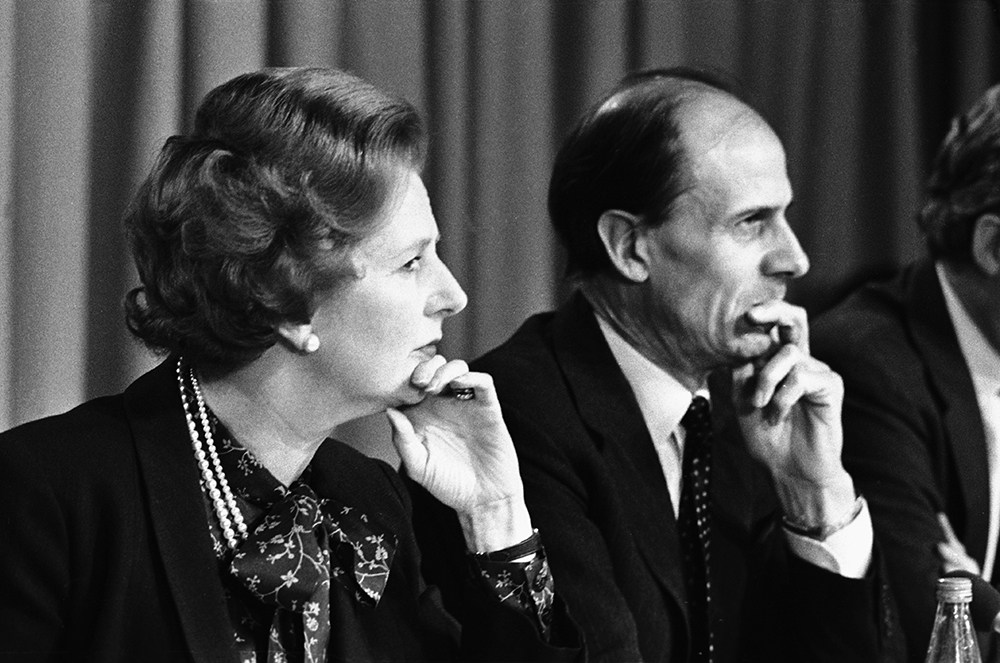
The Bayeux Tapestry is making me think again about what the British have made of the conquest in our heads. My paternal great-grandfather, who was born in England (of Irish blood) in 1847, was christened Norman. I think he was part of the first identifiable generation of Normans. The normalisation of Norman spread further in the generations below him, including the United States (where there was a famous advertising executive called Norman B. Norman) and the Old Commonwealth, and ran strong until roughly the second world war. Indeed, the name became satirically unglamorous, as in ‘Norm’. Every other man in Mrs Thatcher’s cabinets seemed to be called Norman. According to Wikipedia, however, fewer than ten newborn British boys were named Norman in 2025, though I suspect this will change as people rediscover ‘vintage’ names, such as Lettice. Did the rising use of the name in the 19th century indicate an acceptance that being Norman was part of our heritage, rather than an alien invasion? Not many people were called Saxon – I can think of only one, the minor Bloomsbury figure Saxon Sydney-Turner. Nevertheless, I think Norman’s Victorian revival was driven by the same sort of romanticism which brought back Saxon names like Egbert, Hereward and Alfred. My other great-grandfather on my father’s side was called Winfrid, which is Saxon. The two felt no nominal antagonism, unlike Willy vs Pat in Ulster. Indeed, their names were peacefully united in their first shared grandson, christened Norman Winfrid. In St Leonards, six miles from the site of the Battle of Hastings, Norman Road and Saxon Street stand within yards of one another.
Uncritically, the media reproduced this week the National Trust’s press release that its 18- to 25-year olds’ member numbers have grown by 26 per cent over the previous year. This is good news, but not surprising when you consider the amount of promotion the NT devotes to rustling up the young, and above all when you compare prices. In 2022, a family NT membership cost £126. Today it costs £176.40. No wonder such membership is now declining. Also in 2022, ordinary adult individual membership cost £76.80. Today, it costs £100.80. For the young, the 2022 comparison looks very different. In 2022, it cost £48; today, £50.40, a real-terms price drop. This is not genuine long-term growth. The media did not cover a significant change in NT self-reporting. Until now, it has always led with the total of members, which fell just short, at the peak (2019-20), of six million. This year, unexplained, the annual report leads with the figure of ‘memberships’, rather than members, a much lower number because family and couples’ memberships contain more than one person. So suddenly the figure is 2.62 million. Why the change of usage? Perhaps because, with the earlier headline measurement, people could see at a glance that member numbers have continuously fallen from the 5.95 million in 2020 to the current figure of 5.29 million, a drop of more than 11 per cent.
As successive chancellors orate endlessly about how to bring back economic growth, I offer this quotation from The Wealth of Nations: ‘The only encouragement which it [industry] requires, [is] some tolerable security that it shall enjoy the fruits of its own labour.’ Adam Smith had about 99 per cent of the right answer in that one sentence.
Despite publicly exposing scam invitations to speak to book clubs and then pay for the pleasure (see Notes, 22 August), I have just received an email from Karin D of the Wellington City Book Club, presumably in New Zealand, but probably nowhere at all: ‘We aim to give readers a chance to discover the work, engage with its ideas, and learn more about the author behind it.’
Another online wizard has written, offering me his services to obtain ‘new audience eyeballs’. I suppose it’s no worse than ‘Lend me your ears’, but I don’t like the thought of it.




Comments