For much of its history, Albania remained as shadowy and remote as the fictional Syldavia of the Tintin comics. Letters to Albania were sometimes returned from Albany, New York, with the postal direction “Try Europe.”
The country came into existence only after 1912, with the collapse of the Ottoman Empire. Its first ruler, King Zog, was hounded out by Mussolini when he invaded in 1939. Five years later, the Italians and their Nazi German allies were expelled in turn by the Albanian nationalist leader Enver Hoxha. A Muslim-born communist, Hoxha turned his Balkan fiefdom into a self-immolated model of Stalinist planning, where party purges, summary arrests and show trials were routine.
In the early 1990s, Albania hurtled toward capitalism. The bronze statue of Hoxha in Tirana, Albania’s capital, was toppled. In the countryside, village elders overruled parliament in order to redistribute properties according to Albania’s ancient tribal constitution known as the Kanun, which regulates land boundaries – as well as Ottoman-era blood revenge killings. Hoxha had tried to outlaw the Kanun but it never went away, and the tribal code still plays its part in disputes.
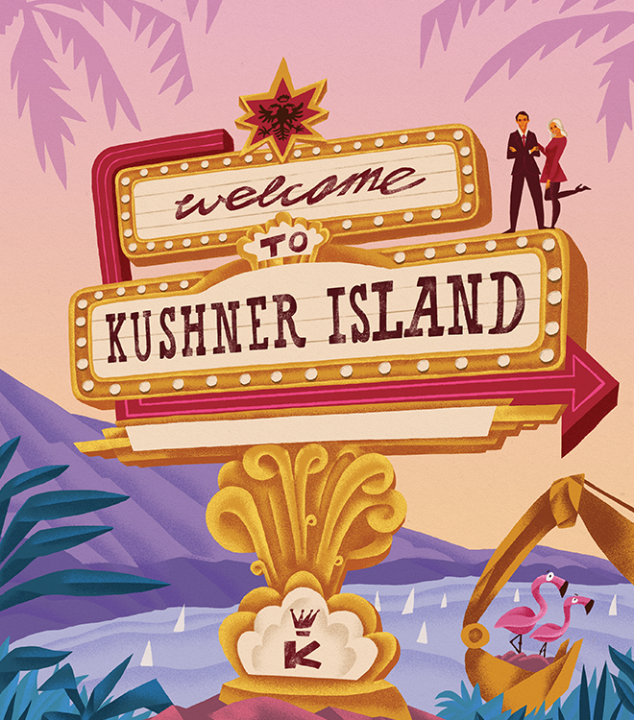
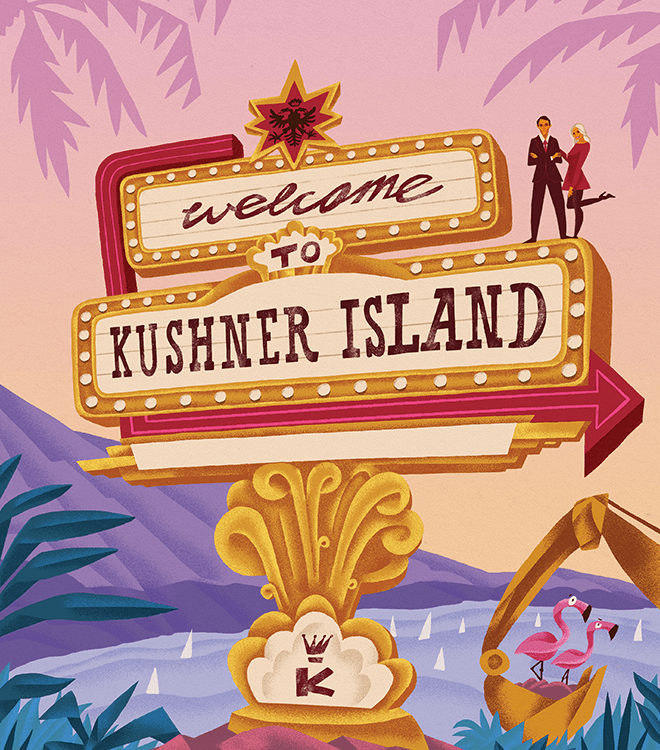
Albania is today the fastest-growing tourist destination in Europe. Serious money is to be made out of real estate, so no issue is more contentious than land ownership. And Albanians are furious that Donald Trump’s son-in-law Jared Kushner is developing vast luxury hotel complexes on protected land along Albania’s unspoilt southern coast.
Not since communism was dissolved has Albania been shaken by such collective outrage
Kushner bought the land for $120 million from a suspected Albanian drug trafficker, Artur Shehu, who fled to Miami after a gunfight in his uncle’s bar. It is alleged that Shehu used fraudulent Ottoman-era land records to claim great swaths of coastal property for himself, though Shehu’s lawyer has insisted that he is neither a drug dealer nor a land thief.
The land is a narrow peninsula between the sea and a lagoon where nesting sea turtles, monk seals and flamingos proliferate. Kushner wants to build a second super-resort on the island of Sazan that faces the peninsula, which tour operators are already calling “Kushner’s island.”
In what has become known as the Flamingo Revolution, thousands of Albanians took to the streets in Tirana earlier this year to condemn Kushner’s property ambitions and the Albanian politicians who stand to gain from them. The protests are expected to gather momentum this fall as Albanians renew calls for their Socialist party Prime Minister Edi Rama to resign. Not since communism was dissolved has Albania been shaken by such collective outrage. The Flamingo Revolution is now in its 15th week.
In my guesthouse in Nartë, on the edge of the disputed peninsula, I was served milk curds and maize bread for breakfast. An abandoned indoor market and Hoxha-era cinema added to the town’s air of dereliction. The inhabitants are mostly ethnic Greek Albanian. They are not against tourism but object to the secrecy and disinformation that surrounds the Kushner development. “VIP tourism of Kushner’s sort will only destroy our way of life,” said Esmeralda Berberi, who runs a corner store. “The Americans are not welcome.” At night in the guesthouse I was awoken by the howling of jackals.
“The jackals are a nuisance – they scavenge for the flamingos’ fresh-laid eggs,” said Joni Vorpsi, an ornithologist attached to Albania’s chief conservation group, Protection and Preservation of the Natural Environment. PPNEA has energized the Flamingo Revolution, which has spread from Tirana into the Albanian diaspora in 80 cities around the world, including Philadelphia.
For the moment, construction of the resort at Zvërnec has stalled but Rama has vowed to see it to completion. Vorpsi shows me how the coastline had been disfigured by concrete, iron stanchions and bits of machinery. A barbed wire fence has been erected around the beach to keep out the locals.
Last May, one protester was dragged away by private security contractors, a gun held to his head, while the Albanian police stood by and watched. “It was a clear sign that the Albanian state was unable to protect its own citizens,” said Vorpsi.
Kushner intends to build a new city here, with as many as 10,000 hotel rooms and villas. The resort is backed by Affinity Partners, Kushner’s private equity firm, as well as by Qatari investors.
Zvërnec is seen by many Albanians as a land grab. “What made us Albanians so angry was the sneaky way land was sold off to the ultra-rich with scant regard for Albania’s sovereignty, let alone environment,” said Marjana Koçeku, who resigned as a Socialist MP over the Kushner scandal.
In 2024, the Rama government amended the law on protected areas to fast-track “high-end” developments. Kushner made his plans for Zvërnec public shortly afterwards. “Obviously that was not a coincidence,” said PPNEA’s executive director Aleksander Trajce. “Zvërnec is a clientelist business deal that favors opaque, oligarchic interests.”
Through Vorpsi’s field glasses, I picked out a flock of water rails pecking for worms in a reedbed. The slate-gray apparitions stalked over the mud. We spotted shrikes, egrets, herons, and hoopoes – but no flamingos. The flamingos have been scared away by the drones that tourists send up to track their flight. They may not come back.
Bledi Mertiri has fished in the Nartë lagoon for 30 years. He lives by the water’s edge in a converted railway carriage with a twisted TV aerial on the roof. He poured me a glass of raki brandy and explained why he supports the Flamingo Revolution.
Kushner plans to build an archipelago of artificial islands in the lagoon as part of his resort. The fishermen would be an embarrassment to the project. Therefore, the Albanian government has refused to renew their permits. “Men from the Fisheries Inspectorate come each week… They fine you up to 10,000 euros if you’re caught fishing.”
The Flamingo Revolution, which was initially led by middle-class Gen Z and millennials, now involves Albanians like Mertiri, who have been left on the verge of indigence. “If there’s no fishing, we don’t exist,” he told me.
Kushner plans to build an archipelago of artificial islands in the lagoon as part of his resort
In the middle of the lagoon and reached across a wooden walkway is a 13th-century Byzantine monastery and church. The English illustrator and author Edward Lear visited in 1848, sketching the pelicans that breed in the rocky inlets of the lagoon.
Father Jani Tereziu, the Eastern Orthodox priest who oversees the monastery, has described the pelicans as a “miracle” but is concerned by what Affinity Partners might have in store. The church would have to intervene publicly if the Disney-like islands, docks, yacht traffic and resort hotel seepage become a reality. “Who on earth would benefit from it?” he asked.
Next day I drove across salt flats toward the half-constructed Vlorë International Airport. Silhouetted against the salt-whiteness, incongruously, were a sheepherder and a couple of errant mules. The sky was a bright magnesium blue. The airport, financed by a Swiss-based consortium, encroaches on the lagoon’s protected wetland and is intended to serve Kushner’s resort plans. Work began in 2021 with no valid construction permits. The security cars on site had blacked-out windows and the trucks had no number plates. Construction was halted last February owing to shareholder conflicts. Rama, a leading supporter of the Vlorë project, has spoken of an eco-friendly “green airport” that will bring untold wealth to the locals. The airport languishes behind razor-wire perimeter fencing.
Negotiations with Affinity Partners over the $1.4 billion sale of the island Sazan were kept a secret from the Albanian people until March 2024, when Kushner shared architectural renderings via social media. Each day, as many as 2,000 tourists visit the island. It is a densely forested, waterless two square miles of limestone rock which Hoxha liberated from German occupation in 1944. Under communism the island was transformed into a military outpost fortified by 3,600 concrete bunkers and pillboxes and ten miles of underground tunnels.
Kushner visited Sazan with his wife, Ivanka Trump, in the summer of 2021 while on a yacht trip with their financier friend Nat Rothschild. “We swam to the island. We went on a hike,” Ivanka enthused on a podcast last May. “We were just captivated.” The US President’s elder daughter spoke of Sazan as a place where civilization had yet to arrive. She claimed to have hiked “barefoot” to the top.
Artur Meçollari, a retired Albanian navy captain who was based on Sazan in the 1960s and 1970s, wonders if she got the right island. “Sazan is full of poisonous snakes and unexploded ordnance,” he told me from his home in Tirana.
Rama was a guest of Ivanka and her husband on the yacht. The Prime Minister told me that Albania cannot hope to finance its economic “transformation through domestic capital alone,” and said elsewhere that Albania would be ill-advised “not to exploit a gift like Sazan.” Albanians are less sure. A restaurant in Zvërnec that opportunistically renamed itself Ivanka Seafood went out of business.
I went to Sazan with Kostandin Xhaho, a medical doctor and PPNEA environmentalist based in Vlorë. We set off early on Xhaho’s motorbike and sped along a pot-holed road to the police station on the edge of Zvërnec village.
Today, almost all revenge killings in Albania are connected to property conflict
Because Sazan remains a high-security Albanian military zone, individual visits have to be monitored. A policeman rubber-stamped our papers and we located our motorboat in the harbor’s oily waters.
Half an hour later, Xhaho cut the engine and eased us into Sazan’s small dock. Before us rose a steep rocky prominence with low brush and three-story concrete buildings that once served as army officer quarters. More than 6,000 troops were stationed on the island under Hoxha. Sazan became symbolic of one of the most bleakly isolationist regimes in human history. Up we climbed through a Jurassic landscape of giant lavender, plumbago and broom. There was a pungent smell of figs.
Since Albania joined NATO in 2009, the alliance has conducted a number of exercises on the island with Italian and British troops. The walls of the abandoned communist schoolroom and hospital have cracked under the impact of rocket-propelled grenades.
Kushner plans to blow up the army buildings to make way for his hotels, but most Albanians want to preserve Sazan as a monument to the country’s 46 years of Marxist-Leninist hibernation. “It’s a unique Cold War time capsule,” said Xhaho.
Meçollari, the former navy captain, told me that Sazan is surrounded by about 120 tons of ammunition, dumped underwater at depths from zero to ten meters. “It doesn’t represent much of a threat today, but for Kushner’s five-star tourism it would be a different matter entirely. No one could guarantee that the innocent scuba-diving tourist would not be at risk from explosions.”
Meanwhile the first of the morning tourists had arrived, shining with sun oil. An Italian woman in a bikini approached us: “Please, where is the toilet?” She would have to wait for Kushner for that.
Today, almost all gjakmarrje – revenge killings – in Albania are connected to property conflict. On my last day in Zvërnec, I met a restaurant owner who had been locked in two decades of court disputes with Shehu, the man who sold the land to Kushner. The restaurateur said he was bound by the Kanun to exact retribution if need be: “Shehu will have to go over my dead body before he gets what’s lawfully mine.”
The great engine of vengeance – the old idea of purification by blood – has already lumbered into motion. The Trump-Kushner family has got into deep water through its association with Mr. Shehu. Blood is quick on the knife in Albania. It always has been.



Comments