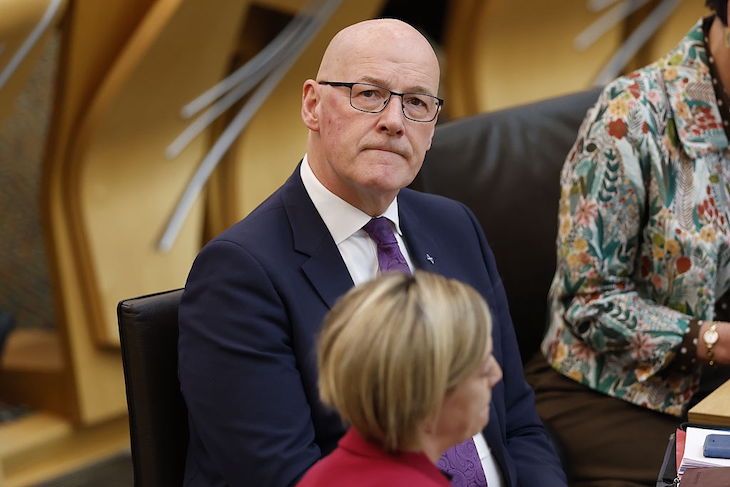
The Programme for Government – picture a dour, cheapo version of the King’s Speech – is an annual statement by the Scottish First Minister outlining his legislative plans for the coming year. SNP leader John Swinney delivered his latest PfG (even the acronym is soulless) on Tuesday and the word of the day was ‘reform’. Swinney proposed to scrap 12 health boards, redraw local council boundaries, reduce the number of public bodies, and generally make government more streamlined and responsive to the needs of service users.
There is no force on this Earth as conservative as the Scottish public sector
There are some decent ideas in there, but none likely to survive contact with the public sector unions whose members form a large segment of the Nationalists’ electoral coalition. Swinney vowed to ‘rewire the Scottish state to ensure services fit around people, rather than expecting them to fit around a static system’, which might sound appealing to you or me but is positive heresy to the lanyard mafia. There is no force on this Earth as conservative as the Scottish public sector.
This is one area where the unions might do us all a favour, for the SNP’s track record on reform is not exactly shining. There was the scrapping of Scotland’s historical constabularies and their replacement by Police Scotland, a source of near-constant controversy more than a decade on. There was the creation of the Education Scotland quango and the Curriculum for Excellence policy that tried to rewrite the fundamentals of teaching, both of which are being overhauled after failing to command the confidence of teachers or parents. There was the attempt to reorganise community and residential provision into a National Care Service, to standardise recycling practices into a national scheme, to give ministers the power to make appointments to university governing bodies. All dropped and never mentioned again.
Elsewhere, the PfG consisted of reannouncing unfulfilled past pledges. A misogyny bill (first promised by Nicola Sturgeon). A new drive to close the attainment gap in education (ditto). A replacement for University Hospital Monklands, which the SNP campaigned on in May’s devolved elections, then cancelled once their Monklands MSPs had been re-elected, but which Swinney assured Holyrood was back on the cards. Pinky promise. Such is the paucity of ambition that the PfG’s set-piece NHS target (no patients waiting longer than 26 weeks to begin treatment) is a downgrade of an existing target (90 per cent to begin treatment within 18 weeks).
In nine months’ time, the SNP will mark 20 years in power at Holyrood. Year after year, grand promises have been followed by meagre outcomes, with the Nationalists banking the credit for policy announcements then claiming they lack the necessary powers when challenged on delivery. The response to Swinney’s PfG speech summarised the problem well. Reform’s Scottish leader Malcolm Offord, a well-meaning businessman who struggles to impersonate a politician, pressed the importance of job creation in the private sector, an alien concept in the Scottish Parliament.
Labour was represented by its deputy leader, Jackie Baillie, since its leader, Anas Sarwar, who just took the party to its worst Holyrood election result, recently jumped ship to Westminster where his scheming against Keir Starmer has been rewarded with a peerage and a ministerial job. The Greens, who were previously in coalition with the SNP, attacked the speech for failing to pledge legislation on transgender conversion and a boycott of Israel. The Tories, God love them, tried to make the case for sound public finances and economic growth, but they’re such a fringe outfit these days, reduced from main opposition party to fifth place, behind the Greens, that no one is listening to them. Then there’s the Lib Dems. We can only hope no one is listening to them.
The SNP is technically a minority government but the opposition is so fractured, and tired, and directionless that Swinney’s lack of an overall majority barely matters. None of the opposition parties poses a genuine threat to the SNP and, although there isn’t another Holyrood election for five years, none of them will be in a position to oust the Nationalists even by 2031.
Devolution, Donald Dewar’s constitutional experiment, has created an executive so powerful that the absence of a parliamentary majority scarcely troubles ministers. The real parliament is the network of third-sector bodies directly funded by the Scottish Government to help shape and then cheerlead for ministers’ policy agendas. Transparency is disdained, accountability unheard of, and scrutiny downright pitiful.
The devocrats, those politicians, bureaucrats, journalists and professional activists whose salaries depend upon the existence of a devolved government, will sometimes concede flaws in the system, but their only answer is more system. More powers devolved. More MSPs. A second chamber. True devolution has never been tried. After almost 30 years of Dewar’s folly, and with only a few exceptions, devolution has not made Scotland a measurably better place to live, work, and do business, and has arguably made it worse in a number of regards.
Devolution has failed. The system itself supplies plentiful evidence of its inadequacy, even as the devocrats and those unwilling to blaspheme against the religion of Scottish exceptionalism avert their eyes and shield their ears. Denial is a refuge from reality, not a triumph over it. The devolution industry will trundle on through this PfG and the next and the next, straining to convince themselves that things are getting better, or will, eventually, one day. Things are not better and they are never going to get better.
Devolution is many things. A job creation scheme for the political and lobbying classes. A constitutional Trojan horse operated by Britain’s enemies. The Frankenstein’s monster of a political science experiment gone very wrong. What it is not is a credible system of government, or at least not one that serves Scotland any better than she was served by Parliament, back when Scotland was an integral part of the UK and not a devolved afterthought. On not one single day of its existence has devolution been preferable to the status quo ante 1999, when Scotland’s interests and services were legislated by Westminster rather than Westminster’s chippy, resentful little brother.
Nothing is going to improve in Scotland until there is an admission that devolution was a grave mistake and action taken to correct course. That will be an agonising admission, one many will never bring themselves to, but without it Scotland will remain stuck in political dysfunction and policy inertia. Most would prefer to stay there, and that is a perfectly respectable point of view, but plentifully populated though that mire will be, some of us want nothing to do with it. If that puts us outside the mainstream, if it incurs for us the eye rolls and sneers and contempt of the devocrats, so be it. There has to be more to Scotland’s future than this, more than a phoney constitutional debate between advocates of 100 per cent independence and those who want only 90 per cent.
The Programme for Government is emblematic of the failed and politically bankrupt system of devolution. It should go and devolution should go with it.


Comments