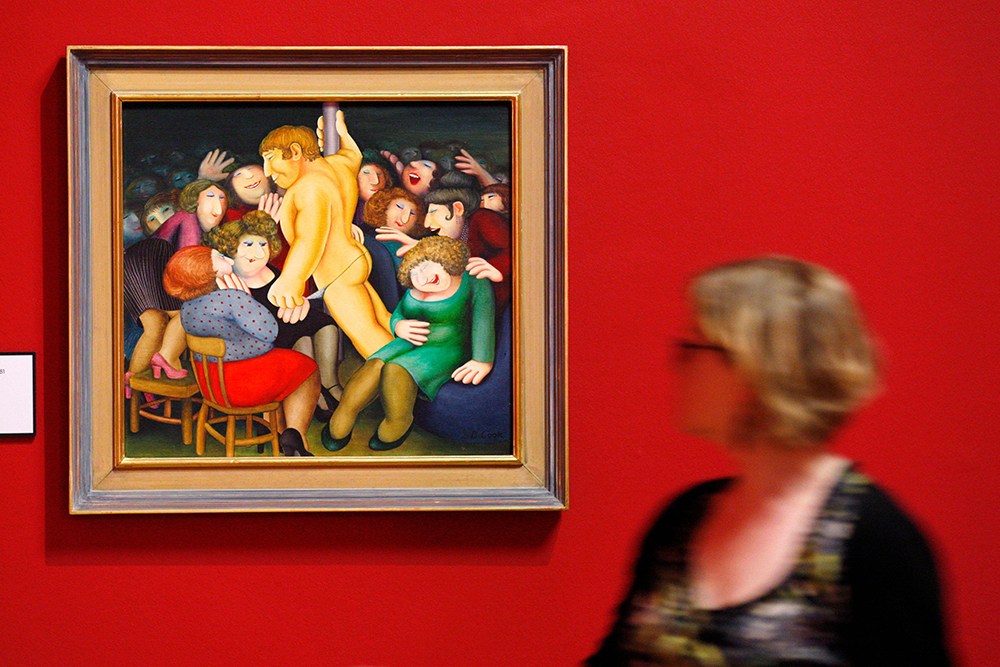
The late Victoria Wood described Beryl Cook as ‘Rubens with jokes’. This was flattering for an artist whose fat, eye-shadowed ladies were more at home in the bingo hall than the boudoir. Fleshy, but utterly unsexy, Cook’s buxom babes have long been objects of veneration as well as ridicule. The question being posed in this, the centenary year of her birth, is whether they ought to be taken more seriously.

Listening to the documentary on Radio 4 this week, I was inclined to think this a fatuous question, over which Cook, had she still been alive, would have rasped. An untrained painter, who worked out of the ironing room of the B&B that she ran in Plymouth, she seems to have set out simply to please – herself as much as others. A nice piece of archive footage captured her recalling some graffiti that inspired her. ‘I am ten inches, would you like me?’ read the first bit, ‘Yes, but what size is your prick?’, ran the response. Cue one of the filthiest laughs you’ve ever heard.
Art historian Louisa Buck, who speaks in not dissimilarly gravelly tones, travelled to Plymouth to meet Cook’s son and daughter-in-law and observe the mounting of a retrospective. The most talked-about painting, the exhibition curator told her in the programme, was Cook’s ‘Ladies Night (Ivor Dickie)’ (1981). If you haven’t seen it, I recommend googling to find a chunky Adonis wrapped around a pole while middle–aged ladies peer beneath his G-string. You can gladly imagine Beryl Cook hiding in the shadows of that crowd. A shy observer, too inhibited ever to attend her own private views, she painted the life she wanted to lead.
One of the most interesting things to come out of the documentary was that her predilection for big women was practical. Making her figures so large, she said, got her out of painting backgrounds, which didn’t interest her in the slightest. This, if nothing else, surely makes comparisons between her work and that of Rubens, Brueghel, Stanley Spencer and the rest quite redundant.
It was an enjoyable and uplifting documentary, even if some of the explanations used to upend the artistic snobbery towards Cook were less compelling. I’m not sure the art world’s failure to take her seriously has much to do with the fact that her subjects are working class, or exist in spaces ‘inhabited by the queer community’, but their humour (and illustrative quality) probably have been a contributing factor. Still, the documentary’s revelation that the Tate is in the process of acquiring one of her paintings for its permanent collection – something Nicholas Serota reportedly swore would never happen – grants Cook, in death, the last (filthy) laugh.
Humour is a problem in literature as well as art. It is such a problem that comedian Helen Lederer and comic novelist Chrissie Manby have launched a podcast called Writing Funny. It’s meant to address the fact that readers have become too ‘angsty’ over what writers can and cannot make funny – a consequence, suggests Lederer, of a failure to accept our lack of control over major world problems. But it does so with a pretension to seriousness that is – almost inadvertently – punctured by its presenters’ inability to refrain from humour. This is to the podcast’s credit.
A shy observer too inhibited to attend her own private views, Beryl Cook painted the life she wanted to lead
What begins as a discussion co-presented by Lederer and Manby quickly turns into Lederer interviewing Manby and commentating (airily but not always favourably) on what their various guests have to say. Manby’s revelation that she amused her schoolfriends by writing short stories for Just Seventeen magazine intrigues Lederer. ‘Were they sexual?’ Lederer asks, before revealing that she once ‘got quite turned on’ writing about a Pullman carriage. ‘I was the class clown in situ,’ Lederer reflects. ‘But you went to the trouble of putting pen to paper and posting it to an editor.’
The podcast is good on the craft of comedy writing, particularly in times of darkness, and on the mysteries of the publishing process. If it risks making the literary world seem rosily, unfalteringly friendly and tight-knit, it is because the comedy world Lederer evokes sounds like such a hotbed of rivalry. It’s bold and fun and slightly brassy: one for listeners of a Cookish disposition.






Comments