The opening of the British Museum’s The Bayeux Tapestry exhibition is not far off now. In early July, a bright yellow truck transported the tapestry from France via Eurostar, arriving in London under cover of darkness. With George Osborne, chair of the museum, posing as the symbol of a new entente cordiale, the display is being hailed both as a diplomatic triumph and as the blockbuster exhibition of a lifetime. Soon many thousands will have the opportunity to experience what Max Adams in his new book describes as this ‘dazzling, cinematic, embroidered strip cartoon’.
Speculation that the tapestry (actually an embroidery on linen) is missing a final scene is probably correct. Originally the last panel may have shown William the Conqueror’s coronation at Westminster Abbey on Christmas Day 1066. This was a crucial event. The crowning of the Norman invader using English rites emphasised William’s belief that he was Edward the Confessor’s legitimate heir.
Twenty years later, at the close of William’s reign, the issue of legitimacy lay at the heart of one of the most ambitious feats of government ever undertaken. Hundreds of royal agents were sent round the country to compile a survey, known in its completed form as ‘the king’s book’. Over a century later the subjugated English were referring to it by a name loaded with the unpopularity and terror the survey had triggered: Domesday, that is, the Day of Judgment.
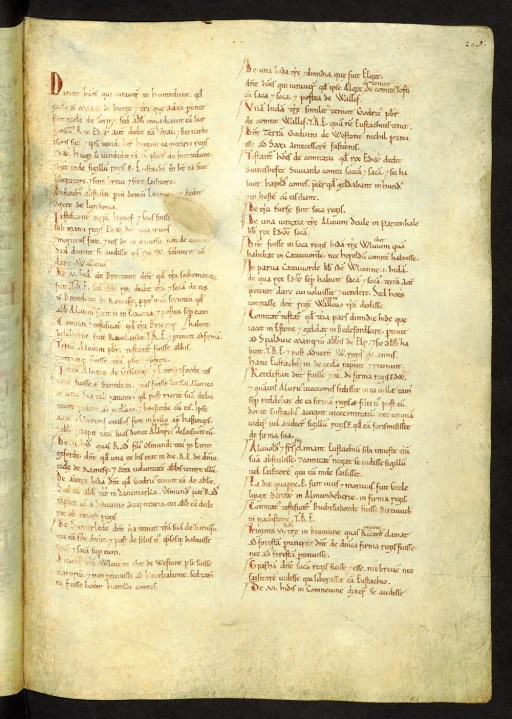
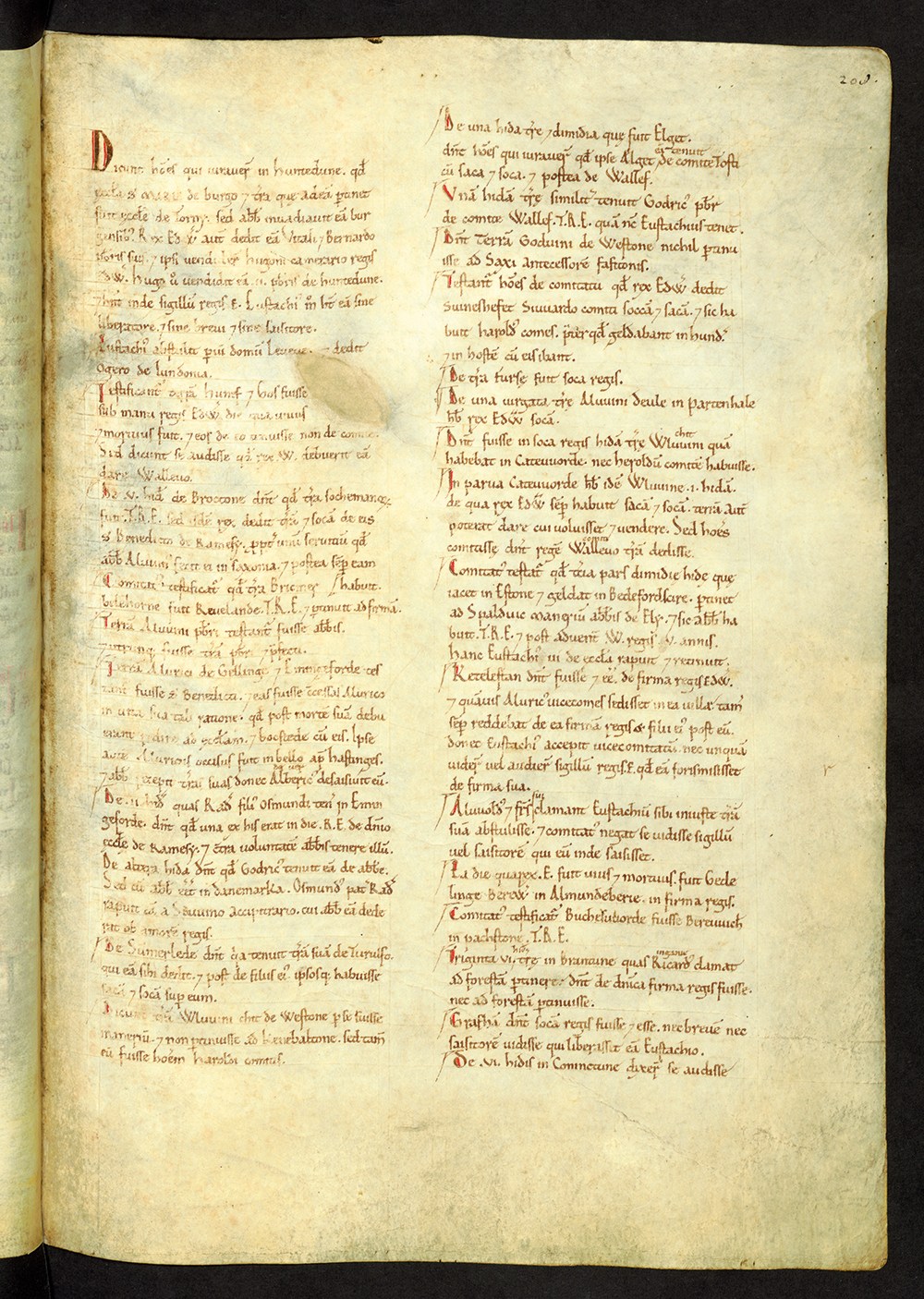
For in essence the Domesday Book was a national asset and tax roll. Its aim was to ensure that William was ruthlessly extracting maximum profit from the land while confirming the land holdings of his barons. However, more broadly the great inquisition of 1086 was intended to set the seal on the massive legal and tenurial changes introduced – often violently – by the Conquest, and to proclaim William once and for all the rightful king of England.

The Domesday Book is an awe-inspiring achievement. As Adams says, more than 800 vellum folios record the names of 13,418 English places, many for the first time in their history. It was produced at speed. Threat of invasion from Denmark –which never came – undoubtedly lay behind the urgency with which the survey was launched. William needed to be sure that he could raise the taxes to foot the massive bill for his army and mercenaries, though according to the great Domesday scholar Stephen Baxter, whose untimely death was reported back in January, the scale of the enterprise suggests that it had long been planned.
How do you bring the Domesday Book alive for a modern audience? Even more perplexing, how do you unscramble its statistics or define the complicated social strata – sokemen, bordars, cottars, and so on – in a way that makes for comfortable reading?
Adams’s answer has been to travel 1,000 miles, mostly on foot, over a period of two years, looking for the England of the Domesday Book. He decided on eight walks through ten counties, out of the 34 covered by Domesday (pages for the key cities of London and Winchester are tantalisingly blank), starting with Lincolnshire and concluding in the north-east. He was helped by the fact that outside the great new industrial cities of the Victorians, English domestic landscapes have remained remarkably unchanged across the centuries. Of the 300 places recorded for Northamptonshire only half a dozen can’t be located now.
Adams is an inveterate walker as well as a trained archaeologist possessing expert knowledge of the Anglo-Saxon kingdoms. What makes Domesday so satisfying is his extraordinary sensitivity to the evolution of the English landscape. He can walk across a field and pocket a Mesolithic spear point lying beneath the surface, or guide us around one of the most beautiful Saxon churches in the country, St Mary’s, at Deerhurst, in Gloucestershire. And, time and again, he shows us on the ground what the Domesday Book’s columns chillingly record in careful script: the Normans’ destruction of ordinary English houses to make way for their motte-and-bailey castles, strong as fortifications and cheap to build.
On his way through England, Adams regrets the modern decline of communal spaces that have become privatised. He notes the urban predominance of barbers, betting shops and takeaways, and the isolating experience that walking has become with few people willing to stop and talk. But to use the words of the great landscape historian W.G. Hoskins, he still finds places, ‘old common lands… for refreshment and sanctuary from noise and meaningless movement’.
By the end of the book you realise that Adams is commemorating the death of old England in the 11th century and beyond. Four to five thousand Saxon thegns, ealdormen, and earls were effaced from the landscape in a few short years by just 200 Norman lords, while the native peoples found themselves subjected to collective punishment.
Look at two scenes depicted in the borders of the Bayeux Tapestry and you’ll see what Adams means when he describes the Norman Conquest as among the greatest land grabs in history. In one, some peasants’ livestock is stolen and they are reduced to forced labour. In another, unbearably resonant across the centuries, a woman and child flee a house as the Normans set light to it.




Comments