John Betjeman, the patron saint of the English parish church, invented the term ‘church-crawler’ in 1948. Rachel Morley acknowledges his genius in this charming guide. But by her own admission she stands at one remove from similar church addicts. Yes, she’s fully qualified, as the director of the marvellous organisation Friends of Friendless Churches, founded in 1957. But she is in fact Irish, born and bred in Cork.
She’s learnt about England through its parish churches and makes a convincing argument that they are the key to English art, architecture, the national character and even the language. The name of the 7th-century Ely nun St Etheldreda mutated into St Audrey, which gave us the word ‘tawdry’ to describe the cheap fripperies sold on St Etheldreda’s feast days.
It’s no wonder the church is so steeped in the English character and landscape. The parish system was established in the 10th century. One Sussex church, Bosham, appears in the Bayeux tapestry, because King Harold visited it before sailing to Normandy in 1064. It has changed quite a bit in the intervening years, but the Saxon chancel arch is still much as it appears in the tapestry: the height, proportions, triple-moulded capitals and thick stumps at the column bases, which Nikolaus Pevsner likened to millstones.
It’s these connections, leaping across centuries, that turn us church-crawlers into addicts, ‘randy for antique’, as Philip Larkin put it in his poem ‘Church Going’. We get a hit from the smallest particular, such as the dark grey colour in stained glass formed by burning and grinding willow twigs, or ‘bone black’, the pigment made from burnt and crushed animal bones.
Morley has a fine eye for the out-of-reach details. Church bells are often inscribed with mottoes: ‘I call the quick to church and dead to grave’ in Calstock, Cornwall, from 1773; and the Terminator-like ‘Prepare to die’, in Croft, Lincolnshire, from 1716. Bell-ringers were a thirsty lot. From the 17th to the mid-19th century they were issued with ‘gotches’ – big ceramic pots for ale with a hole for a tap or spout. Some held 32 pints.
There’s so much wonder in an ancient parish church that it’s amazing we church-crawlers are thought eccentric. Who couldn’t be gripped by, say, Bewcastle Church, Cumbria, tucked inside a Roman fort on a Bronze Age settlement? The earliest Saxon sundial in England survives there, built into a high cross carved with vines and flowers. Pevsner described it as ‘the greatest achievement of that date in the whole of Europe’. That was the 660s. Again and again, the earliest surviving things are found in churches. The mechanical clock in Salisbury Cathedral, dating from 1386, is one of the oldest in the world. Age – and the memories it brings – explains why we keep on returning to churches. Their size means that they can literally store memories – like the plough parked under the war memorial in Salle, Norfolk, a memento of the farming dead.
‘So many dead lie around,’ writes Larkin in ‘Church Going’ – one of the reasons he finds a church to be ‘a serious house on serious earth’. Tens of millions of people are buried in British churchyards. A university friend once called me creepy for spending time mooching around Oxford churchyards. But, sex apart, is there anything more interesting than death?
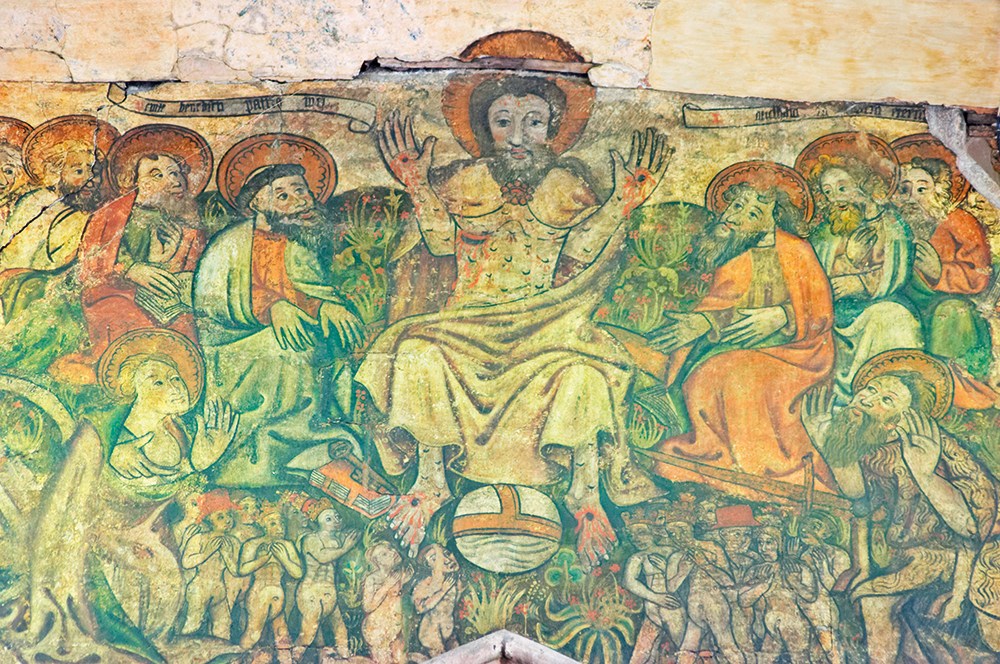
And churches are not just full of the dead but of pictures of death – in the Doom paintings of the Last Judgment, usually over the chancel arch. One of the finest, in Holy Trinity, Coventry, escaped the Blitz in 1940. Its vicar, Revd Graham Clitheroe, patrolled the roof for 11 hours, putting out incendiary bombs, and, thanks to him, the 1430s ‘Doom’ survives there. In one corner, a hairy demon rounds up three women, naked except for their butterfly headdresses, carrying tankards. They are alewives, doomed for watering down beer to cheat their customers. Pretty harsh justice.
With her day job for the Friendless Churches, Morley is forever faced with trying to save redundant churches. There are small triumphs. She finds a lost medieval rose brass (a rare floral memorial) from Edlesborough Church, Bucks, in a forgotten bank vault in Bedfordshire. The desire to protect and save has kept our parish churches going for more than 1,000 years. Long may it last.






Comments