
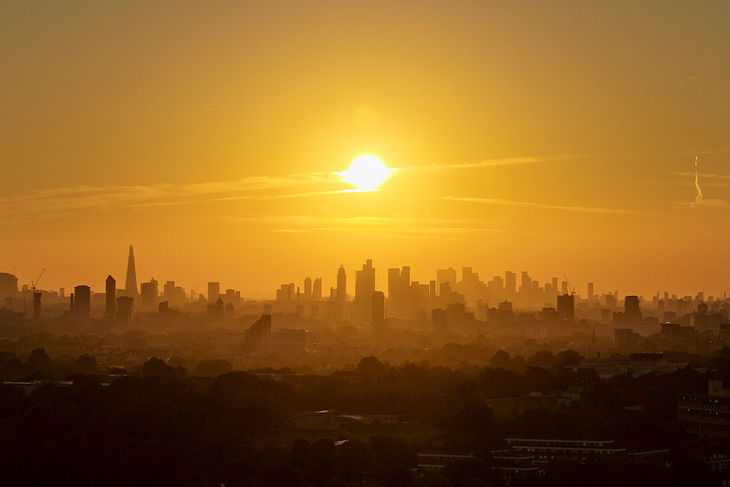
Hugo Rifkind – formerly of this parish, now a columnist in the Times – has written a Jeremiad blaming climate sceptics for this jolly hot summer we’re having. He admits that it is ‘overkill’ to make such a silly claim. But then goes on to make it anyway by accusing sceptics of helping to create a ‘political landscape in which inaction became a powerful rallying cry for much of the right’.
And what’s even worse, fumes our Hugo, they haven’t even got the decency to apologise for the damage done by their ‘blithe and ill-faith narratives’. Instead of wailing ‘mea culpa’ at Right-All-Along Rifkind as he crunches his sweaty way across the ‘Velcro-like grass’ in Hyde Park, these slippery sceptics have just slunk away and pretended it never happened.
The increase in global mean temperature over the last 150 years has been actually pretty modest
Not a word of this is true, though. And I should know because I’m one of the sceptics Rifkind singles out for blame, when he refers sneerily to a Spectator cover story I wrote in 2009 headlined ‘Relax: Global Warming Is All A Myth’. ‘Hmm. Was it?’ asks Rifkind, rhetorically. Yes, it was, Hugo. And it still very much is.
That’s why, far from crawling under a rock out of embarrassment for the role my scientific ignorance played in our boiling world’s imminent destruction, I have of late been doubling down on my claims.
In 2012, I published a book, Watermelons, noting that there was no credible evidence whatsoever for so-called ‘catastrophic anthropogenic global warming’. In the updated 2025 version, I add that it was a scam all along – and that the people behind it always knew it was a scam, because it was never about saving the planet but about money, power and Malthusian ideology.

One of the things Rifkind would have learned if he’d read the original book properly instead of just cherry-picking passages to scoff at is that weather is not the same as climate. A boiling summer in Europe is no more indicative of global warming than a freezing North American winter is of global cooling. Climate change is about worldwide trends over a prolonged period, not about localised extreme weather events which, by definition, are happening all the time all over the place and mean very little.
So even if – as the BBC keeps insisting – this really is the hottest summer in Britain ever, it wouldn’t alter the fact that the increase in global mean temperature over the past 150 years has actually been pretty modest: a rise of perhaps one degree centigrade or so. This is probably less warming than you experience every day between the time you get out of bed and the moment you have your mid-morning coffee. A crisis worth bombing the economy to the dark ages for, would you say?
Most people, when presented with an honest cost-benefit analysis, would say ‘no’. We like our cars, our foreign holidays and not being so fuel poor that we can’t afford to heat our homes in winter. But these and many other basic freedoms have become increasingly under threat thanks to policies like net zero, which characters such as Ed Miliband insist are vital if we are to avert climate catastrophe.
Where, though, is the proof that these economically destructive taxes and regulations are needed? And where is the evidence that quixotically attempting to reduce levels of the beneficial trace gas CO2 – currently busy greening the Sahel region, and regularly pumped into commercial greenhouses to increase productivity – will make any meaningful difference, especially when much bigger CO2 producers like China are ploughing on regardless?
These are questions that the vested interests pushing these policies never feel comfortable addressing because the answer in both cases is ‘there isn’t any’. That’s why so many of the arguments you hear from climate evangelists – Rifkind’s latest diatribe being a case in point – are aimed at the emotions rather than the intellect. The scientific and economic arguments just don’t stack up so they have to engage in rhetorical trickery.
This is one of the things that so shocked me when I was researching Watermelons: the extent to which the climate change industry depends on lies, bullying, cheating, tortured data, manufactured evidence and relentless propaganda. Some of this emerged in the Climategate email leak, which Rifkind misrepresents as climate scientists using ‘casual language about data, which they nonetheless used flawlessly’.
Nope, it showed the scientists at the very heart of the ‘climate consensus’ – the top experts cited in the Intergovernmental Panel on Climate Change reports used by world leaders to justify extreme green policies – behaving not remotely like honest scientists but like paid political activists. They weren’t looking for the truth, which had already been decided. Their true function was policy-driven evidence-making on behalf of the powerful global elites, who stand, in various ways, to benefit from this utterly fake but profitable crisis.






Comments