In the 1953 classic Roman Holiday, Gregory Peck takes Audrey Hepburn on a tour of the Italian capital on his Vespa. They scooter past the Colosseum, stop for gelato by the Spanish Steps, and sip champagne and iced coffee in front of the Pantheon. But Peck, that rake, sold Hepburn short. No Roman holiday is truly complete without checking out Ponza, a tiny island off the Lazio coast.

Ponza is to the Romans what the Hamptons are to New Yorkers: a safe haven in the muggy summer months. Plus, they can escape all those yokel English-speaking tourists who stalk the Eternal City. Ponza still feels like the Italy of La Dolce Vita. (Federico Fellini shot parts of Satyricon on its beaches.) And unlike Capri, the island has not been spoiled by the international jet-set and the parade of influencers that inevitably follow like medieval courtiers.
Only 3,000 or so people live on Ponza all year round. During peak season, there are more than 20,000. For most of history, Ponza was sparsely populated. Going back to ancient Rome, it was where the powerful were banished. None other than Benito Mussolini had a brief spell there in July 1943, after the Fascist regime fell. No crummy gaol for him though. Il Dulce stayed at a bed and breakfast, room and board. When his guards let him out, he paced up and down the beach and chatted up local women. His mating call, according to news reports at the time, was tearing up his shirt like Bruce Banner when he morphs into the Hulk. Alas, the historical record is silent as to whether that seduction technique met any success.
More than eight decades later, safe in the knowledge that the island was now free of sexed-up tyrants, I travel to Ponza for a summer getaway. The easiest way to get there is from Termini, Rome’s main railway station. In a venerable display of Italian kitsch, the station’s gigantic glass bookshop sells pope-themed bookmarks. So I grab one featuring Giovanni Paolo II – my holy pontiff of choice – and get on the air-conditioned train to the coastal city of Formia. An hour and a half later, I am on a ferry to Ponza.
In a venerable display of Italian kitsch, the station’s gigantic glass bookshop sells pope-themed bookmarks
The first thing I see as I approach the island is hues of orange, yellow, and pink. As the ferry gets closer, those colours come into focus to reveal a crescent-shaped harbour dotted with bright casette. A wall, painted terracotta, runs along the circumference. Below are docks and fisheries. Above, literally, is Ponza’s high street with restaurants, upscale boutiques, and grocery stores that still look like it is the 1960s.
I walk to the edge of the harbour to the taxi station. There are only 12 taxis on the island, and dozens of people ahead of me, so I wait. A young woman, clearly not Italian, is hunched over her smartphone, trying to order an Uber. The young man behind her, clearly Italian but not a local, tells her not to bother. ‘This is Italy,’ he says. Only later do I realise that, actually, appearances are deceiving: Ponza has a pretty efficient bus system and you can even buy digital tickets.
I share a cab with a Roman couple here for a couple of weeks and head north. There are hotels nearby, but I am staying twenty minutes away at Le Forna, a tiny village perched atop white volcanic cliffs. My rental studio, built into the side of a cliff, is one of many ‘cave houses’ on the island. Once the homes of fishermen, they have shot up in value in recent years, a windfall for locals.
From there, I walk down steep stairs to Cala Feola, one of the only sand beaches on the island. Nestled in a cove, foliage all around, it looks like a postcard brought to life. The water is clear and shimmers in the sun. In the distance, small boats sway to the gentle rhythm of the Tyrrhenian Sea.
At the base of the cliff, spilling out from the rock face, sits restaurant La Marina. I have their spaghetti alla vongole, which is fresh and light. However, expect to pay the same as in Rome. The vibes may be quaint, but the prices are not. Inflation didn’t stay on the mainland.
Part of the fun of being in Ponza is trying out different beaches. Down the road from Cala Feola are volcanic pools, connected by rugged rock arches, known as Piscine Naturali. While the scenery is spectacular, the terrain is perilous. Slipping is a permanent threat, and those rocks have probably sprained more ankles than the Argentine football team during the last World Cup.
Another hotspot is Frontone Beach. While it is halfway between where I am staying and the harbour, the only way to get there is by boat. There are taxi boats, but it is easy enough – and cheaper – to catch a ten-minute shuttle from the harbour. Framed by an immense cliff, swept by the winds, Frontone looks out onto the open sea.
At the tail end of Frontone is, for my money, the best restaurant on Ponza. While Acqua Pazza in the main town has a Michelin star, Da Enzo is the island’s gem. I go there in the evening, when it serves a set menu of pasta and seafood. Enzo, the dashing owner, picks me up in the harbour, along with other patrons, on his speedboat. When we arrive, the whole open-air restaurant is lit with candles. As night falls, those tiny flames scintillate in the dark like fireflies.
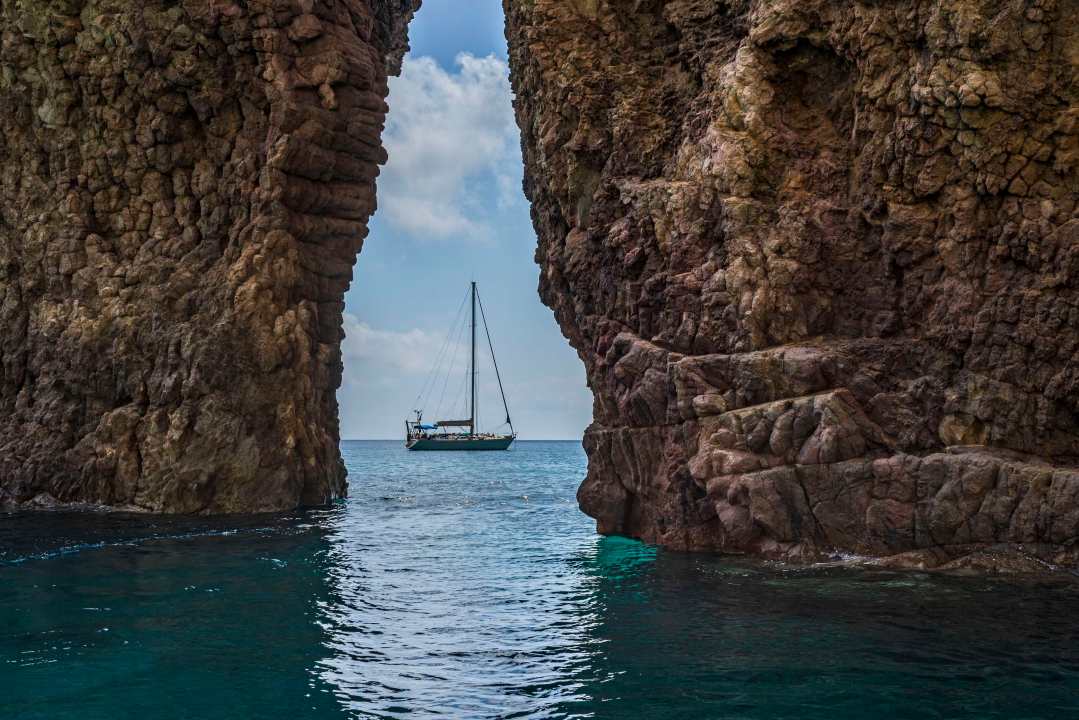
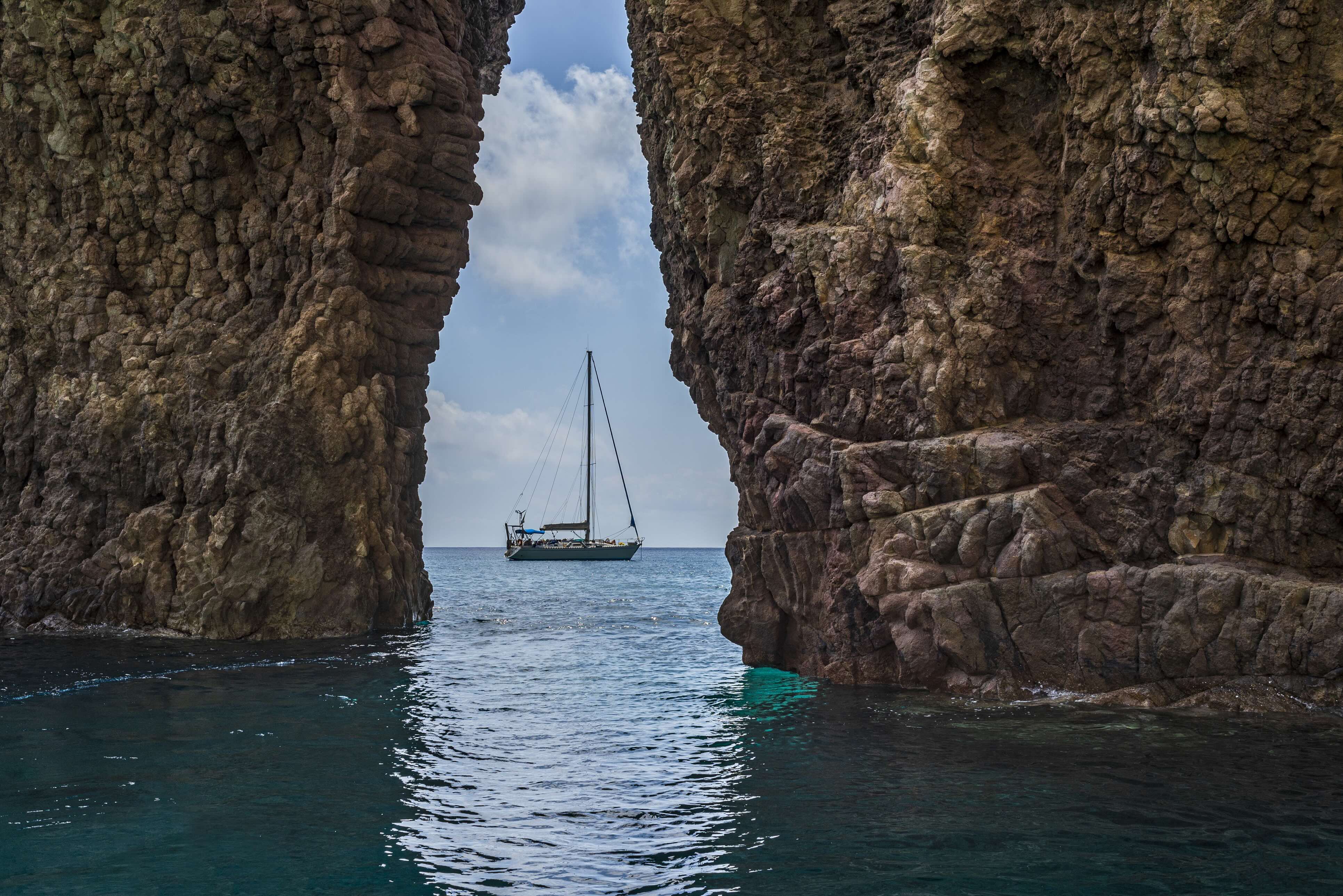
If no Roman holiday is complete without going to Ponza, no Pontine holiday is complete without taking a boat tour. On my final day, I board a boat – Barca Con Luca – departing from Cale Feola. We tour the smaller islands nearby and stop several times to swim in coves and sea caves. The scenery, dramatic and sun-drenched, evokes The Odyssey. Legend has it that Ponza was once the island of Aeaea, where the sorceress Circe turned Odysseus’s men into pigs.
But, unlike Odysseus, we are not alone. Dozens of boats are anchored at every spot. I end up speaking to a man in his late seventies, flaked by his daughter and grandchildren. He tells me that he remembers once coming to these same spots and being by himself. As it turns out, he was born on Ponza just after World War II. Back then, many parts of the island were not electrified. Dirt roads still existed. And tourism was limited to a handful of artists from Rome.
The man confesses to being shocked at how fast the island is transforming. It is a salutary reminder that many tourists, including myself, come to Ponza to experience a halcyon past that has all but vanished.




Comments