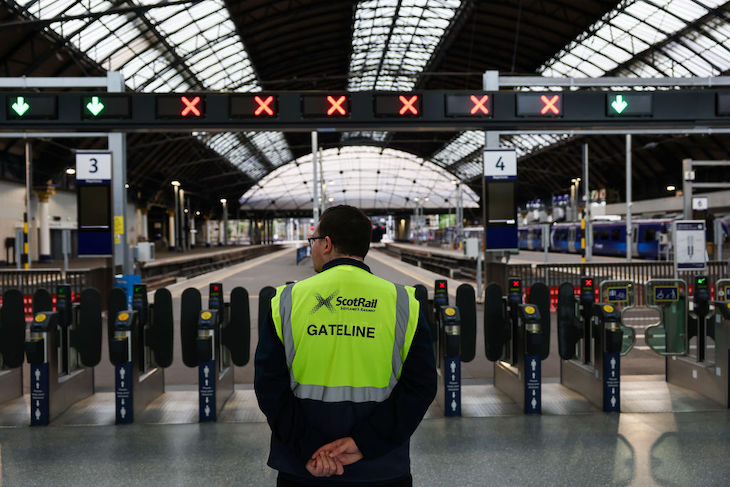
If there’s one thing more annoying than sitting on a plane next to someone who has paid half what you did for your ticket, it’s to see a fare-dodger push through the barrier at a railway station. Ah, we have a solution says the Department for Transport, announcing that £33.4 million is being allocated to train operators to, as it were, raise their barriers.
Barriers are not the hoped for silver bullet
This little pot of money definitely belongs in the realm of ministers trying to show they are doing something about an issue that raises the hackles of law-abiding train-travellers. Indeed, according to the Rail Delivery Group, the industry-wide body that represents the train companies, it is we, the taxpayers, who bear the brunt of this lawlessness, given that the rail industry is subsidised to the tune of £350-£400 million a year. How is this figure worked out, I wondered, since fare-dodgers are unlikely to own up to their misdeeds? Annoyingly, the RDG told me they could not divulge the methodology as the information was ‘commercially sensitive’. So sensitive indeed that they would not even explain why this was the case. Railway economics it seems are even more opaque than economics as a whole.
The Department for Transport’s big thing is barriers. Quite possibly tall ones that will prevent people jumping over them. Or more of them. Barriers everywhere seems to be the proposed answer to fare dodgers who will need to take to pole vaulting. But in fact, that is a misreading of the problem. Barriers are not the hoped for silver bullet.
But at least one politician will be applauding. Robert Jenrick who had recently converted from dark blue to light blue ran a much publicised one man campaign in May to stop fare dodging at Stratford in East London by bearding miscreants and berating inactive staff who, like security guards in shops these days, seemed to be doing little to stop them.

Jenrick had a point but sadly for him he cannot claim credit for this initiative since the DfT told me it had already been agreed in last November’s spending review. The wheels of the department run even more slowly than some of its trains.
The coverage of the announcement has suggested that the idea was to install higher barriers which miscreants could not climb over, but the department press office was at pains to point out to me that this was not actually the case. The money allocated will be spent on installing barriers in those stations that currently don’t have them, and at others where they may be reinforced. How exactly, remains as much of a mystery as the amount of money lost through fare dodging.
It is ultimately up to the operators to decide how the money is spent and they will determine which stations have the best business case for improving their barriers. Places such as Liverpool, Stafford and Manchester Piccadilly, as well as smaller stations like Hertford East, Nuneaton and Tamworth are among those allocated for improvements.
The fanfare over a few barriers managed to catch the attention of the media because it is an issue passengers feel very strongly about. It has to be said, however, that the effect of this small sum spent on a handful of Britain’s 2,589 stations is hardly going to dent the huge cost of fare dodging.
It is not a few extra barriers that will make the difference but people, and, importantly, staff who care about what they are doing. As a child, I indulged in a bit of fare dodging myself at Kensington High Street Underground station, then barrier-free but guarded by ticket collectors. The trick was not to buy a ticket and simply dump a couple of pennies into the collector’s hand when you exited, mumbling ‘Bayswater’, which was only a couple of stops down the line and therefore cheaper than my real departure point. But the more diligent ones would say, ‘Now, laddie, tell us where you really came from,’ in a voice that made you think you might be getting a clip round the ear and you coughed up – though where the money ended up was another question.
Today’s equivalent is the disabled-cum-bicycle barrier, the wider one that stays open longer allowing through not only those not fleet of foot, but those who are very much so and have no ticket. The height of the barrier is irrelevant. The effectiveness of this process is dependent on the person guarding the barrier. All too often I get waved through with my bike without a ticket check.
Even where there are barriers, they are often thrown open when, for instance a station gets too busy because of football supporters and the staff, fearing a crushing incident, open the barriers and give up on checking tickets. Moreover, at night barriers are all too frequently simply opened as there are no people to staff them. This happens even at a station as busy as Peterborough or King’s Cross where a couple of security staff may be there but have no interest in anything other than keeping order. It need not be like that. A couple of years ago I got on a suburban train at the unstaffed station of Maryhill in Glasgow, heading for Queen Street, and despite it being 11p.m. the barriers were closed and £2.20 was extracted from me on exiting by a charming ticket collector.
All too often I get waved through with my bike without a ticket check
Barriers, in fact, are a somewhat 20th-century solution to a 21st-century problem. Ticketing is becoming more and more digitalised and apps that simply charge passengers for whatever journey they take without the need to buy a ticket in advance are currently being trialled. How this equates with spending money on barriers needs to be explained.
In the end, however, this issue is not just about fare revenue. The purpose of checking people getting onto trains is a security issue, along with preventing riffraff or even the homeless who may be using the trains to keep warm from getting into carriages and it is important for rail passengers’ perceptions of safety. The attack on a train near Huntingdon last year by a crazed knife wielder highlighted the necessity of keeping possible miscreants off the railway.
People, not barriers, are therefore the solution. Moreover, these people should be working for the railway itself, rather than for some outsourcing company with no interest in how much revenue is being collected. It will be interesting to see if the managers of the nascent Great British Railways, which is supposed to emerge from the chaos of the privatised system in the autumn of next year, will get the message.





Comments