
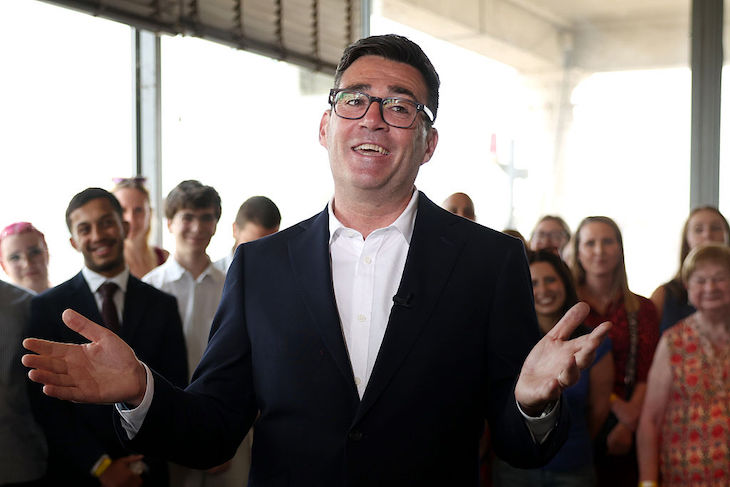
Burnham’s schtick is that he is going to re-discover Labour’s true faith
When I was covering Barack Obama’s battle with Hillary Clinton for the 2008 Democratic presidential nomination, there came a moment when only she among sentient adults seemed unwilling to acknowledge that Obama had beaten her. We would traipse to Clinton rallies to be greeted, without fail, by the strains of my favourite Tom Petty song, ‘I Won’t Back Down’. (‘You can stand me up at the gates of Hell/ But I won’t back down/ No, I’ll stand my ground/ Won’t be turned around/ And I’ll keep this world from draggin’ me down/ Gonna stand my ground…’) It was delegate votes, rather than anyone draggin’ Clinton down, which cost her, of course, but for years afterwards I couldn’t hear Petty’s gravelly voice without seeing Hillary’s pasty, pantsuited visage.
And now another politician comes along to ruin one of my favourite songs. The next time I play New Order’s ‘True Faith’, I will try to recall a sweaty sixth-form disco and the sense of possibility. However, I fear what will pop into my head is the smiley features of Andy Burnham, our next prime minister, gently bopping like a twinkly uncle at his niece’s wedding, anticipating the attentions of every divorcée in the room when he goes to the bar.
Just as with Clinton, these were theatrically performative lyrics at the announcement of the result of Labour’s leadership non-contest. Burnham’s schtick is that he is going to re-discover Labour’s true faith and win back the voters who, in his telling, the party has abandoned.
After failing twice before to become leader, Burnham looked very much like the kid whose face was now basking ‘in the morning sun’. New Order, one of Manchester’s finest bands, crooned away: ‘I feel so extraordinary/ Something’s got a hold on me/ I get this feeling I’m in motion/ A sudden sense of liberty.’ This is his moment and he looks like he is enjoying the motion and liberty. Burnham’s pledges to do more for people and places which have been left behind could have been penned by Bernard Sumner, who wrote of how, in such communities, ‘the value of destiny comes to nothing’.
But listening to Burnham’s speech – which was perhaps understandably directed more at the Labour party than the country (the address to the voters will follow on the steps of No. 10 on Monday) – he also seemed still to embody this line from the song: ‘I can’t tell you where we’re going/ I guess there’s just no way of knowing.’
‘I know what I believe after 25 years as an elected representative,’ he said. ‘I know what I want to do. I have a plan.’ So far, however, he hasn’t really told us what he will do. There are three types of plan in politics – the plan for where you want to go, the plan outlining what that means in practice, and the plan for how to execute and make that journey. Having listened carefully to Burnham, we still only really know the first bit.
He set out five key pledges, the only moment he aped Tony Blair in the entire speech. They are:
- Work relentlessly to build a culture of one Labour team, shorn of the ‘insidious briefing culture’ which has bedevilled every other government
- Build a new politics focused on problem solving rather than point scoring
- Set a ‘distinctively Labour’ direction, rather than ‘try to out-green the Greens or out-reform Reform’
- Be a PM who governs for everyone and is for the North, South, East and West, plus Wales, Scotland and Northern Ireland
- Take power back from Westminster and Whitehall and give it to the places who have lost both political and economic clout
Here’s what we learned from the whole thing:
Like a lot of Labour figures, he thinks demonising Thatcher works, but no one under the age of 55 ever voted for her
He can do disarming honesty
Burnham apologised both for the failings of the political class and for moments when he has fallen short. This doesn’t stop being unusual and notable and will connect with the public, though there is an element of humble braggery about it.
…And jokes
As my column this week revealed, Burnham made merry with the old joke about the Blairite, Brownite and Corbynite walking into the bar. ‘Hello, Andy,’ the barman says. In future ‘when a Burnhamite walks into a bar, as many Burnhamites are wont to do’, the man said, the barman would say instead: ‘Good to see you, we don’t like factional politics in here.’
He wants one big tent, but does that include extremists?
He told Labour he was ‘not seeking to suspend or punish members whose views might be different from mine’. Starmerites will be wondering if this means Burnham wouldn’t have kicked out Jeremy Corbyn for his approach on anti-semitism (the issue which has caused many of the expulsions) but they will also look at the strong representation of pro-Palestinian politicians around him and wonder if this could cause an issue.
He’s not above a little spin
Burnham claims he has not yet decided who will get the top cabinet posts. This is either disingenuous or disturbing. He becomes prime minister on Monday. You would hope he was neck deep in economic discussions with his putative chancellor already.
The dad act stays
‘I won’t change,’ Burnham said. ‘I have a style. It’s my style. I’ll stay close to the ground, close to the people.’ He likes his Manc dad outfits, he said, even more so because Kemi Badenoch was rude about them. Burnham spoke about getting his ideas from the people he meets in ‘Greggs and the pub’. It is an admirable intention to stay in touch with the public mood and politicians need to do it by more than just reading a focus group report. But, bluntly, it’s difficult to sustain as prime minister. His personal security will be off the charts higher and every single PM visit comes after an advance team has been to scout the locations. Spontaneity is hard and every PM ends up in a bunker sooner or later. It’s good that Burnham wants it to be later, but he doesn’t seem to realise how much he’ll have to trim his sails.
He blames Thatcher, but will voters?
In some ways this was a hugely radical speech. Burnham sees his accession to power as a watershed moment which will do away with the entire Thatcher-Blair-Cameron-Starmer consensus on how Britain is run. He constantly talks about turning the clock back 30 years and reindustrialising and giving power, money and dignity to what he sees as the victims of neoliberalism, ‘the forgotten places up and down the country’. He promised a return to ‘the Labour they once knew – we will be that version of Labour again.’ But what is his goal here? Does he really want to remind people of the 1970s? The Thatcher revolution was accepted by the English working classes, who voted for it in huge numbers, as a necessary price to pay to lift the UK out of its status as the industrial and economic sick man of Europe. Like a lot of Labour figures, he thinks demonising Thatcher works, but no one under the age of 55 ever voted for her or against her in a general election and those who did will still be split.
His heroes tell a tale
Burnham singled out three political heroes for thanks and praise. The first was Lord Blunkett, the former home secretary, whose parliamentary private secretary Burnham once was. They share a route from City Hall to the top in Whitehall and a communitarian politics – and it is interesting that Burnham, like Blunkett, seems to be more socially conservative on crime and immigration than the London Labour party, which has dominated for decades. The second was Margaret Beckett, who was briefly acting Labour leader but is best known these days for what she herself said was the ‘moronic’ decision to put Jeremy Corbyn on the leadership ballot paper in 2015. Finally, there was Neil Kinnock, arguably (with George Galloway) the greatest parliamentary orator of the last 50 years, who twice failed to win general elections. Burnham was generous to Keir Starmer for making Labour electable again and giving him something to build on, but there was no mention of Attlee, Wilson, Blair or Brown.
Telling tales won’t be enough
Burnham spoke affectionately about how Kinnock’s speeches ‘fired up a young man’ with ‘rhetoric that remains unmatched’. The rationale a large number of Burnham’s fans cite is his ability to communicate. On social media this is undoubtedly true and there were moments of folksy charm here which will probably go down well with the public, but Burnham’s delivery of the speech itself was as flat as his vowels. This is a man who can do intimacy and interaction with voters, feeling their pain as Bill Clinton once did, but he is not a platform orator.
Burnham wants to be a domestic prime minister but that’s not wholly possible
There was no mention of foreign affairs at all. That may come on Monday, but it was still odd, at a time when the world is in turmoil, to hear nothing on Britain’s place in the world, or the war in Ukraine. He seems keen to appoint a heavyweight foreign secretary (potentially one of the Milibands) and keep Jonathan Powell as National Security Adviser and leave them to it. But world events have a way of demanding the PM’s time. I remember Rishi Sunak telling me that foreign affairs and security issues stole 40 per cent of his working time, at a time of far less turbulence, when he wanted to be doing other things.
There was no mention of tech
As I say, the message to the country may be different, it may be an optimistic prospectus for a thriving nation with a growing economy, but the message to Labour was very much ‘let’s get back to the good old days’ – and there will be concerns that this means more taxing, spending and borrowing, even if the sensible Shabana Mahmood is chancellor.
It’s hard not to be sceptical, but we must also be fair. Burnham has a far more coherent world view than Starmer, even if some of it is misguided, and he is, in most presentational ways, a figure it is easier to like – and that is a long way from nothing in politics. He has far more experience of executive political power and Whitehall than Starmer, Blair or Cameron when they became PM. As someone who has got bored of himself banging on about how politicians need a plan, it was good to hear Burnham say that he does so explicitly.
It’s hard not to be sceptical, but we must also be fair
He also said: ‘I am ready.’ No one is ever ready, of course, for the relentlessness of the highest office, but if he is to be successful, the detailed proposals and the means of executing them, which emerge next week, will have to match the seriousness of his diagnosis and ambitions to shift a generational consensus.
If Burnham gets it wrong, there will be some singing True Faith in the future who focus on this line: ‘The chances are we’ve gone too far/ You took my time and you took my money/ Now I fear you’ve left me standing/ In a world that’s so demanding.’




Comments