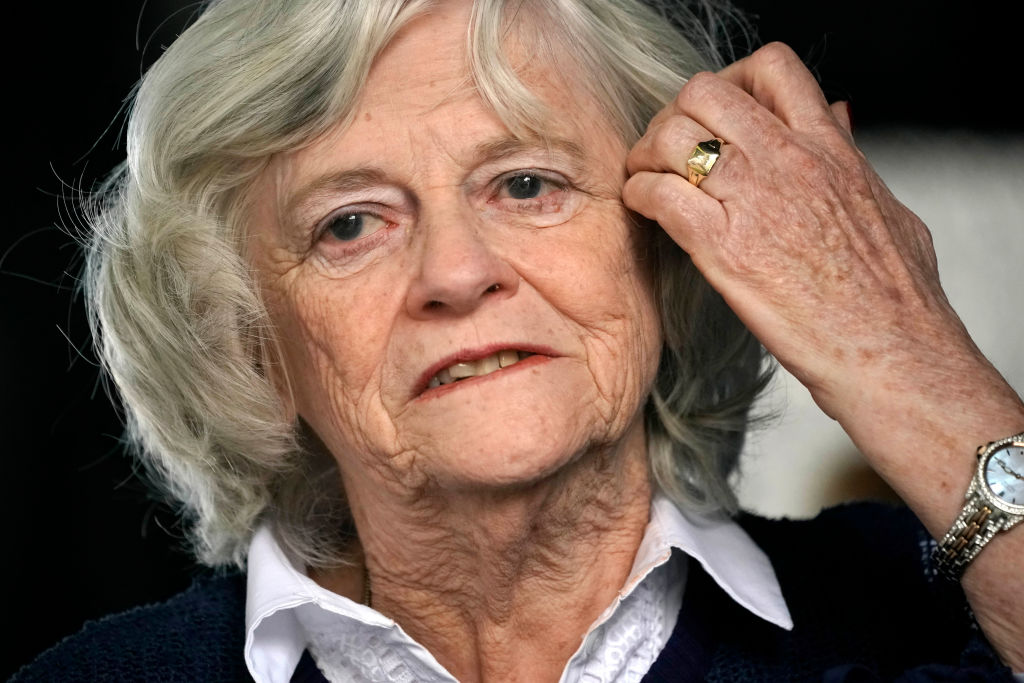
I was just waking up last Friday when I heard the news of Ann Widdecombe’s death. It was still very early here, and at first the story didn’t land properly. Days later, counter-terrorism police said they believed it was a targeted attack. That part is particularly haunting.
Widdecombe’s kind of redoubtable consistency – the instinctive mix of tradition, order and plain speaking is what marks the best of British conservatism
Here in America, while not a household name, Ann Widdecombe was not completely obscure. Not because she spent much time courting American audiences, but because she focused on things that hit close to home for those of us engaged in defending western civilisation. She talked about national sovereignty as if it was still a normal thing to defend. She spoke plainly about borders and the right of a country to decide who comes in and why. On questions of life and family, she didn’t hedge or apologise. Her candour and unapologetic style had appeal beyond Britain. Plenty of American conservatives recognised her arguments and we respected the fact that, like us, she kept making them. She was truculent, certain and refreshingly unafraid of being disliked.
She also seemed to grasp something about the relationship between Britain and America that Britain’s current leaders have forgotten. She saw the US-UK relationship as an essential, non-negotiable anchor for global stability and shared democratic values. She pushed back when others tried to downplay the special relationship. That matters robustly on this side of the Atlantic, with our shared inheritance under siege.
Apparently, Widdecombe held forth right up until the end, giving robust interviews backing Nigel Farage’s decision to trigger a by-election and calling the process investigating him a ‘kangaroo court.’ Only the day before her death she was still speaking plainly and without fear. In what may have been her final interview, she spoke of a ‘game of personal destruction’ targeting those who challenge the consensus. The tragedy of her death was the loss of a consequential conservative voice.
Widdecombe’s death is all the more devastating because of the admirable person she was. She never softened her positions to make them more acceptable. She opposed abortion and assisted dying on principle. She treated politics as a place where moral convictions were allowed to matter, even when holding them came at a cost. That kind of redoubtable consistency – the instinctive mix of tradition, order and plain speaking is what marks the best of British conservatism.
British police have described the attack as targeted, and other figures in Reform UK have begrudgingly been given extra protection. The fact that a prominent conservative voice was killed in her own home fits into a pattern that has become impossible to ignore on both sides of the Atlantic.
Over here we struggle with the same ugly reality. Conservative politicians and activists who speak out on immigration, biological sex or life issues have faced a steady rise in threats and violence. Trump was shot at twice. Charlie Kirk was killed last year while speaking at a university event. Pro-life centres have been attacked and local officials warned that people know where their children go to school. The targets have overwhelmingly been on the right.
What makes this worse is how much of the atmosphere has been shaped by the language coming from Democratic politicians and the media that amplify them. For years the message has been that the other half of the country isn’t simply mistaken but actively dangerous – a threat to democracy that needs confronting rather than debating. When that kind of framing becomes normal, it changes what some unstable people think is acceptable. It creates a climate where attacking someone on the right can start to feel justified. The gloating reactions to Widdecombe’s death from some quarters only confirms how normalised this demonisation has become.
In her tribute to Ann’s life, my friend, the marvellous journalist Allison Pearson, recalled how Widdecombe once told students at the Oxford Union: ‘Nobody has the right to live their lives being protected from offence or hurt feelings. It is an occupational hazard of living in society, she said. If you really can’t take it, become a hermit.’ She believed in free speech not as an abstract slogan but as something worth defending even when it costs something. When people in positions of influence spend years telling the public that certain views are not just wrong but monstrous, they help create the conditions in which violence against those who hold them starts to seem less shocking.
What happened in that cottage in Devon should trouble even people who never shared her politics. Ann Widdecombe lived her life with faith, grace, honesty, and joy. If the price of public disagreement keeps rising, the space for ordinary disagreement shrinks and what a sad condition we will occupy.





Comments