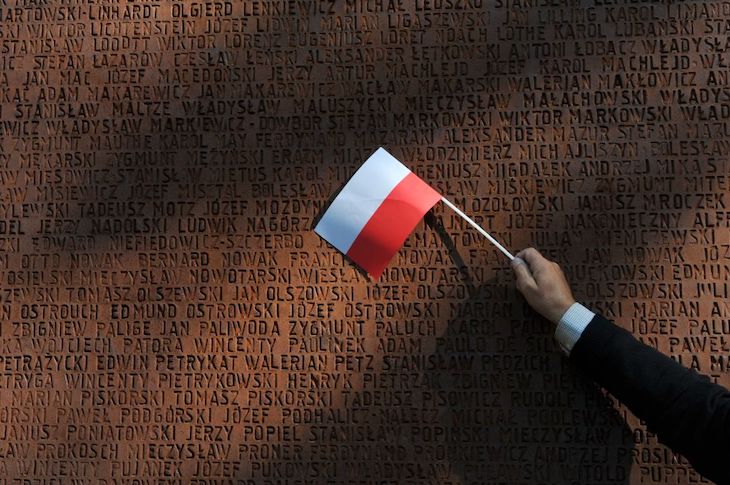
Poland was once a staunch ally of Ukraine. But president Zelensky’s decision to name a unit of the Ukrainian Special Forces after the “Heroes of the UPA” appears to have shattered the relationship for ever. Help may be at hand, though: in the form of the humble British historian.
Others want Poland to go further: there are calls to close the border with Ukraine
While Polish and Ukrainian politicians have their own agendas and aren’t trusted by the other side, some British historians have near-mythological status in eastern Europe. Eastern Europeans often feel neglected by Westerners, who unduly spend most of their time poring over the histories of Germany and France, so when a Westerner does write about Eastern Europe, they are immediately admitted into the good graces of whoever they write about. Historians like Roger Moorhouse and Norman Davies are much better known to the east of the Oder than they are in Britain. If they could speak out or call for calm, Ukrainians – and Poles – would listen. And there is a chance that these two former allies could patch things up.
For now, though, the fallout from Zelensky’s decision in May continues.
Poland has stripped Ukraine’s leader of the Polish Order of the White Eagle, the highest honour which can be awarded to a non-Pole. Others want Poland to go further: there are calls to close the border with Ukraine, for all funds and loans for Ukraine to be blocked and residency rights for all Ukrainians currently in Poland to be revoked. In Ukraine, just about every senior Ukrainian who has ever been granted a Polish decoration has now handed it in, with no hint of remorse.
Not long ago, of course, Poland was an exceptionally pro-Ukrainian country. It was the first to send weapons to Ukraine, even as Western experts were predicting Kyiv would fall in a matter of days. Over three-quarters of all Poles had donated money to Ukraine and, since the invasion, the country accepted over 1.2 million Ukrainian refugees: they now make up almost five per cent of Poland’s population.
All this has only served to magnify feelings of ingratitude when Zelensky went out of his way to honour the UPA.
The UPA – or the Ukrainian Insurgent Army – are, in Ukraine, uncontroversially seen as heroes of Ukrainian independence, a few of whom may have been bad eggs. In Poland, they are seen to have systematically massacred over 100,000 Poles with extreme brutality in order to have a clearer claim to Volhynia, a hitherto ethnically mixed region, in the post-war settlement – around a third of the region’s residents were Poles.
I will not describe the accounts of murder here, for fear of spoiling your meal, but they can be easily found online. Suffice to say, those with even a passing interest in Eastern European history know that there is no inter-ethnic hatred worse than that of one type of Slav toward another.
The timing of the whole farce is particularly bad. On Saturday, Poles observed the National Memorial Day for Poles killed by Ukrainians in Volhynia, an annual commemoration instituted by the Polish Parliament in 2009.
To give due credit to the Ukrainians, there have been some attempts at reconciliation. Even at the time of the massacres, Ukrainian leadership often tried to tame what was going on – with limited success – and several Ukrainian presidents have since paid tribute to the victims of the massacres at various commemorative monuments.
But an official apology never arrived. Instead, the more frequent reaction coming from Ukrainian officials is deflection. Some, such as the historian Vakhtang Kipiani, point to the actions taken against Ukrainians by the Polish Armia Krajowa (AK) in the aftermath of the massacres: the AK is estimated to have killed up to 3,000 Ukrainians in retaliation. Ukrainian-American academic Roman Sheremeta tries to blame the Russian NKVD, claiming they would dress up as the UPA when executing Poles.
The Ukrainians have also not helped themselves by consistently blocking Polish attempts at exhumation of the UPA’s victims, or by the fact that almost half of Ukrainians in modern-day Volhynia do not even believe that the Volhynia massacres happened. Indeed, outside of Volhynia, most Ukrainians have never heard of the massacres. The naming of a Ukrainian unit after the UPA was the straw that broke the camel’s back.
As a Pole, I will refrain from commenting on the above: I am obviously biased and, besides, there is nothing that a Pole could say that would convince a Ukrainian. Nor is there, frankly, anything that a Ukrainian could say that would convince a Pole. One will always suspect the other of an ulterior motive, and they would be right to. Ukrainians naturally want to view those who won their independence as heroes, and Poles naturally do not want to hear excuses for murderers whose victims are still well within living memory.
Alas, a neutral adjudicator is hard to find. Nobody has ever changed their mind after having been exposed to the HR-ish tones of EU bureaucracy, so the EU won’t do.
The Americans have tried, too. American historian Timothy Snyder has written about the subject extensively but has avoided weighing in on any one side of the disagreement since the start of the Russian invasion.
Now, the only thing capable of moving the needle on the issue are the erudite tones of the British historian.
There are several reasons for this. First, Britain is outside of the EU. Second, neither Poland nor Ukraine can suspect Britons of having an ulterior motive. Third, both Poles and Ukrainians generally like Britain: the latter for helping them during the current war, the former for having helped them during the previous. And fourth, several British historians have nigh-celebrity status in Eastern Europe.
As well as Moorhouse and Davies, Antony Beevor, Tony Judt or Andrew Wilson are likewise household names abroad.
Unless one side relents, anti-Ukrainian moods in Poland will only continue to grow. Once they culminate, Ukraine will be almost completely physically isolated, putting the entire Ukrainian war effort at threat. Only one type of man can save it. British historians, assemble!

Comments