
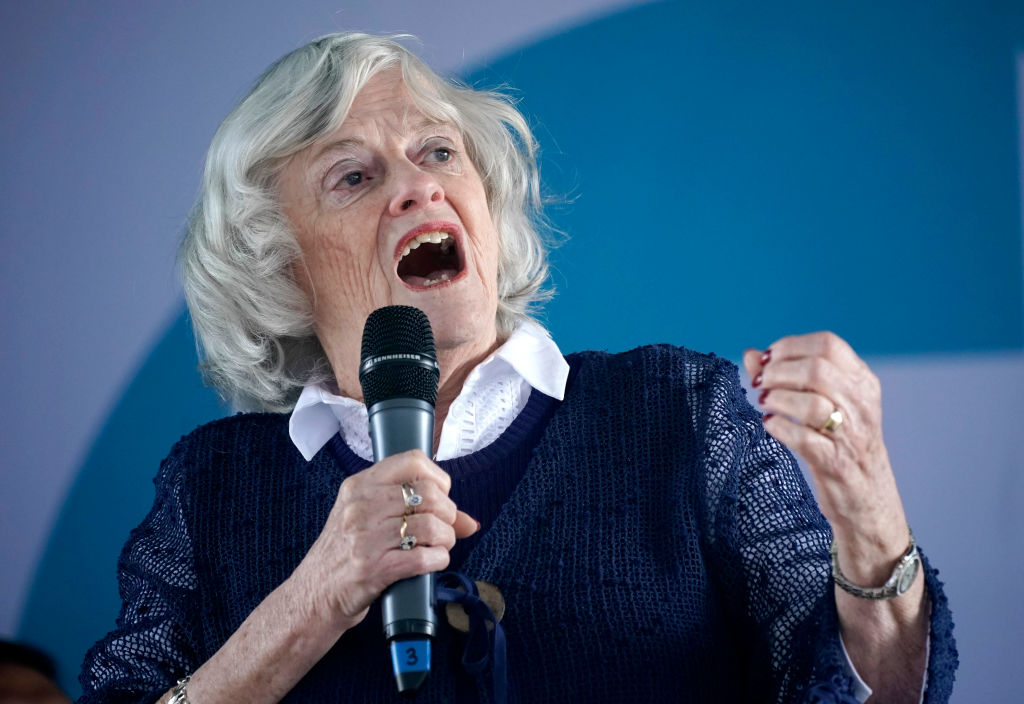
The death of Ann Widdecombe calls to mind the song of the same name by Victoria Wood. The festive ditty describes the then-shadow home secretary, as ‘our favourite Tory biddy’ with Wood, done up to resemble the no-nonsense Conservative, emerging from behind a curtain crooning: ‘Ann Widdecombe! Ann Widdecombe! I sing, I dance, I lean to the right/ I’m truculent, I’m succulent, I am a star.’
Revelling in the demise of an old lady, all because she refused to affirm your sexuality or gender identity or because you mistake her fidelity to two millennia of Christian doctrine for irrational hatred, does not make you the better person
The lyrics were absurd and Wood’s approximation of Widdecombe – with buck teeth and bulging bosom – grotesque, but the song captured something about the Tory that none of the other send-ups of the time managed. Widdecombe was ludicrous, and for many objectionable, but she was indeed a star, one ready-made for the dawn of reality television.
Widdecombe was a more accomplished TV star than MP because, while her unmodernised views and unstylised demeanour were out of step with the Blairified politics of the late Nineties, they made her something the British are eternally drawn to: an eccentric. Wood seemed to understand that too and, though I doubt she was sympathetic politically, she ran the musical number past Widdecombe before recording it, a courtesy Widdecombe said no other comedian ever extended to her.
While her detractors in the political class and media could never forgive her social conservatism, her fame had nothing to do with policies or principles. It was all her. The viewers of Strictly Come Dancing and Celebrity Big Brother relished her candour and certainty in an age of fence-sitting and triangulation. The strangled screech and gimlet-eyed look so often lampooned by parliamentary sketch-writers only added to her authenticity.
Her appeal crossed class lines because, whatever our background, everyone over a certain age has known an Ann Widdecombe. She was the fearsome headmistress who bellowed at us for having our shirts untucked or for running in the corridor; the parish choir director who would sooner frolic naked in the baptismal font than allow an acoustic guitar anywhere near her ensemble; the jam-making, scone-baking, sherry-taking maiden aunt who ran her local branch of the WI like Monty commanding the Eighth Army at El Alamein. She represented a kind of woman once intrinsic to British life but since lost to feminism and changing social mores. Women who rolled up their sleeves, took charge, knocked heads together and doled out unvarnished truths, not in spite but in Christian love.
These were women for whom the term ‘redoubtable’ could almost have been coined. Widdecombe was redoubtable and she was more than a reality TV star. She was a Conservative MP and minister, later a Brexit MEP and later still Reform’s justice spokeswoman. As these shifting loyalties intimate, she was neither a partisan nor an ideologue. Her approach to politics was instinctive, not analytical, and far less programmatic in her thinking than many of her progressive opponents.
She was the reactionary Eurosceptic who backed liberal Europhile Ken Clarke for Conservative leader and called him ‘the best prime minister we never had’; the pious Christian who thought the peacemakers blessed but helped found a pro-nukes rival to CND; the opponent of same-sex marriage who equally opposed withdrawing the right once granted; the Home Office minister who defended the shackling of pregnant women prisoners as a necessary evil but who would brook no defence of her party’s favourite form of civilised barbarism, fox-hunting; the pro-lifer on abortion and euthanasia who urged the reintroduction of the death penalty for particularly heinous murders and the slaying of police officers.
If that sounds like a very confused political philosophy, it is because Widdecombe hewed to that often confounding but highly successful coupling of liberty with order, prejudice with adaptability and tradition with innovation that is known as Toryism. Toryism is disdained by intellectuals, political scientists and other doctrinaires of liberalism for prizing intuition over reason and circumstances over systems. But the dowdily unromantic and sometimes excessively cautious Toryism of the kind practised by Ann Widdecombe has been responsible for less human misery than more enlightened alternatives.
Where she was dogmatic was in her faith, which she would have called the faith. Raised in an Anglican family that produced several vicars, she parted ways with the Church of England over its ordination of women and after months of counsel from a priest became a Roman Catholic. In some ways, it was more of a homecoming than a conversion, for her maternal grandfather had been a member of the faithful and Widdecombe’s mother spoke with deep gratitude of the nuns who tended to her father when he was dying. When it came time for boarding school, 11-year-old Ann was dispatched not to an Anglican institution but to a convent school in Bath.
There she was required to attend Mass, despite her Protestant upbringing, and as a result she left school ‘knowing a lot about Catholicism but not remotely sympathetic to it’. Widdecombe, who read Latin at university, also held one of the most convoluted positions on the liturgy that I’ve ever encountered. She disfavoured the old Mass, which was in Latin, because the priest faced the altar rather than the congregation, but she also lamented the new Mass, in which the priest faces the congregation rather than the altar, because it’s in English. Her preference was for the new Mass but celebrated in Latin, which probably won’t mean anything to non-Catholics reading this but it’s like saying George Harrison is your favourite Beatle.
There is much that is still not known about the circumstances of Widdecombe’s death, but her passing seems to have been sudden, violent, and in a manner that no one, let alone a 78-year-old woman, should have to face. Eternal rest grant upon her, O Lord, and let perpetual light shine upon her. May she rest in peace. There have been less charitable responses to her death, mostly from lost souls who revile her because they have been told they must, because she was a homophobe and a transphobe and sundry other epithets.
Revelling in the demise of an old lady, all because she refused to affirm your sexuality or gender identity or because you mistake her fidelity to two millennia of Christian doctrine for irrational hatred, does not make you the better person. It makes you the kind of moral totalitarian that progressivism breeds: a demoniser of difference and dissent, a part-time practitioner of tolerance, a bigot for the good guys.
So what if she deemed homosexuality morally disordered even as she enjoyed close friendships with a number of gay men? I’m a gay man and a Catholic and I found her stance on the Latin Mass far more offensive than anything she said about homosexuality. Spend some time living away from social media and among people from different backgrounds and with different opinions and you will come to learn that some of the strongest friendships span political, religious and moral divides.
Ann Widdecombe’s political legacy is modest and mostly confined to the internal workings of the Tory party during its wilderness years. But she left a mark on the world by the manner in which she lived her life – with faith, grace, charity, honesty, and joy. It was a way of living that brought her peace and interior happiness and made her, even for those of us who disagreed with much of her politics, our favourite Tory biddy.




Comments