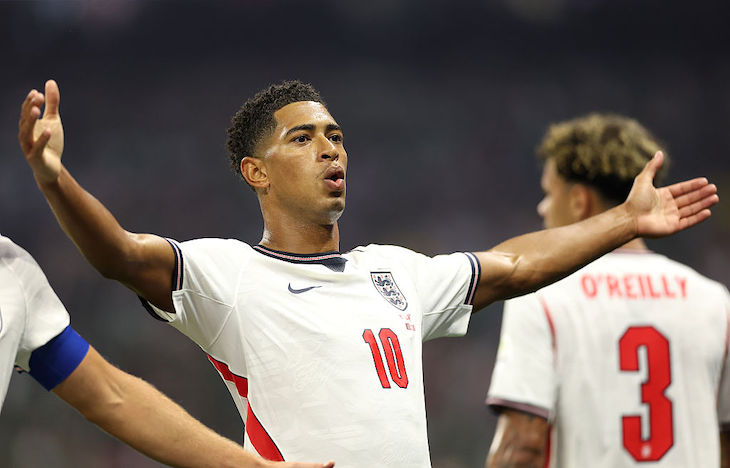
Jude Bellingham has been England’s star man at the World Cup. In England’s 3–2 victory over Mexico on Monday, the Real Madrid attacker not only scored two goals, but made vital blocks at key moments during the game. His performances throughout this tournament – including three Player of the Match awards, four goals and one assist – have been nothing short of world-class. Bellingham’s confidence, unapologetic attitude, swagger and unorthodox temperament have been infectious. But these qualities have not always been welcomed.
For some, Bellingham’s flash of frustration signalled ego and petulance
Last autumn, headlines fixated on Jude Bellingham’s touchline reaction to being substituted in a World Cup qualifier against Albania. Reactions were sharply polarised: for some, his flash of frustration signalled ego and petulance; for others, it showed a young, prodigiously talented man under immense pressure.
Ian Wright’s impassioned defence of Bellingham pushed the issue further, reigniting the long-running debate about racism in English football. But there is a deeper question worth asking: what did Bellingham’s expressive personality have to do with race?
We must begin with England’s scepticism towards “razzmatazz”: a long-standing social instinct that shapes everything from politics to football. English society has historically been defined less by explicit values than by sensibilities: understatedness, an aversion to spectacle, suspicion of charisma, and a quiet preference for competence over showmanship. This cultural code applies irrespective of race. Even white English stars who deviate from it – Paul Gascoigne, David Beckham, and more recently Jack Grealish – have been criticised for their flamboyance or emotional excess.

Criticism of English footballers for ‘showboating’ is clearly not confined to black players. But when non-white English players step outside cultural norms about how players should conduct themselves, the reaction shifts. Their behaviour is no longer seen as reflective of their own individual personalities, but as a sign of some broader cultural difference that does seem to relate to their skin colour. This is why the criticism aimed at Raheem Sterling, for being ‘flashy’, or for Marcus Rashford, over his behaviour on and off the pitch, was uncomfortable.
We see echoes of this with Jude Bellingham. He has been called “too American”, and an “ego-driven” showman, despite having no cultural or familial link to the United States.
Benjamin Disraeli offers a useful cultural analogy for this dynamic. In Victorian England, his flamboyance, melodrama and theatrical charisma were routinely interpreted as “Oriental” traits – even when those behaviours were simply personal quirks. Despite serving twice as prime minister and shaping the political imagination of his era, he was never regarded as fully normative; his Jewish heritage marked him as permanently adjacent to the English default. The pattern is clear: when someone is already perceived as ‘different’, any breach of the behavioural code is no longer seen as individual temperament, but as evidence of them being different.
Bellingham perhaps represents something culturally disorienting for England. He was born in Stourbridge, is fully British, English in heritage. Yet he is also a mixed-race, globally elite superstar: charismatic, expressive, aesthetically brilliant and unapologetically confident. His personality disrupts the older English ideal of the self-effacing star: the player who hides brilliance behind modesty. It is a new way of being English.
Yet Bellingham’s love for country cannot be denied. He recently said that hearing the national anthem reminds him of his late grandfather, and that their close relationship inspired his patriotism: a legacy renewed every time he belts out “God Save the King” in an England shirt. This captures what much of modern politics has struggled to put into words. There is constant talk of adhering to British or English values, but that language does not quite capture the relational inheritance that Jude Bellingham embodies every time he steps onto the pitch for the Three Lions.
England is still trying to work out who, or what, counts as a representation of its national character. The treatment of Bellingham exposes how strongly many still associate Englishness with a particular, downplayed emotional style. Yet the assumption – that Englishness is about being understated, or perhaps emotionally repressed – is losing cultural authority. The emerging face of Englishness is more hybrid, more expressive and more diverse than the older scripts allow. Jude Bellingham is playing a key role in the public imagination of what that might look like.





Comments