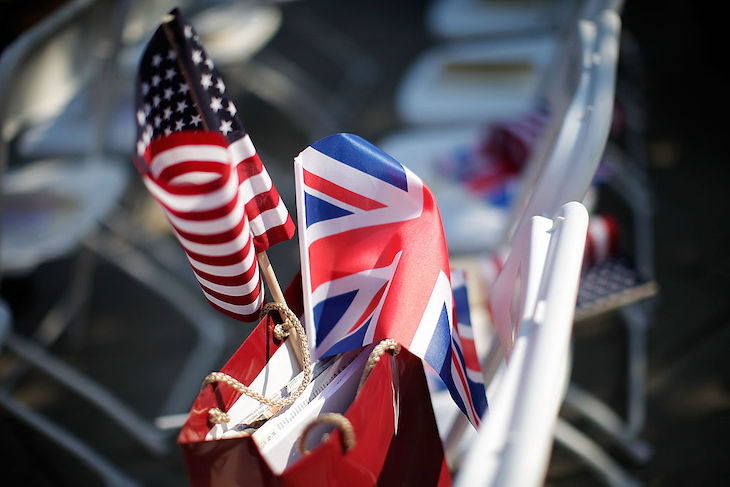
As the United States marks 250 years since the country’s unilateral declaration of independence, most of the 4 July celebrations have focused on the rebels. But Benjamin Franklin and Thomas Jefferson have hogged the limelight for too long. What about the American Loyalists, those who defied the intense social pressure and stayed loyal to the British Crown?
Loyalists were often bad writers who simply lacked the flair of radicals such as Thomas Paine
In popular imagination, the American Revolution was a contest between the Americans and the British. In reality, however, only about 40 per cent to 45 per cent of the colonial population joined the rebellion. Around a fifth stayed loyal. The rest backed neither side.
In many cases, the revolutionary divide split communities and families, with even some of the ‘Founding Fathers’ not being able to get all of their family on board with their radical politics. Benjamin Franklin’s son, William Franklin, is the most famous example. Imprisoned after refusing to support the rebellion as the Governor of New Jersey, he went on to lead the New York Loyalists after being freed as part of a prisoner exchange.
This ongoing support for Loyalism made sense, since there were good economic, constitutional, geopolitical, and religious reasons for many Americans to oppose separatism.
The independence project was radical, idealistic and, to many contemporaries, impractical. Many were concerned about the colonies’ ability to defend themselves without the Royal Navy’s support and the cost of paying for their own defence. It was also far from clear how such a state would function effectively. Many colonists were also loyal Anglicans who were reluctant, to say the least, to take up arms against the head of their Church.
So why did the Loyalists end up losing the battle of ideas? The answer is both trivial and profound: subpar political communications and intimidation by radicals.
The truth is that, for the most part, Loyalists were bad writers who simply lacked the flair and rhetorical style of radicals such as Thomas Paine. Most of us who had the misfortune of reading Paine’s Common Sense would be hard-pressed to deny his literary talents, talents that were needed to rally crowds and spread radical ideas. Conversely, the Loyalists wrote dry, legalistic, and at times, unreadable responses that failed to inspire their own supporters, let alone win back radicals.
James Chalmers’s Plain Truth was the first Loyalist response to Common Sense. Despite raising some valid concerns about the future of American security in the face of European empires, the pamphlet was overly verbose and academic. Chalmers, much like most Loyalists, clearly either ignored or failed to consider the colonial public’s appetite for sharp invective and scathing critique.
This is not to say that all Loyalist pamphlets were quite as bad as Chalmers’s. Published in late 1776, Charles Inglis’s The True Interest of America offered a much more readable and rhetorically infused criticism of Paine’s radicalism. Inglis’s background as an Anglican clergyman made him eminently suitable to confront Paine’s numerous theological and historical falsehoods.
Unfortunately, the result of his efforts was much the same as it had been of other loyalist pamphlets. Inglis’s point-by-point rebuttal to Common Sense sold poorly. It failed to influence the intellectual climate of the time. There is perhaps an eternal lesson here to all politicians who fail to grasp the importance of rhetoric and political myths.
However, the Loyalists’ inability to match radical rhetoric was not the only hurdle.
Revolutionary fervour led to the rise of violence, intimidation, and even outright censorship of the Loyalists, which made it difficult to circulate their pamphlets. In more radical cities, Loyalist literature was burned before it could even reach the public.
Despite all this pressure, numerous Loyalists showed steadfast commitment to their cause, keeping up the military and ideological struggle until Britain realised that she had no hope of quashing the rebellion. Chalmers, along with numerous other Loyalists, ended up serving in the British army during the Revolutionary War before being exiled to Britain.
Inglis, being an Anglican clergyman, also remained in America until the British withdrawal. Indeed, his resolve remained steadfast even in the face of intimidation and the presence of rebel troops, as he is said to have prayed for the King in the presence of George Washington in New York. After the war, he was exiled to Nova Scotia, a popular destination for Tory exiles, where he was followed by his entire congregation. Notably, Anglican ministers were very effective at keeping their flock loyal to the Crown, unlike Loyalist writers.
In retrospect, many Loyalist fears proved unfounded. While the process did not occur overnight, the new United States developed into a military, economic, and cultural superpower. However, based on what they knew at the time, it is hard not to admire the Loyalists’ intellectual rigour, as well as perseverance in the face of violence and intimidation. And, of course, their loyalty to their King. This 4 July, we should raise a toast to the Americans who stayed loyal.



Comments