
France kick off their World Cup campaign today against Senegal – and it seems almost inevitable that, win or lose, there will be ugly scenes on the streets of France during the tournament.
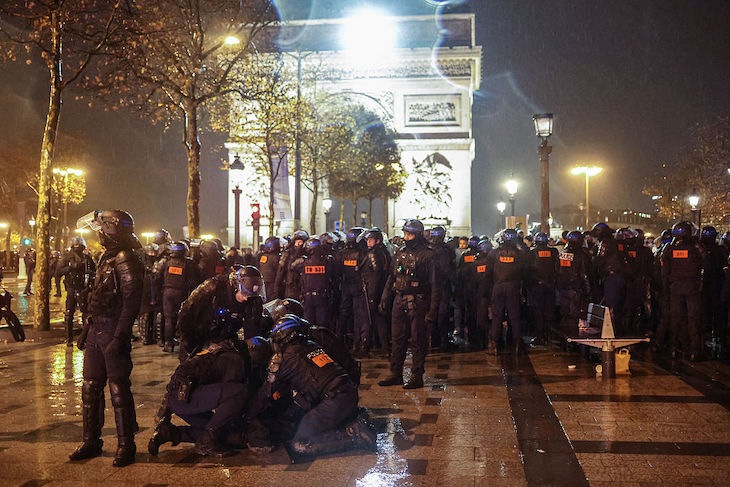
Shops were looted, cars burned and police officers attacked by mobs
In some cities, a curfew have been imposed. Clermont and Toulouse have ordered all unaccompanied under 16s to stay indoors between the hours of 10pm and 5am. The curfew applies only to certain matches, those judged to be ‘high-risk’; these include all France matches and some involving Morocco, Tunisia and Algeria.
Jean-Luc Moudenc, the centre-right mayor of Toulouse, justified the curfew by pointing to the “incidents during the Champions League final”. That was a reference to the widespread rioting across France after Paris Saint-Germain beat Arsenal last month to retain their European crown. Shops were looted, cars burned and police officers attacked by mobs of young men. Some were PSG fans; but many took advantage of the football to come to the city centre and pillage. The violence was a repetition of what unfolded in Paris twelve months earlier, when PSG beat Inter Milan to win their first Champions League title.
It was also similar to the mayhem that erupted during the 2022 World Cup. Some Moroccans celebrated their team’s progress to the semi-finals by running amok in French cities, vandalising trams and attacking police.
In Morocco itself there was no trouble, of course. No football fan would have dared incur the wrath of King Mohammed VI’s security forces. But in France it is different. Many of the Moroccan supporters were born and bred in France but it is still not the country they support. The same goes for many Algerian fans.

The last time France played Algeria was in Paris in 2001; the Algerian supporters jeered the Marseillaise and then invaded the pitch in the second-half, causing the match to be abandoned. The two countries haven’t met since.
The violence and disorder that have become synonymous with football in France is one reason the sport’s appeal has waned in recent years; in 2025, the most watched sports event on television was France’s defeat of Scotland in the Six Nations rugby championship.
Increasingly, rugby is the sport for ‘Old France’, that is to say traditional France. Football, on the other hand, is representative of what Jean-Luc Mélenchon hails as ‘New France’. The leader of the far-left la France Insoumise (LFI) is the politician of choice for those of an immigrant background; in the 2022 presidential election, he received 69 per cent of the Muslim vote.
In March’s local elections, LFI scored their biggest success in winning the town of Saint-Denis, to the north of Paris. The new mayor, Bally Bagayoko, declared it a victory for ‘the New France’, which he says embodies ‘the pride that is France – a pride we applaud on football fields’.
With a population of 150,000, Saint-Denis is the largest town in the department of Seine-Saint-Denis. This department is the heart of French football; it hosts the national stadium – the Stade de France – and five of France’s 26 players at the World Cup grew up in Seine-Saint-Denis.
The most famous is Kylian Mbappé, the captain of the side and one of the world’s best players. Another proud son of Seine-Saint-Denis is Jordan Bardella, the president of Marine Le Pen’s National Rally party. Bardella and Mbappé are not friends. In 2024, Mbappé was one of several French players from an ethnic minority background who urged voters to reject the National Rally in the legislative elections. Last month, he told Vanity Fair why he is opposed to Le Pen’s party: ‘It affects me personally; I know what it means and what consequences it could have for my country when people like them come to power.’
Mbappé’s remarks angered Bardella, who mocked Mbappé – a millionaire who plays for Real Madrid – for moving to Spain and failing to win a trophy.
Marine Le Pen’s father, Jean-Marie, criticised the France football squad for being too diverse in the 1990s. In fact, the squad back then reflected the cosmopolitan nature of French society; players such as Zinedine Zidane (Algerian parents), Patrick Vieira (born in Senegal) and Didier Deschamps.
Deschamps is the coach of the current France side, a team dominated by players of African descent. It has been the case for a number of years. When France won the World Cup in 2018, the US-based South African comedian Trevor Noah joked that ‘Africa won the World Cup’.
Gérard Araud, France’s ambassador to the USA, admonished Noah, saying of the French players: ‘They were educated in France, they learned to play soccer in France, and they are French citizens. They are proud of their country, France.’
Since then, the French football team has become politicised. Players air their political views and politicians react accordingly. LFI embrace the team because, in their eyes, they represent their vision of a ‘New France’; Mélenchon is selling a French football shirt with his name on the back above the number 27: the year of the presidential election that he hopes to win.
For right-wing politicians such as Eric Zemmour, the French team ‘represents the banlieues of Arab-Muslim immigration’. Some of these banlieues have set up ‘fan zones’ for the World Cup, so that locals can watch the matches on a giant screen. There won’t be any fan zones in the centre of Paris; the city is still recovering from the PSG riots.
The fear in France is that there will be more violence in the weeks to come. A recent leaked memo from the National Directorate of Public Security warned of the likelihood of disorder from ‘foreign communities’ in France during the tournament.
For many troublemakers, the football is just an excuse. The real reason they riot is to show their contempt for the Republic.



Comments