
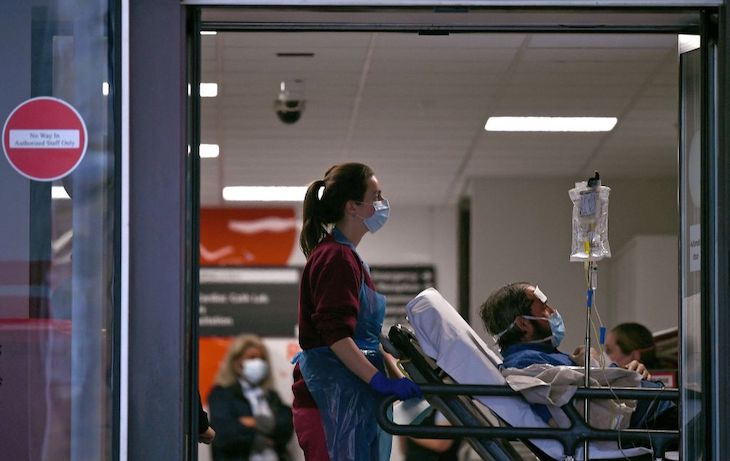
‘Corridor care’ should be an oxymoron, but is instead such a feature of the NHS now that nearly 3,000 people a day found themselves being treated in corridors, cupboards or even car parks last month. New figures show that 2,241 patients a day on average who had corridor care while in A&E, with a further 669 being cared for in cupboards, toilets and car parks. These are the latest official figures which show how the NHS isn’t working – but earlier in the week the Royal College of Emergency Medicine came up with its own estimate of how many people were dying unnecessarily as a result of long A&E waits: 1,300 a month.
A&E has been broken for at least a decade now
Both figures provoked interest but not outrage for the simple reason that they’re not surprising or particularly new: A&E has been broken for at least a decade now. The RCEM’s analysis suggests that in that time, the excess deaths have risen tenfold, from 1,657 in 2015 to 15,860 in 2025. It used a study of more than five million patients to develop this estimate.
Whether or not politicians agree with the figures – and they often quibble with these kinds of estimates from the RCEM – there is a bigger problem here, one identified by RCEM President Ian Higginson. He said:
‘To make things worse we are being asked to focus on the least sick patients to try to marginally improve headline statistics, rather than on those who need our services the most.’
The problems lie outside A&E, in the form of ‘exit block’ – meaning patients can’t get into other wards in the hospital because they too are full – and that’s often in turn caused by a failure to find safe social care placements to discharge a patient into.
But gaming the system, as so often happens in A&E, will make the stats look better without changing the reality. So too will the solution that some hospitals have come up with which is that they ‘don’t do corridor care’. Talk to any ambulance worker who regularly takes patients to any of these trusts, and they’ll point out that this just means they’re waiting on the tarmac with people for hours, often the entire length of their shifts. That isn’t solving the A&E crisis either.
A&E is often seen as the shop window of the health service, and figures around its performance one of the vital signs that the NHS is functioning properly. But the attention at the moment is focused on the wrong vital signs: just because a hospital isn’t doing as much corridor care as another, doesn’t mean the problem has been solved at all.






Comments