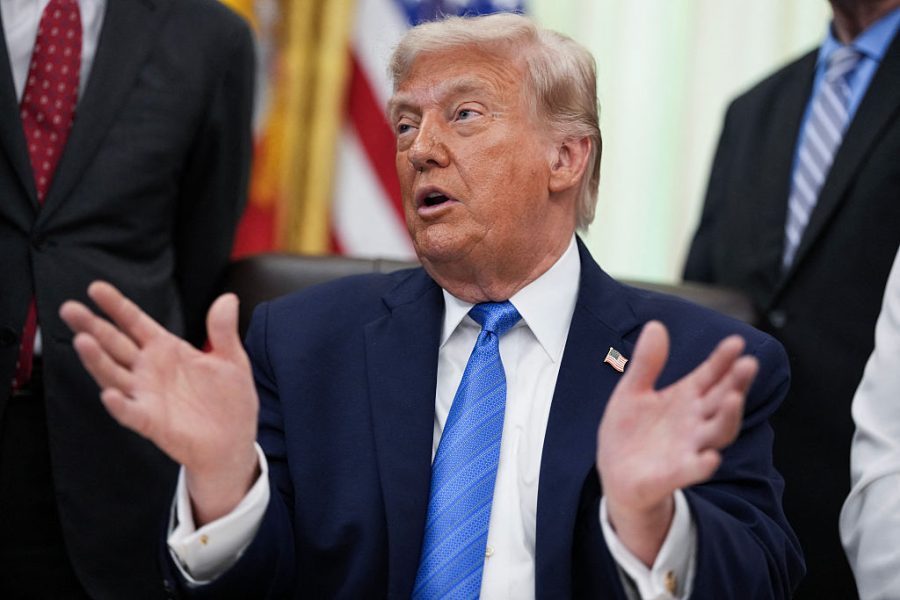
In a now-familiar pattern, US President Donald Trump announced an imminent escalation in the stand-off with Iran on Thursday – before reversing course a few hours later in the face of self-declared diplomatic progress. In a post at his Truth Social page that afternoon, the President wrote that ‘at some point in the not-too-distant future, we will be taking Kharg Island and other oil infrastructure points and assume total control of their Oil and Gas Markets’. Kharg Island is Iran’s primary oil export hub in the Persian Gulf. It handles around 90 per cent of Tehran’s crude oil exports.
The President appeared to half walk this statement back almost immediately after making it. In a call with Fox News later that day, he said that his preference had in fact always been for taking the island but that he was not sure if ‘America has the stomach for it’. Then later in the day, he reversed course entirely, announcing that he had cancelled air operations scheduled against Iran for that night because a deal had been reached between the US and Iran. The deal had been approved ‘both in concept and great detail’ by all involved parties, he wrote.
The place, very clearly, where Trump feels comfortable is where deals are made
Media channels associated with Iran’s Islamic Revolutionary Guards Corps (IRGC) responded to the announcement with derision. The Tasnim news agency wrote that Trump had already claimed ’38 times’ in the last two months that a deal had been reached and recommended that unless Iran also announces an agreement, this declaration should be treated as similar to previous ones. Fars News, more prosaically, noted that Iranian sources suggested that no agreement had been reached, while holding out hope that agreement might be imminent.
Israel Channel 12 News, meanwhile, quoted Israeli sources as confirming that Jerusalem was not part of the negotiating process and is not party to the agreement. Prime Minister Benjamin Netanyahu’s office released a statement saying that Israel appreciates President Trump’s commitment to reaching a ceasefire that will:

Include the removal of enriched nuclear material, the dismantling of enrichment infrastructure, limits on missile production, and an end to Iran’s support for its terrorist proxies in the region.
There are no indications that the deal Trump claims has been reached contains any provisions regarding the Iranian missile programme or its strategy of supporting Islamist proxies to foment instability and build power across the Middle East. Indeed, all available evidence suggests that the US has abandoned any hope of achievement on these two files, and is concentrating on seeking a breakthrough on the nuclear issue alone, in return for various concessions to Tehran, and the mutually agreed reopening of the Strait of Hormuz.
It remains to be seen what exactly the proposed memorandum of understanding contains. Available information suggests that it includes as its central point the reopening of Hormuz and a 60-day negotiating process on all remaining issues. What all this to-ing and fro-ing indicates is that the US administration has no real plan for extricating itself from the dilemma in which it finds itself mired.
On the one hand, as Trump’s statements regarding Kharg reflect, that, as the overwhelmingly stronger power in conventional terms, the US has the capacity both to reopen Hormuz by force and to cut off Iran’s remaining lifeline for the export of its oil. On the other hand, there is little public support for an expansion of the war, and none at all for the prospect of coffins coming home which the ground commitment necessary to take Kharg would surely involve. Concurrently, the Iranian regime appears disinclined to award Trump the appearance of achievement or even an honourable exit from this dilemma.
It is difficult not to draw the conclusion from all this that Trump’s administration entered the war on 28 February without a proper analysis of what the Iranian regime was, or of its strengths and weaknesses. The President is correct, as he often notes, that Iran has little left by way of a navy. ‘Their navy is totally gone – 100 per cent,’ he told Fox News recently. ‘The air force is totally gone – 100 per cent.’
The problem with this is that the particular strengths possessed by the Iranian regime are not located in the field of conventional air or sea power. The regime in Tehran is an Islamist, ideological gathering, engaged in a ‘forever war’ of its own – of society against society, rather than army against army. Its practical successes, both in retaining power in Iran and in building influence and strength from the Gulf of Aden to the Mediterranean, derive from its ability to mobilise (mainly but not only) Shia Muslim loyalties and commitments and to use these as the engine for political and paramilitary mobilisation.
It is likely that nothing like this really exists in Trump’s world. One imagines him and those around him dismissing such issues as unreal or unimportant, assuming that in the end, everyone’s motives are similar, everything is for sale and a deal can always be reached. His remarks this week following exchanges of fire between Israel and Iran that ‘each of them had their fun’ but that now it was time to ‘get back to the table and make a deal’ appear redolent of such a view.
Trump, caricatured before his presidency as a warmonger, is nothing of the kind. The place, very clearly, where he feels comfortable is where deals are made. And in particular, where deals reflecting the greater physical strength of his side are concluded, with the other side coming to understand the benefits of accepting the power differential and understanding how it can gain from it.
The problem is that the Islamic Republic of Iran is not an entity which is prepared to play this role. The US could force it back. But the political support for the inevitably costly means required to do this isn’t there. Hence the present shenanigans.
Israel, too, for a long time failed to understand the nature, depth and seriousness of the Islamist project raised against it and intended to result in its destruction. Neither the security establishment, for all its technical skills, nor the current prime minister, for all his authentic intellectual depth and interest in history and ideas, properly grasped the nature of this challenge. The result were the policies that made possible the massacre of 7 October 2023. There has since been something of a course correction, though the costs of engaging Iran and its allies, the sacrifice required, and the tenacity which will be required to defeat it long-term are all issues with which Israeli society is still grappling.
In any case, the current curious dance-with-itself diplomacy of Trump’s administration shows the extent to which the seriousness of the challenge has not yet been internalised in the west. The responses of British officials, of course, such as Foreign Secretary Yvette Cooper’s call this week for ‘both sides’ to ‘show restraint and de-escalate immediately’, and for ‘negotiations…towards the lasting settlement that we all need, for peace and stability in the region’ serve to add an additional inadvertently comic element to the picture.




Comments