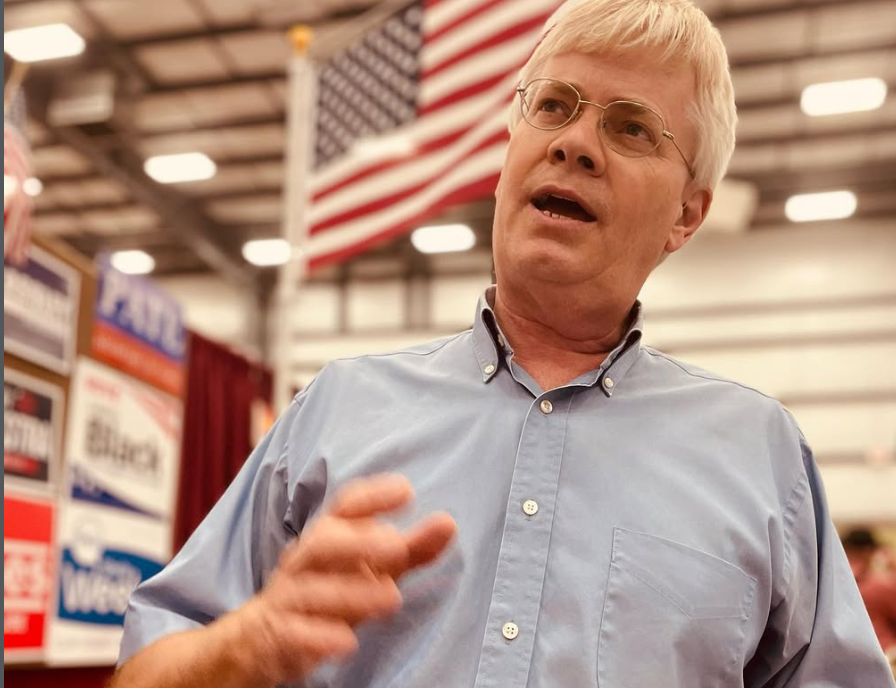
I’ve long regarded Iowa’s Jeff Taylor as one of the most interesting politicians in America – and that was before I knew that he had once died and come back to life.
Jeff, 65, is a political science professor at Dordt University and a two-term state senator from a rural district in northwest Iowa. He’s written books on Bob Dylan, William Jennings Bryan, the decentralist tradition in American politics and other worthy American subjects that are of no demonstrable interest to, say, Marco Rubio or Hakeem Jeffries. He is thoughtful, mild-mannered, affably learned and willing to make radical breaks with the corporate stooges of the Republican establishment. And now he has written a book about the day he died.
The driver turned off the siren and slowed down. The boy was dead for between 30 and 45 minutes
I’ve heard of politicians coming back from the dead – Richard Nixon after his 1962 loss in the California gubernatorial race comes to mind – but this is a resurrection of an altogether more literal sort.
In May 1965, when Jeff was four years old, he came down with what appeared to be a bad case of the flu. Bad turned to worse, and soon the boy was motionless, unresponsive and running a fever of 105 degrees. The hospital in Spencer, Iowa, could do nothing for the comatose child, who was eventually diagnosed with the often-fatal mumps encephalitis. He was rushed – ominously, in a hearse turned ambulance flying at more than 100 miles per hour – to the hospital in Sioux City.
En route, Jeff stopped breathing. The nurse wept. The ambulance driver wept. Jeff’s mother Judy, furious and desperate, shouted over and again, “I can’t stand this!” Until a kindly and comforting voice whispered into her ear, “Yes, Judy, you can and you will. For I love Jeff as you love Jeff. And I will care for Jeff as you have cared for him.” Feeling as if “someone poured warm liquid over her,” Judy replied: “All right, Lord, I give Jeff to You.”

A sense of calm descended upon the hearse. Jeff had no heartbeat. The nurse disconnected the oxygen and IV. The driver turned off the siren and slowed down. The boy was dead for between 30 and 45 minutes. Jeff was DOA at the Sioux City hospital. The physician, after declaring the boy dead, offered his condolences. And then a nurse detected a twitch in the corpse. Astonishing! But the doctor tamped Mrs. Taylor’s hope. Even if the boy had somehow come back, the duration of his oxygen deprivation meant that he would be “a vegetable.”
But he was not. Jeff made a full recovery, which the Sioux City doctor, through sobs, called “a true miracle from God.”
A Beautiful Day to Die is Taylor’s attempt – as a historian and “irenic evangelical indebted to a variety of Christian traditions, including Quakerism and Kuyperianism” – to investigate his own death, relying upon journal entries, hospital records and interviews with witnesses.
Taylor’s wife Shirley feared that this book might “give off kooky religious zealot vibes” and even harm his political career. Her words “gave me pause,” Senator Taylor concedes, “because as a politician – principled but still a politician – I possess a certain amount of political ambition and I care, on a personal level, about my reputation. But I felt I could write the book in such a way that my story and I would not come across as nutty or embarrassing. We had a family meeting when my agent found a publisher,” and Shirley gave her blessing.
As a child, Jeff “had no fear of death.” I ask if this is still the case. “Not as much!” he says. “Now that I’m older, and I watched my father die from illness last summer, mortality is something I can’t help but think about on occasion. I’m a Christian believer but I’ll admit that sometimes the thought crosses my mind, ‘What if I’m wrong and there’s no life after death? What if there’s nothing?’ I can’t keep that thought from arising occasionally even though I know, deep down, that it goes against both faith and reason. My story, as well as lots of evidence found in Scripture, help to reassure me when this doubt presents itself. Maybe my book will play a role in giving a little confidence and consolation to others who read it.”
Young Jeff believed that he had been saved for some great purpose – maybe even to become president. In adulthood, those grand worldly ambitions have been refined. Rather than a destiny of “fame and power,” he says, maybe his work is in “seemingly small social interactions that have benefited people and advanced the Kingdom of God in some ways.” Instead of “something showy and spectacular,” he now prefers “the Dorothy Day approach to improving the world.”
Dorothy called it “the way of love,” and boy do we ever need a rebirth of that.





Comments