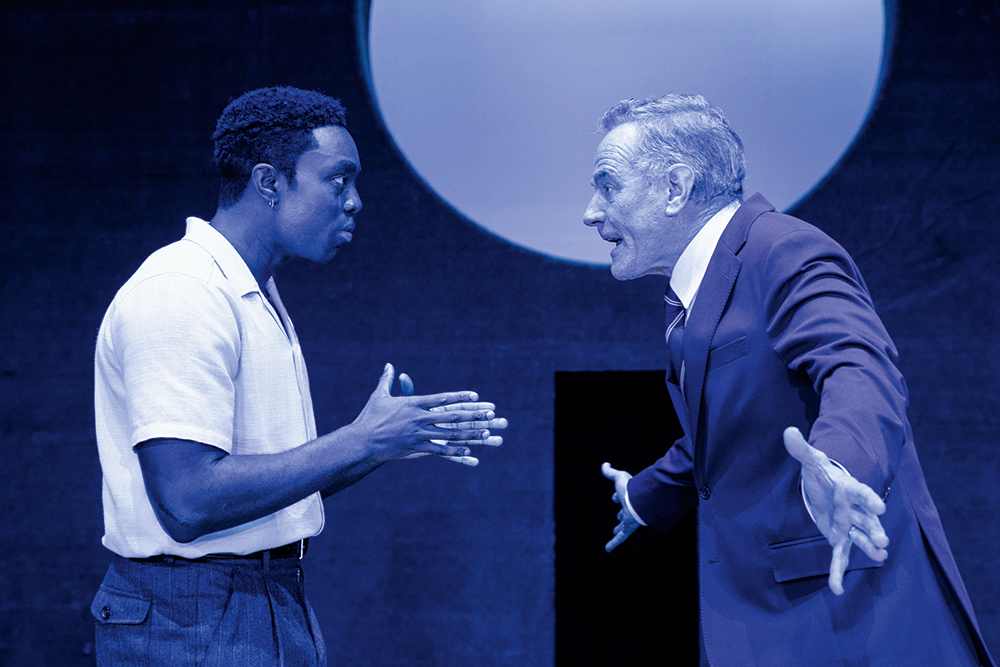

Arthur Miller may have died two decades ago, but America’s answer to Euripides and Sophocles is having a moment. The great tragedian’s plays have been revived, and revived again, ever since he first broke through in 1947 with All My Sons, but even by his standards, the new productions just keep on coming. His most famous play, Death of a Salesman, has opened on Broadway to rave reviews and Tony nominations galore, with a cast-against-type Nathan Lane as the doomed Willy Loman and Laurie Metcalf as his loyal wife Linda. Across the pond, Bryan Cranston has recently finished an equally acclaimed run as Joe Keller in All My Sons.
There are high-profile new productions of Death of a Salesman planned for London’s National Theatre (with Paul Mescal) and Stratford, Ontario’s Shakespeare festival, and no fewer than nine international stagings of The Crucible taking place this year. Other, more obscure, Miller plays, from The Price to Broken Glass – which recently played at the Young Vic in London, speaking volumes about his transatlantic appeal – are receiving new productions. A postmodern spin on The Crucible, John Proctor is the Villain, had a lauded run in the West End after a similarly successful spell on Broadway. And Miller’s daughter, Rebecca, is herself an accomplished filmmaker whose recent documentary on Martin Scorsese, Mr. Scorsese, attracted rave reviews, suggesting that creative genius has passed down the generations.
Miller’s drama is revived because it dares to say unpalatable things about the American dream
There is probably no 20th-century American playwright who has the same standing as Miller. The once-lauded likes of Eugene O’Neill, Tennessee Williams and Edward Albee produced their own masterpieces, but none of them has the same universality as the man who was, notoriously, Marilyn Monroe’s third husband. The reason his dramas are revived and revived is that they dare to say unpalatable things about the postwar American dream, whether explicitly, in the case of All My Sons, or implicitly, as with Death of a Salesman.
Set against this, Miller’s canon contains as many flops, disappointments and near-misses as any of his contemporaries. It is highly unlikely that the likes of Mr. Peters’ Connections, The Creation of the World and Other Business or Resurrection Blues will be revived any time soon. The last two were egregious flops, with the latter failing completely despite a 2006 London premiere that was directed by Robert Altman at the Old Vic – then under the artistic directorship of a pre-disgrace Kevin Spacey – and with a cast including Neve Campbell and Matthew Modine. One critic said of it: “There is often a thrilling wildness and freedom in the late work of great artists. One thinks of Beethoven’s quartets, Yeats’s poems, Rembrandt’s final self-portrait. And then one contemplates Arthur Miller’s Resurrection Blues – and shudders,” before reflecting: “It is wild and free all right, but far from being thrilling it is the most terrible embarrassment. Who could have possibly thought it a kindness to stage a play that can only do grievous damage to the dramatist’s posthumous reputation?”
In the event, the critic need not have worried. Miller, who died the year before the play was staged, was far beyond the jurisdiction of even the New York Times’s notoriously hard-to-please theater reviewer, and the incoherent jumble of ideas and jokes that an ailing Altman was unable to corral into compelling drama has now been mostly forgotten, although a later staging in Chicago in 2010 restored a semblance of honor to the play’s reputation.
Still, as the play’s Wikipedia page dryly notes, “Miller was not known for his humor.” This is not wholly fair or accurate. The reason Resurrection Blues failed, but the Lane-Metcalf production of Death of a Salesman has succeeded so admirably, is not because the playwright was only able to write in dark registers of Sturm und Drang tragedy, but because he was able to mix naturalism, surrealism and something primal to captivating and consistently surprising effect.

The original title of Salesman was The Inside of His Head and although it was changed, the sense of interiority remains. Through a series of interlocking flashbacks, fantasy scenes and straightforward realism, Miller manages to take the sexagenarian salesman Loman and turn him into a figure who is somewhere between pitiable and pitiful. When Willy declares that “a man is not a piece of fruit” as his embarrassed employer refuses to give him the desk job that he so desperately craves, he is both articulating a universal truth – “you can’t eat the orange and throw the peel away” – and is blind to his own logic. In order to eat the orange, you have to throw the peel away.
And that, in turn, is why Loman, for all his plans and schemes, is doomed; he has an old-fashioned belief in rightful treatment and being rewarded for hard work, which never materializes. Even his suicide, done in the conviction that his family will benefit from a life insurance payout, is in vain; his sparsely attended funeral shows how little impact he has had on the world. But this is in keeping with Miller’s tragic resolutions for his male protagonists, who, more often than not, end up killing themselves or at least allowing themselves to be killed, in fits of guilt, panic or misguided righteousness. When John Proctor is hanged at the end of The Crucible, after refusing to allow his false confession to be publicly displayed, his wife Elizabeth states simply: “He have his goodness now. God forbid that I should take it from him.” The audience might have more sympathy with the Reverend Hale, who asks her, “What profit him to bleed? Shall the dust praise him? Shall the worms declare his truth?”
Such questions might be asked of Miller, too. As a public figure, he is best remembered for his acrimonious five-year marriage to Monroe, which he later dispassionately explored in one of his most underrated plays, 1964’s After the Fall. As a card-carrying leftist, he deplored what he saw as the McCarthyite witch hunts that later inspired The Crucible, but also saw his plays banned in the Soviet Union because of his supposed sympathy with other dissident playwrights. (Amusingly, a Beijing production of Death of a Salesman, directed by Miller himself, was a considerable hit in the early 1980s, when it was read as a coruscating satire on American imperialism and capitalist values.) He was not always consistent in the causes he adopted, either. He was happy to mine his private life for material – and wrote extensively about his marriage to Monroe in his memoir Timebends – but then refused to support Salman Rushdie when he was forced into hiding by the fatwa that was declared after he wrote The Satanic Verses.
Miller was, in other words, a fascinating, contradictory figure who wrote fascinating, contradictory plays. Even his failures are compelling, not because they are unjustly overlooked works of great drama (they are not) but because they are from the author of Death of a Salesman and A View from the Bridge, who seemingly decided that, having made his name and reputation relatively young, he was at liberty to pursue whatever other angles he chose for the rest of his life.
Miller was a fascinating, contradictory figure who wrote fascinating, contradictory plays
If his enduring plays stand for anything, however, it is a mixture of anger toward American values and a deep residual respect for the opportunities that the country gave a kid from Harlem who had to work his way through university as a laboratory assistant and dishwasher to pay his tuition. While we can predict what his attitude would have been toward Donald Trump and the MAGA movement, he is also one of the few playwrights who could have captured the President as a multifaceted player, devoid of caricature, refusing to judge him in the reductive and basic fashion of most living dramatists.
It is impossible to imagine a contemporary Arthur Miller, because these days writers worry about whether their plays tick enough boxes when it comes to diversity or social issues. They thereby neglect the heartfelt through line of tragedy that their forefather’s writing is imbued with.
Those who have seen the latest Death of a Salesman on Broadway have been full of praise for its bold staging, dominated by the Chevrolet that Willy will eventually take his own life in, and for its vivid and fresh performances. Yet at a time when America seems as uncertain and rudderless as it has ever been, we still enjoy look to the Loman family, vainly pursuing a dream based on illusion and groundlessness.
Miller once commented in an interview that “whoever is writing in the United States is using the American Dream as an ironical pole of his story.” It is this ironical pole – bent and misshapen though it often is – that lies at the heart of his drama and which, in all its forms, makes this playwright the quintessential American commentator, both of his own time and of ours.





Comments