
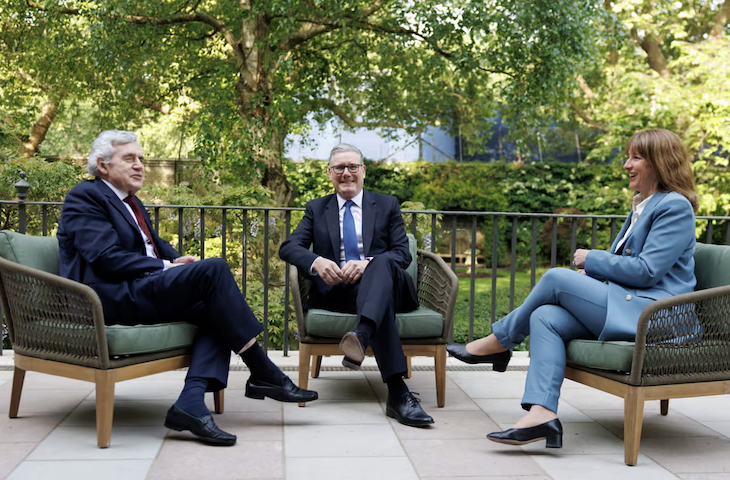
When Keir Starmer needed advice about clinging to power in Downing Street, there was only one person to call. Gordon Brown knows all about hiding behind the net curtains of No. 10 as electoral reality sets in. As Labour fell to a historic defeat at the local elections, the Prime Minister decided that what voters wanted was a special envoy on global finance – and that a Labour prime minister who never won an election was the man for the job.
Brown has been keeping himself busy doing what he does best: settling scores
The appointment is the latest act in Gordon Brown’s rather happy post-prime ministerial life. Brown has been keeping himself busy doing what he does best: settling scores. Every now and then, his great clunking fist descends from the clouds to take someone out. In recent months, his targets have been dead (Jeffrey Epstein) or dying on their feet (Andrew Mountbatten Windsor; Peter Mandelson). But there’s only so much satisfaction to be gained from punching down. Brown wants to be remembered as the left’s John Major; a Grown-up Elder Statesman who, in that famous slip of the tongue of his at PMQs, ‘saved the world’. His return to Downing Street won’t save Starmer, of course, but it’s just the tonic for Gordon.
The trouble is that Brown’s attempt to rehabilitate himself is hard to swallow. At best, his years in Downing Street were a wasted opportunity, spent fighting his boss Tony Blair for the keys to No. 10 only to squander the opportunity when it finally came; at worst, the decisions he took set Britain up for failure and are a key reason why we’re in such a mess.
One of Britain’s biggest problems today is its ballooning welfare bill, which will reach £63 billion by 2028. Millions of people are stuck in a welfare trap, condemned to live off a state that can barely afford to sustain them. The Tories must shoulder some of the blame for failing to address this crisis, but there is no doubt that Brown was the architect of welfare Britain as we know it today. Frank Field was right when he said that ‘it was Gordon Brown’s unthinkable expansion of the tax credits system that created the welfare monster we have today.’
Delaying today’s problems for tomorrow was a speciality of Brown’s. In his first Budget as chancellor in 1997, Brown abolished tax credits on dividends for pension funds. It was a good day for the taxpayer but a terrible one for future generations. Pensioners paid – and are paying – a heavy price for that decision. One estimate puts the total loss in growth in funds that would have accrued from reinvested dividends at £250 billion. Thanks, Gordon.
We’re paying the price for New Labour today in other ways, too. Brown aggressively expanded Private Finance Initiative (PFI), using borrowed cash to pay for the building of public infrastructure like schools and hospitals. The very purpose of PFI was to keep borrowing off the government’s balance sheet. But this meant postponing the problem of paying for another day.
Today, many of the PFI-backed buildings opened under Labour are in a terrible state. My local hospital, the Princess Royal University Hospital, in Farnborough, was one such project funded by PFI. Nowadays, it is a place to avoid; a stuffy, decrepit building where old folk go to die, rather than get better.
Then, of course, there’s the gold that was sold. Between 1999 and 2002, Brown flogged 395 tonnes of UK gold reserves – roughly half the national holding – at near 20-year low prices. Brown’s bottom is the name given to the gold market at the time. ‘It was the bottom of gold’s two-decade bear market,’ says Adrian Ash, director of research at investment firm BullionVault. The Treasury got an average price of $275 an ounce for its gold; by 2011, the price reached more than $1,900 an ounce; today it’s around $4,000. Thanks, Gordon.
Peter Mandelson’s return is another thing we can thank Brown for. In the wake of the latest Mandy scandal surrounding his links to Epstein, Brown said he took personal responsibility for bringing Mandelson back into the fold. Those words count for little 16 years on when the Dark Lord is down and out for the last time. Back in 2008, when Brown gave Mandelson the political resurrection which he appears to have used feathering his own nest, the then PM said he needed ‘serious people for serious times’. While the latest revelations about Mandelson are shocking, even back then it was plain to see Mandelson was trouble. Brown can hardly plead ignorance about the man he resurrected.
Brown’s supporters point to his success in riding out the 2008 financial crisis. It’s true that, as PM, he reacted swiftly to shore things up; but his loose fiscal policies – and willingness to splash other people’s cash in the good times – left Britain in a worst shape than it might have been going into the crash. Let’s not forget, too, that while Brown lurched into action when Lehman Brothers toppled, he failed to see the crash coming.
Rather than face up to the damage he did, Brown prefers to go on the attack
His response to the crash also gets less scrutiny that it deserves: we have Brown to thank for setting the precedent of nationalising risk and privatising profits by bailing out the banks. The quantitive easing he pioneered also stored up trouble for Britain. So, too, did his decision to switch the inflation measurement from RPI (Retail Prices Index) to CPI (Consumer Prices Index). This flick of the pen made life easier for Brown. But by removing housing costs from the inflation figures, it left the Bank of England powerless to use interest rates to control soaring house prices. The result has been a generation of young people unable to afford a house.
Rather than face up to the damage he did, Brown prefers to go on the attack. In recent months, the New Statesman has been his vehicle of choice for his various interventions into public life. The magazine has responded to Brown’s overtures by lauding him. ‘The elder statesman could be enjoying a lucrative semi-retirement on the speaking circuit. Instead, he’s campaigning for the downtrodden,’ writes Kevin Maguire. Surely, though, the time for Brown to campaign for the downtrodden was when he was prime minister? Maguire goes on to praise Brown for eschewing the lucrative engagements that Tony Blair typically says yes to. But Brown choosing a different path to Blair doesn’t mean that he is somehow noble; he probably wants to put as much distance between himself and his political rival as possible – just like the old days when they used to scrap it out in Downing Street.
Brown was the architect of welfare Britain as we know it today
Anyway, like Blair, Brown is no stranger to speaking on the international circuit – including in Saudi Arabia and to a Russian bank. For that latter engagement, the office run by former Prime Minister Gordon Brown was paid more than £100,000. The ex-Labour leader declared a fee of £124,494 for a speech he gave to Sberbank and another corporate giant, Troika Diolog, in February 2012. Sberbank, which was the largest financial institution in Russia, was sanctioned by the US Treasury department in 2022. When The Spectator’s Steerpike column reported that news, Brown saw red: he complained to Ipso, the press regulator. He particularly didn’t like the pay off – ‘Kerching!’ – which referenced the fee received by the office bearing his name. Now that Brown moonlights as a journalist – a kind of gamekeeper-turned-poacher – would he still be as robust in facing down a publication that was reporting the truth?
Brown’s go-to line then, as it is now, is that the money went to Office of Gordon and Sarah Brown. So what is the Office of Gordon and Sarah Brown? The organisation has certainly given plenty to charity, but in bearing his name it’s impossible to escape another purpose of this outfit: it’s a PR operation with a simple message: Gordon Brown isn’t like those other horrible prime ministers. Its website proudly informs us that ‘Reducing child poverty was one of the many achievements of the previous Labour Government’. It also informs us that ‘Gordon renounced the non-contributory Prime Ministerial pension’ he was owed. Much has been made, too, of the fact that he won’t be paid for his latest appointment under Starmer.
But that doesn’t mean that Brown isn’t still costing taxpayers money: as a former prime minister, he is entitled to lifelong police protection. He is also eligible for the Public Duty Costs Allowance, money to assist former prime ministers still active in public life. The limit is currently set at £115,000 a year. Only one former PM, Rishi Sunak, doesn’t claim a penny. But Brown certainly does: in 2023-24, the Office of Gordon and Sarah Brown received £114,788; in 2024-25, his office got £114,644. Perhaps this is a small price to pay for a man whom the Office for Gordon and Sarah Brown pompously tells us ‘is widely credited with preventing a second Great Depression’.



Comments