It has been one of the core activities of the jobbing reporter since newspapers came into being. The most direct means of interrogating the subject of any potential story has always been to find out where they live – or, failing that, work – and then approach them there for comment. This is what is known, to use the succinct industry term, as ‘a door knock’.
Villains, heroes, ‘pantsdown’ politicians: all fair game for a door knock. But technology has changed this essential journalistic function
It became and remained a staple activity of news reporting because it was a shortcut affording immediate and direct access to almost any potential source (barring those who had staff to open their doors for them). Admittedly those who carried out the knocks – hacks – were unloved or even despised but with the element of surprise they could often secure a key quote – and might every now and then even be welcomed in for a full interview.
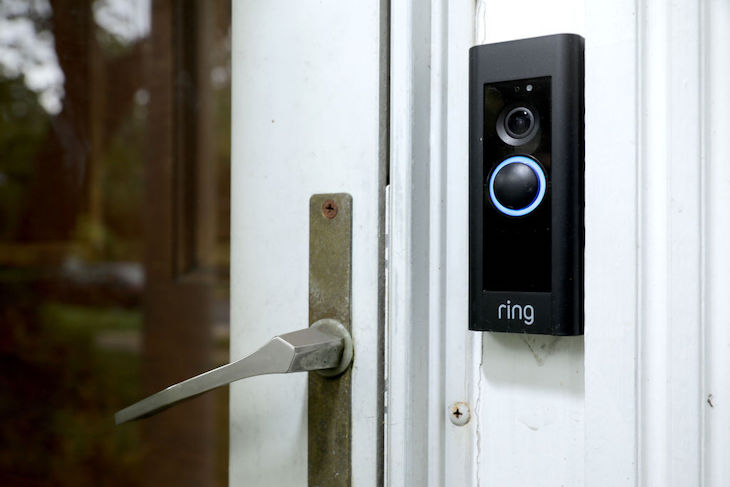
Villains, love cheats, heroes, ‘pantsdown’ politicians: all fair game for a door knock. But lately, technology has begun to change the nature of this most essential journalistic function: the widespread adoption of the Ring doorbell has altered the dynamic.
Ring doorbells allow people to see who is at their door without having to open it, which in turn means there is no longer that critical moment when the unexpected hack and their subject come face to face and the former has a brief chance to spit out a question.
The first inkling of a problem came not from journalists but from the Office for National Statistics – who warned after the last census, in 2021, that in some areas people with the video doorbell feature linked to their phone simply won’t open the door. As The Spectator reported earlier this year ‘some…flat refusals come because of Ring doorbells…’

It seems inevitable that this will impact journalism in a similar way: after all, members of our profession are invariably more unpopular than, say, a census officer, or indeed almost any other profession.
I did my first doorknock in 1993 (TV presenter Michael Aspel – marital split) and dozens more followed. But I’m still a comparative novice, having spent most of my newspaper career as an editor at a desk rather than, as it’s known, on the road. And from that perspective, as a desk man, I came to appreciate how some reporters are consistently better than others at getting a result from a doorknock rather than being told in no uncertain terms to go away.
These superior reporters are what I think of as ‘doorstep artists’. Something about their manner seems to consistently encourage candour. But no doorstep artist can work their magic in an exchange with a sceptical person viewing them through the fish eye of their doorbell camera via their phone screen, rather than in the flesh. The odds of success are immediately diminished.
This point was brought home recently when I tried to commission a stringer (i.e. an overseas reporter for hire) in South Africa to ‘knock a couple of doors’, only to be told that this is simply impossible there as so many live in secure compounds with video doorbells that turning up in person without an appointment is seen as practically an act of aggression.
Every news hack will have done door knocks. Most will have a story or two, as I was reminded during a recent reminiscing session with a bunch of fellow veteran hacks. My favourite of these concerned a chronic agoraphobic who had overcome his grave fear of leaving his front door for the first time in months in order to heroically save a neighbour from death by fire. The local paper sent a reporter to interview the agoraphobe about his heroism, but when the reporter called the agoraphobe had popped out.
The story of my own I have repeated most often was about knocking the late Sinead O’Connor. In fact, immediately after her death in 2023, I even told it here in The Spectator. It reflects better on her than me, it must be said. Similarly my friend and colleague Mark Solomons wheeled out his old story about a knock for a recent piece here about the owners of West Ham.
Such stories get told and retold, as you can see.
The most memorable door knocks are usually the most tragic: ‘death knocks’ as they are morbidly known. But perhaps surprisingly this subcategory has among the highest success rates. This is because, despite the widespread perception among the press’s critics that such approaches are the ultimate intrusion, many bereaved people actually do wish to discuss their loss, to pay tribute to their loved one; many, many more than one might expect.
But death knocks are notoriously gruelling to carry out, even more so if the person being knocked actually does want to open up. In these circumstances both interviewee and interviewer often end up in tears.
Yet if the widespread adoption of Ring doorbell is beginning to affect the success rates of door knocks, there is a trade off of sorts: they are increasingly frequently providing video footage which ends up making a story in itself. This can be of the parochial ‘delivery driver stole our kitten’ variety or more visceral: as, for example, in the notorious case of the murder of the family of BBC commentator John Hunt when the killer’s movements to and from the family home could be traced in footage from the doorbells he passed; a haunting record.
Before becoming a hack I once worked as a census officer myself, in Vauxhall and Stockwell in 1991. Reflecting back now it feels quite quaint that 98 per cent of households would open up and let us in to ask our intrusive questions. Journalists could never hope for such success rates – and those rates look set to dip further now.






Comments