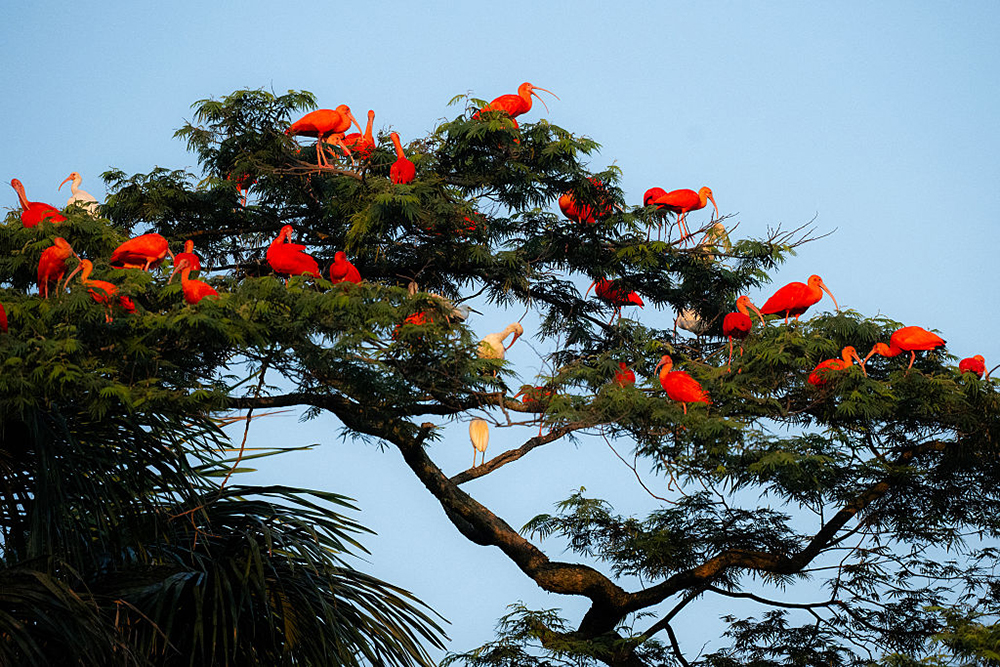



It was just after seeing my first resplendent quetzal that I hatched my crazy plan to visit Colombia. I was in the Costa Rican cloud forest at the time and my guide – you need a guide because the birds are impossible to spot without someone who a) can identify the different calls and b) carries a $2,000 Swarovski Optik monocular – said, “Of course, if you really like this sort of thing the place to go is Colombia.”
Costa Rica, delightful though it is, only has around 900 species of bird. Colombia, on the other hand, has nearly 2,000 (including 83 endemics: i.e., ones you can find nowhere else), more than any other country in the world. When I tried impressing on my wife what an incredible incentive this was, she wasn’t convinced. “But what if we die?” she said.
This, I can tell you with some confidence now that we’ve been, is a misconception about Colombia. We spent nearly two weeks there, driving long distances in a hire car, and never felt remotely threatened, not even in the once dodgy, Mad Max-style neighborhood of Medellín called Comuna 13, where, yes, you possibly might have been killed in Pablo Escobar’s day, but which is now a tourist attraction.
But I’m quite glad that Colombia does have this reputation because it has stopped it being ruined by mass tourism. Rarely in Colombia do you get that “if only I’d got there in the Nineties…” feeling. Rather I feel like a bold pioneer, exploring terra incognita, living on the edge, but still within easy reach of a hotel where my luxe private chalet has an outdoor rainforest shower and decent bedside reading lights.

I am thinking, for example, of One Santuario – a remote boutique hotel on the Palomino River in the foothills of the Sierra Nevada mountains. Not so long ago, this whole area was controlled by the Medellín cartel and the river valley would have been dotted with coca plants, tended by the local indigenous tribe – the Kogi – in their distinctive, pure white outfits, guarded by men with machine guns.
Today, the valley is a popular excursion. I climb up a forest track and visit a Kogi village. Then I launch myself into the river on a giant inner tube and drift downstream, my journey enlivened by the occasional rapids and glimpses of toucans, parrots and kingfishers flitting amid the secondary rainforest which has now swamped the former coca plantations.
About two hours away, in Sierra Nevada de Santa Marta national park, I saw a pair of blue-billed curassows. This may not mean much to you, but it will to birders.
This is the very species pictured on the cover of the Lynx field guide to Birds of Colombia (ed. Steven L. Hilty), the definitive 608-page, color-illustrated compendium, which I can never quite decide whether to leave in my hotel room or lug along in my knapsack. The blue-billed curassow is listed as “very rare and local resident,” which is exactly the kind of bird I want to spot because it means hardly any birders ever will, even if they keep coming back year after year.
It was pure chance that there was a pair of blue-bills near the road, rather than deep in the scrub. Even then, there was no way we would have seen them without having a local guide – a team of guides in fact. One stayed with us, so as to identify any species that crossed our path. Two others went ahead on a moped to scout and report back on tempting sightings.
Without such friendly, eager and very knowledgeable guides, we’d be completely lost. How else am I going to be able to tell whether the hummingbird I’ve briefly glimpsed (there are 163 species in Colombia and they move very quickly) is a bronzy inca or a brown inca with sufficient confidence to tick it off my list?
The bird I most wanted to see, though, was a condor because my favorite Tintin book is Prisoners of the Sun, where they feature quite a lot. They are much less common in the northern part of South America than in, say, Peru, but there’s one place in Colombia where you are pretty much guaranteed a sighting, the El Nido del Condor ecolodge on the plateau of a mountain in the coffee-growing region.
It’s inaccessible by road so you have to get there either by cable car or on horseback. The horse option ought to be terrifying: the winding tracks are so rocky and vertiginous, with boulder-strewn rapids at the bottom, that it would be suicide on even the most sure-footed Kentucky nag. But on the small, tough, sturdy local criollo horses, it’s a doddle. The key is just to keep looking ahead – never over the edge of the cliff – and leave the horse to get on with it.
We slept in a very luxurious tent, with a huge double bed piled with thick blankets (because it can get quite cold up high). And we spent our day on the plateau, spotting hummingbirds and raptors, or trekking down the steep-sided river valley to drink coffee with a local farmer, Pedro, who showed us the condor nest perched on a cliff near his home.
Back at the ecolodge there’s a viewing platform. Because it’s so high up, we often saw the condors from above, which means we got to see the white secondary flight feathers. From below, they look completely black. Eithexr way they’re very impressive, the biggest of all the birds of prey with a wingspan of almost ten feet.
Not so long ago, this whole area was controlled by the Medellín cartel and dotted with coca plants
After a couple of days, though, we did start to feel a bit condored out. Every time one appears, the hotel staff ring a bell and yell “Condor! Condor!” “Yeah, whatever,” we responded after a while. El Nido del Condor is one of the most stunningly beautiful places I’ve stayed, but it’s amazing how quickly we became blasé about its wonders.
On the final day, I went for a last ride with Pedro because I just couldn’t get enough of those terrifying zig-zag tracks and those cool horses. There were cows grazing on the steep slopes and, on the way back, when I saw them being milked, I asked Pedro if we could investigate.
The man milking the cows took a mug and filled it with warm milk, straight from the cow’s teat. It was delicious and creamy. A bit gag-inducing at first. But no doubt full of healthy raw milk enzymes.
That night I must have visited the toilet in our outdoor bathroom area about two dozen times. Even with all the blankets piled high on me, I felt shiveringly cold, except when I was sweating buckets with fever. The drug gangs are unlikely to kill you in Colombia. But the raw milk just might.




Comments