
We’re not used to famous pedophiles having a great talent; perhaps because all of their drive goes into their secret obsession, they’re generally just operators with a lot of front. It’s been easy to slice the cultural contributions of, say, Jerry Sandusky from one’s life and not feel the least absence.
If the chattering classes are allowed to keep their Eric Gill, why can’t the dancing classes keep Michael Jackson?
On the other hand, we’re inclined to give Caravaggio a pass, as he was such a great painter as well as a boy-abusing murderer – and it was such a long time ago, that the victims can’t speak out. The same goes for the pedophile Paul Gauguin, who spent many years spreading syphilis among a proportion of the girl children of Tahiti. That Eric Gill had a nice way with fonts is undeniable. Still, considering the number of pedophiles they have promoted and protected – and their performative contrition in recent years – it’s odd how in Britain the BBC still glorifies this enthusiastic rapist of his daughters and the family dog. In 2022, a man took a hammer to Gill’s “Prospero And Ariel” sculpture outside the BBC’s headquarters, with a quite reasonable cry of “Pedophile!” The BBC’s response was to spend more than $650,000 restoring it and placing a protective screen around it. Hug an incestuous kiddie diddler today!
For those of us with more lowbrow tastes, Michael Jackson is the “problematic” artist we struggle with – or, to be more accurate, wonder briefly whether it’s worth switching radio stations when one of his songs comes on. (Many of them banned his records after the horrific revelations of the Leaving Neverland documentary but have sneaked them back on since.) Should we shun his recordings, having heard the revolting testimonies of his victims? Or should we separate the man (who’s dead anyway, so it’s not like he’s getting royalties) from the music while acknowledging the suffering of the children involved?

Another choice, which seems unpalatable to any but the most fervid fan, is to dismiss the accusations altogether, and “whitewash” him – a very apposite word, considering the numerous skin-lightening creams he used on his once-lovely face. His own children – so light-skinned that they resemble the result of an illicit liaison between Nicole Kidman and Casper The Friendly Ghost – occasionally pop up to remind us what a great guy he was.
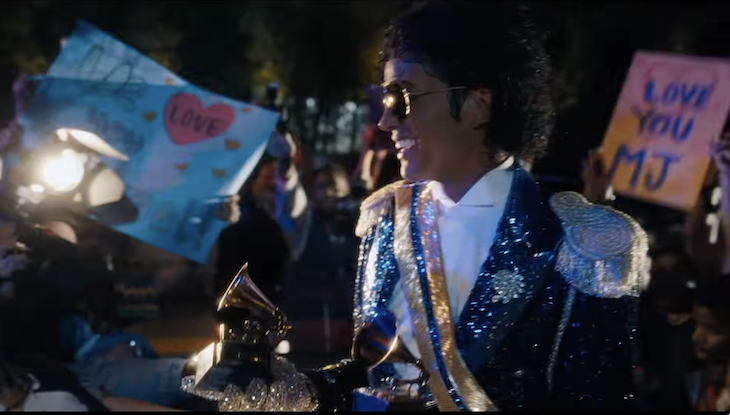
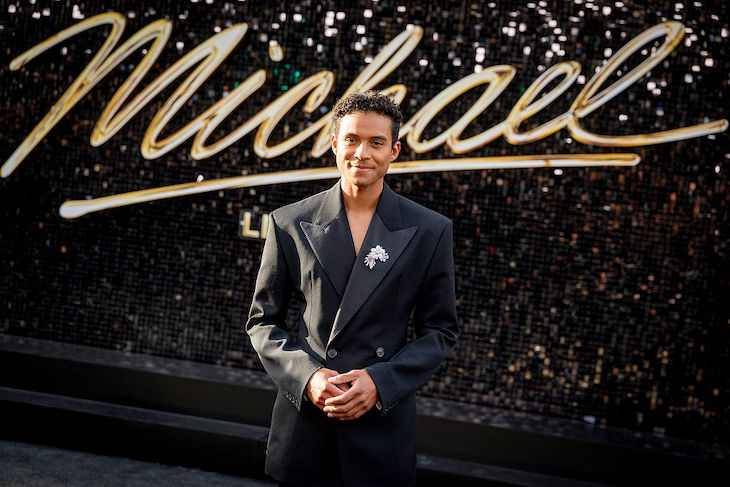
Now, a new film, Michael, starring Jackson’s nephew Jaafar (which seems non-specifically slightly creepy), backed by the Jackson estate and using Jackson’s original vocals, seeks to further this process; in the Times of London, Kevin Maher writes of it that: “Future cultural historians will look back on this Michael Jackson biopic as a watershed moment for the genre. It will be known as that infamous film in which the subject became completely untethered from reality and the film delivered instead two hours of pure and unadulterated bullshit. That’s as defined by the American philosopher Harry G. Frankfurt in his essay On Bullshit, as speech intended to persuade without any regard for truth.”
It does sound dreadful. Jackson is portrayed as a cross between St Francis of Assisi and Princess Diana, told by his mother as a child that the Lord has blessed him with a “special light.” Galvanized by seeing a young fan in a wheelchair, he’s soon haunting children’s hospitals, which with hindsight seems more Jimmy Savile than Diana Spencer. The producer claims that it aims to “humanize but not sanitize” Jackson, but conveniently it stops in 1988, before the accusations of child abuse started. Maher concludes: “The music scenes nonetheless are quite brilliant and thrilling …Jackson was a once-in-a-generation genius and his musical legacy is quite safe, his sales spiked by 10 percent during the Leaving Neverland controversy. In the end he probably deserved more, for better and worse, than this.”
Conveniently, my relationship with Jackson’s oeuvre is rather like the film’s; I stopped being a fan as he grew paler and frailer and utterly bereft of the exuberance which he had as a youngster. As he became more famous, the more he wore the Emperor’s New Clothes in my eyes; at his best, he could serve up a decent slice of pop-soul, but that was largely because he had the supreme producer Quincy Jones to work his magic. Done up like Liberace auditioning for the Black And White Minstrels, yelping and jerking and grabbing at his genitalia in a way that seemed to signify alarm rather than arousal, it all looked weirdly like the male equivalent of a little girl in her mother’s high heels.
For those of us with more lowbrow tastes, Michael Jackson is the ‘problematic’ artist we struggle with
Toward the end, his music was woeful; think of 1995’s Earth Song, surely the nadir, with lyrics so frankly half-witted it sounds like a depressed bot with a mental age of 13 was let loose; “What about animals?/Turned kingdoms to dust/What about elephants?/Have we lost their trust?” In the video, Jackson – looking a dead ringer for the actress Neve Campbell – wanders through a charred dystopia, passing sad families of Africans and Aborigines; he’s had so much “work” done, especially on the skin-lightening front, that the whole expensive enterprise looks like a flagrant example of White Savior Complex show-boating.
In comical contrast to the high-minded content of this dirge, the bassist Guy “Like A Prayer” Pratt recalled that Jackson was recovering from extreme plastic surgery at the time of recording, and hid under a mixing desk in the recording studio, passing instructions to Pratt through an assistant, both of them having to pretend that Jackson was not in the room. (Yep. I’d sure take lectures on how to live by someone who behaved like that.)
It’s telling that Jackson was a pop outlier when it came to wrapping himself in the camouflage of ecology. His only “political” interests appeared to involve children and the environment; identifying as a Good Person, he could then act as badly as he pleased, as we see all over NGOs and the predatory men who staff them.
The more famous Jackson became, his music took on the worst aspects of white rock and lost the best elements of soul, appropriately as his skin grew lighter. But O, those early Jackson 5 records! He wasn’t even a teenager when I Want You Back, ABC, The Love You Save and I’ll Be There went to the top of the Billboard Chart, all in 1969; they were three-minute masterpieces, and his age seemed the least remarkable thing about them. When Never Can Say Goodbye came out in 1971, Jackson was 13 and I was 12 and though it sounds precocious to say, I felt that it was the first song I heard that made me understand about being in love, how cataclysmic and compulsive and corrosive it can be. It has to be one of the best soul records ever made.
So my mode of being a Michael Jackson fan is a simple one; I think of the records he made when he was obviously not abusing children – being a child himself – as being made by a different person to the one who allegedly encouraged underage boys to drink wine he called “Jesus juice” from Coke cans at Neverland, all the better to molest them. I adored him when I was a child and he himself was a child and, to put it crudely, too young to do any damage. I don’t care for his later work – but lots do. And if the chattering classes are allowed to keep their Eric Gill, why can’t the dancing classes keep Michael Jackson? But they should do so honestly, and resist the urge to honor him with monuments that will only attract derision and vandalism – which, in the end, is all that this film is.






Comments