

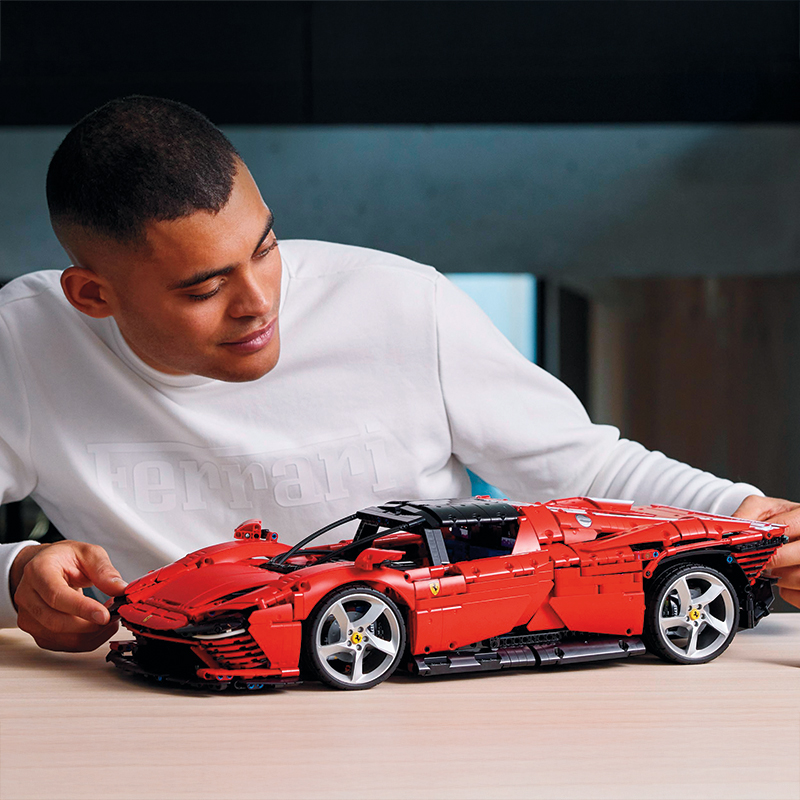
Once upon a time, Lego was just a toy that we grew out of. Except that it never really was just a toy, and the generations that grew up with the clever building system never forgot the lessons it taught in mechanical thinking, or lost the fascination with structure, motion, and cause-and-effect that it engendered. More powerfully, Lego taps into the desire to create order and pattern (who doesn’t remember the frustration of right brick, wrong color?) that also drives the collecting impulse. Given all that, it was only a matter of time before Lego grew up, too. And grow up it has, with luxury car makers from Ferrari and McLaren to Porsche happy to actively collaborate on limited-edition models for Lego’s Technic Ultimate Car Concept series.
The Lego Technic Ferrari Daytona SP3 is a 3,778-part, 1:8 scale model of the supercar realized in exhaustive detail: a functioning 8-speed sequential gearbox, moving V12 engine pistons, chrome-painted rims, butterfly doors, and the prancing horse logo on the steering wheel. The model was even updated when Ferrari altered the aerodynamics.
But comprehensive accuracy is only part of the story. For Lego’s project to prosper, the ancillaries needed to be right, from managing the limited edition through to the 240-page hardback book on the project that details the design process and even includes contributions from Ferrari designers.
Cleverly, the Lego project doesn’t attempt to be a substitute or replica of the real thing; it’s still noticeably Lego. As much as it’s detailed and faithful, the model is abstracted and the definitive joins and studs remain visible: mechanical logic is prioritized over photorealism. That, and the hours needed to complete the model, make it an exercise in collection and engagement – this is for those who are more interested in the idea of a Ferrari than owning one (though, anecdotally, there is quite a crossover). While these sets aren’t designed to play, they are designed to work, to express physically what they represent: gear trains are exposed, steering racks articulate, and the suspension compresses under load. Assembly is a way of engaging with the story.
The emergence of Lego as a collecting phenomenon has been a long time coming, but its organic and leisurely paced evolution is part of the story and a pillar of its credibility. The roots lie in the wildly successful launch of Lego Technic in the late 1970s along with the emergence of stores like the Sharper Image and Brookstone that specialized in kinetic gadgets from Newton’s Cradles to Congreve ball clocks. The interest was already out there, but it wasn’t until Lego linked up with another pole of ’70s culture, Star Wars, that the company realized the potential of more ambitious models such as the Millennium Falcon.
The success of its 2019 Land Rover Defender is emblematic of the audience Lego has found. Technically ambitious, it taps into the same drives, demand for, and interest in the real-world Defender. The completed cars typically go on display, in dens and personal spaces, where they work more as art, saying just as much about their owners’ tastes and ambitions as any street-art limited-edition from the likes of Banksy or Shepard Fairey – think of them as sophisticated buildable designs rather than plastic models. It’s a valuing of mechanical culture that’s similarly reflected in the Nixie tube sculptures and kinetic art championed by Geneva’s MAD Gallery, or the growing interest in early tech such as Curta calculators and Enigma machines.
That Lego has now signed a partnership with F1 will add fuel to the fire. Even if the intention expressed is to engage younger audiences, it’s almost certain to boost demand among more affluent, older demographics.





Comments