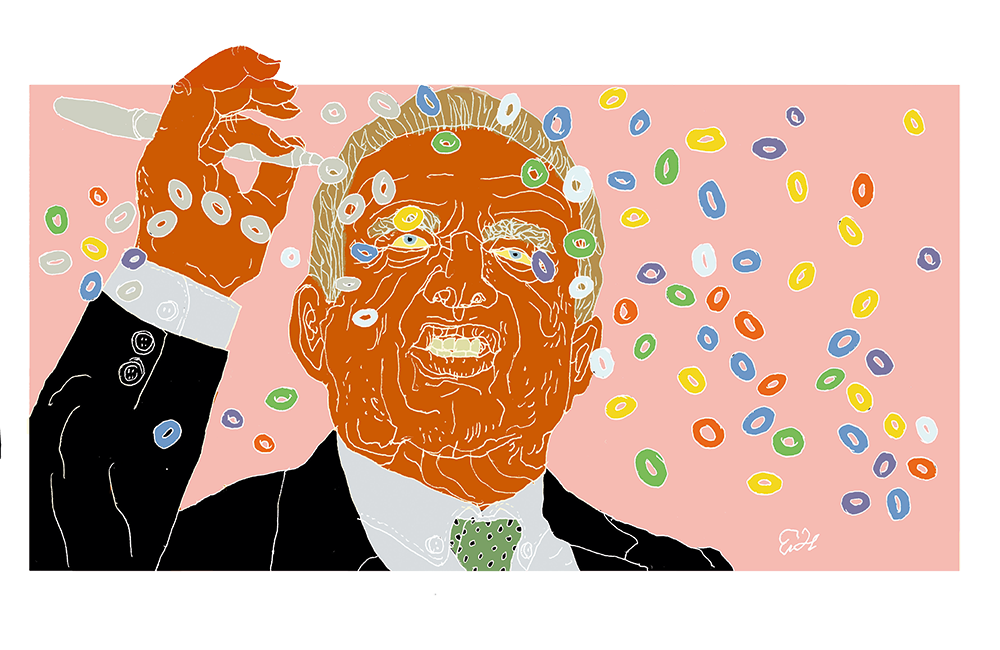


Start saying your goodbyes, America. Tartrazine-tinted pickles, oranges with a Citrus Red No. 2 spray tan and maraschino cherries glowing with erythrosine – all are on the way out the door, thanks to Robert F. Kennedy Jr.’s crusade against artificial food colorants.
And if you’ve got any tears left to cry, here’s another emotional hit: Target just announced it is pulling cereals containing petroleum-based dyes from its shelves by the end of May. Loving you was red, Froot Loops.
Critics jeered that a voluntary program would never get anywhere, but Kennedy has been fairly successful
That Taylor Swift song really fits the bill on RFK’s anti-dye crusade. Losing them will be blue like we’ve never known: MAHA-friendly foods will have to swap Blue No. 1 for less-vivid natural replacements such as butterfly pea-flower extract and spirulina. And as for dark gray all alone, that’d be the red velvet cake without any Red No. 40 in it. Dark gray because no dye; all alone because nobody wants it.
So say the makers of Duncan Hines cake mixes, although they hastened to add that they’d be replacing the Red No. 40 with beets. “Something like red velvet cake needs to be red, so we’re not going to sell gray velvet cake,” Conagra chief executive Sean Connolly said in an interview. “We use beets as an alternative…”
But once you’ve stopped smiling at the notion of gray velvet cake, you may find yourself puzzled, as any home baker might be. I, for one, have made plenty of dye-free cakes from scratch, using flour, sugar, eggs, oil and the other usual suspects. None of them have turned out gray. Black (because they were burnt): yes. All shades of brown, via beige and yellow, to white: yes. But almost never gray. (Once, when it seemed to me a good idea to add frozen blueberries to the batter, the juice reacted with the baking soda to turn the cake a rather horrible greenish gray. I learned my lesson.)
So why, we might wonder, would a dye-free Duncan Hines mix turn into a gray cake? Could it be that dyes are used to make you excited about eating something that would, without them, look like alien food? Worse yet, could they trick you into eating something that possibly is alien food, and therefore shouldn’t be used for anything but cushion stuffing, care packages to Mars and survival kits designed to outlast a nuclear fallout? Color me horrified.
There are health risks associated with consuming high levels of petroleum-based dyes (cancer, for some; hyperactivity and attention deficiency in children, for others). One wonders how scientists can tell if it’s the dye or the food at the root of the trouble – but when you reflect that some children become distracted and hyperactive at the mere sight of candy, it becomes evident that the color has something to do with it.
Kennedy hasn’t actually banned the most widely used petroleum-based food dyes, he’s just requested that the food industry voluntarily switch to natural food colorings, pushing the sector to resolve challenges such as higher costs, smaller supply and the technical difficulty of working with natural food colorants. Critics jeered that a voluntary program would never get anywhere, but in fact Kennedy has been fairly successful. So far, industry leaders such as Walmart, Kraft, Hershey and Kellogg’s are all playing ball.
Maybe this is the real reason Kennedy is against petroleum-based dyes: not so much because of their health risks, but because they wave the wand of illusion over compounds and blends and capsules that might, without their coats of many colors, be entirely unappealing.
How much fun would sweets be in natural hues? Surely much less so than they are now, with violent primary colors currently assailing the eyes of anyone in the candy aisle. Food writer Malia Wollan reports that the American consumer’s fun-o-meter is particularly sensitive to color and notices even very slight alterations: “If a naturally colored M&M tastes the same but has a lighter tinge, Americans will say it does not taste ‘as fun,’ while Europeans are more likely to accept such slight color changes or miss them altogether.”
Wouldn’t it be better for us all if the best-looking food in the grocery store was fresh produce, meat and dairy? It’s hard not to suspect that’s what Kennedy may be shooting for. He released new dietary guidelines for Americans in January, followed by a Super Bowl advert starring Mike Tyson as part of his new Eat Real Food initiative (which sounds like it was named by the parent of a college student). Eat Real Food is very strongly opposed to processed food in all forms – and very strongly in favor of protein. “This is not an attack on industry or a legal definition,” its website assures us. “It reflects a public health reality families live with every day.”
It’s hard for nutritionists to be against eating real food, so the slogan had critics’ guns spiked from day one. Still, they managed to grumble that the new guidelines put meat and cheese ahead of vegetable protein. But whether or not vegetable protein is actually better for you, the FDA made the right call. If you’re trying to wean Americans off processed food, telling them to eat soy protein chunks and quinoa is not the way forward. Show up with a ribeye steak and you might have a fighting chance.
Giotto’s blue frescoes should live forever; it’s hard to feel the same way about the blue M&M
If M&Ms were to go from vibrant to pastel, if Skittles had to be white, if Gatorade looked like water and red velvet cake had beet juice in it, what would be the net civilizational loss? Not much, is my inner sense – but then I have visited the M&Ms store in Times Square, so may be biased. Giotto’s blue frescoes should live forever; it’s hard to feel the same way about the blue M&M.
Goodbye, Yellow No. 6. Farewell, Red No. 3. Hit the road, Fast Green. If their vanishing from our shelves takes some processed food consumption with them, RFK will get America humming a new tune – perhaps one from country star Morgan Wallen this time: “I got better since you got gone.”






Comments