

Geostrategists used to fret over the “Eastern Question” or the Maginot Line or the Missile Gap. Today there is no doubt that the overriding geostrategic question of our day is whether the President of the United States is playing with a full deck. With the US-Israeli war on Iran failing, and depleting much of both countries’ non-nuclear defenses, with the Strait of Hormuz closed and western economies spiraling toward depression, Donald Trump greeted the world on Easter morning with a message to Iran’s leaders to “Open the Fuckin’ Strait, you crazy bastards,” then threatened the next day to wipe out Iranian civilization.
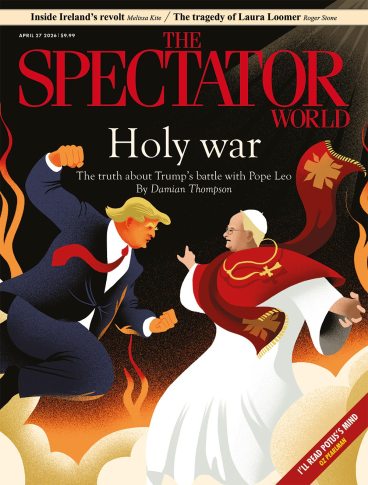
He then denounced the Pope for having imparted Catholic teachings on just and unjust war. As a kind of grand finale, Trump posted an image of himself dressed up as Jesus Christ and appearing to heal the dead, with light glowing out of his palm where Jesus’ stigmata would be. The writer Matthew Walther, besides describing the post as, for Catholics, “the most profoundly offensive act imaginable, a grave public sin that brings shame to, and invites God’s judgment upon, our nation,” also noted that in the long annals of western government, replete as they are with mad kings, no leader had presented himself as Jesus in quite this way.
The overriding geostrategic questionof our day is whether the Presidentis playing with a full deck
In this context, the President’s fondness for trolling and confabulation has been almost reassuring. On March 17, he spoke of the many western countries that were lining up to help the United States crush Iran. Which ones? “Numerous countries,” Trump replied. “I’d rather not say yet.” A month later, the tally of those countries was zero.
As the journalist Chris Lehmann showed in 2017, Trumpian mumbo-jumbo has a particular pedigree. The President’s father was a member of the Marble Collegiate Church in Manhattan, presided over by Norman Vincent Peale, a mid-20th-century evangelist of the “power of positive thinking,” and Trump would celebrate his first marriage there in 1977. Trump’s daughter Ivanka is a Peale-ian herself, once writing that “perception is more important than reality.” If you get carried away with such thinking, bad news or contradiction is more than an annoyance. It is a threat, and the bearer of it an enemy.
The organizations Trump runs tend to produce an alternate reality. Michael Wolff’s Landslide (2021), probably the best book about the Trumpian management style, showed how in the weeks between Trump’s loss of the 2020 election and the storming of the Capitol by his followers on January 6, 2021, his sober-minded advisors (such as attorney general Bill Barr) cleared out. Their replacements were selected for their willingness to bring consoling messages – former New York mayor Rudolph Giuliani, for instance, and attorney Sidney Powell.
The result was that Trump, who can be a good listener, grew steadily more attached to the most dastardly interpretation of what had happened on election day. In turn, those around him had to conform more and more to that account to get his ear. Something similar is happening now in Trump’s circle of close advisors, which seems to have shrunk down to his son-in-law Jared Kushner, his golf partner Steve Witkoff and (possibly) his policy advisor Stephen Miller.
J.D. Vance was not at the crucial February 11 meeting during which Benjamin Netanyahu convinced Trump to go to war. But he was chosen to accompany Kushner and Witkoff to Pakistan to negotiate with Iran. Whether Vance is the Moe, the Larry, or the Curly of this triumvirate, his presidential prospects are not rising. No individual ever saw his standing enhanced by a close association with Trump.
Nor is it much better for institutions and collectivities. Look at Israel. In his April 1 speech, Trump tried to win Americans over to the war but failed, because he wound up conveying that the war had nothing to do with them. “We don’t need their oil,” Trump said of the Iranians. “We don’t need anything they have. But we’re there to help our allies.” Trump is rendering Israel less tolerable not only to the Europeans who oppose it already but also to the American voters who have been the country’s lifeline. More dangerous than being Trump’s foe is being his friend.
Trump’s destructive side made him a trusted protest candidate for a disgruntled electorate, and a good ally for the break-all-the-rules types in Silicon Valley. He really is a wrecking ball. But that makes the present situation dangerous. No matter how much it destroys, the United States cannot win this war, because it has been unable to describe, or even establish, what its own interests are. Trump cannot negotiate his way out of the problem because he has exhausted the ability of others to cooperate with him. It has not been lost on the Europeans that he cannot keep his word to those he disagrees with. As for the Iranians, it is tough to pursue negotiations when your negotiating partners are trying to murder you from the air.
A change has come over Trump. Maybe it is the same distillation that Wolff described in his book about 2020. It became noticeable in December, when Trump mocked the murder of Hollywood director Rob Reiner and his wife. In March, Trump rejoiced at the death of investigator Robert Mueller. He has now attacked his most patient European defender, Italian premier Giorgia Meloni, for lacking “courage” after she defended the Pope against the President’s attacks.
For all his vaunted deal-making expertise, Trump has, for a second time, been suckered out of his presidency. The danger for the world is this notion of his that perception matters more than reality. He may wake up one morning and decide he would rather be thought a villain than a chump.




Comments