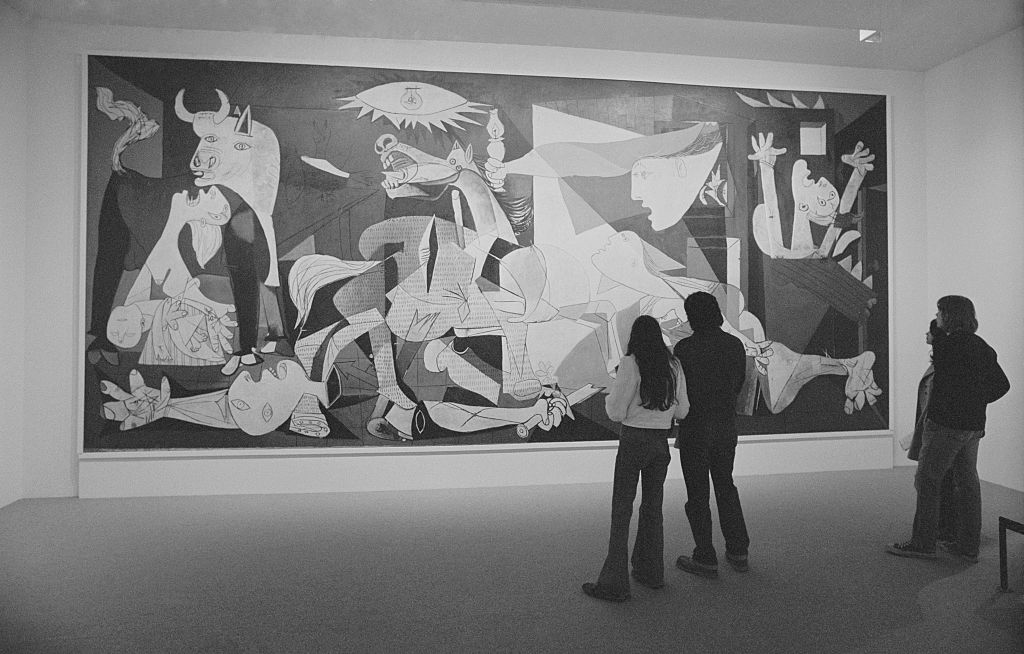
A row has erupted in Spain over what to do with Pablo Picasso’s 1937 Cubist masterpiece ‘Guernica’. Since 1992, this gigantic black-and-white painting – which depicts the bombing of the Basque town of Guernica in April 1937 by planes from Fascist Italy and Nazi Germany – has hung in Madrid’s Reina Sofía Museum. The Basque government has now requested that it be transferred to Bilbao’s Guggenheim Museum from October this year to June 2027, to mark the 90th anniversary of Guernica’s destruction.
It’s often said in Spain that you need only scratch the surface to uncover Civil War-era grievances: the Guernica dispute shows how true this is
The resulting dispute has quickly turned political. Basque president Imanol Pradales claims that the presence of Guernica in Bilbao for nine months ‘would be a gesture of historical memory and symbolic reparation towards the Basque people’ – a reference to the 1936-39 Spanish Civil War, in which Francisco Franco’s Nationalist forces were supported by Hitler and Mussolini.
Pradales, whose PNV party provides crucial parliamentary support to Socialist Prime Minister Pedro Sánchez’s minority coalition, has warned that not granting his Guernica request could be a ‘serious political mistake.’ Sanchez has referred the matter to the Ministry of Culture; meanwhile, the debate amongst regional politicians has focused on Guernica’s undiminished political symbolism. It’s often said in Spain that you need only scratch the surface to uncover Civil War-era grievances: the Guernica dispute shows how true this is.
Guernica (or Gernika, in its Basque spelling) was a centre of Republican resistance in early 1937, and a town of vital strategic importance. Franco was only too happy to let his Fascist allies use it as a testing ground for aerial bombardment techniques. Estimates of the number of people killed in the attack, which destroyed most of the town’s buildings, range from 150 to over 1,500. Obliterating Guernica proved crucial to Franco’s success in northern Spain, over which he had gained control by October 1937.

Madrid’s feisty Conservative president Isabel Ayuso, who usually aims her vitriol at Sánchez, has labelled the Basque government’s request ‘blind, absurd, oikish.’ Ayuso claims that ‘it makes no sense for everything to be returned to its origin… In that case we should send all of Picasso’s works to Málaga’, the southern city in which the artist was born.
Ardaldo Otegi, leader of the leftist Basque nationalist party EH Bildu, responded to the Madrid premier with a furious message on X: ‘Isabel, the contribution of your lot in Gernika was the Condor Legion’, he said – a reference to the Luftwaffe fleet that bombed the northern town with Franco’s blessing.
Note the phrase ‘your lot.’ A spat about a painting has redrawn the battle lines as they were 90 years ago, between leftist pro-independence groups in the north and right-wing unionists in the capital. The Basque branch of Sánchez’s Socialist party, however, has criticised the region’s government for precisely this reason, saying that is ‘not appropriate to open a new chapter regarding grievances, and seeking reparations or apologies from the Spanish government.’
This vicious argument has obscured the most important practical question raised by the Basques’ request – namely, where is Guernica most likely to be seen by the largest number of people? In this sense, there’s not much to separate Madrid’s Reina Sofía from Bilbao’s Guggenheim: last year, the former received 1.6 million visitors, the latter 1.3 million. Either would be a good home for Picasso’s anti-war masterwork, but experts say another move would be too traumatic for the 90 year-old canvas.
Picasso painted Guernica in Paris immediately after the town’s bombing, completing it in June 1937. First displayed at that year’s World Exposition in the French capital, the canvas then toured Europe and the US, finally landing at New York’s Museum of Modern Art (MoMA) in 1939. Picasso stipulated that it should not be returned to Spain until the restoration of democracy, which occurred gradually after Franco’s death in 1975. Picasso died in 1973, so never saw Guernica’s return to Spain in 1981, when it was installed in Madrid’s Prado Museum. In 1992, it was transferred to the neighbouring Reina Sofía.
All these moves have taken their toll. Spain’s minister of culture Ernest Urtasun claims that ‘the reports are clear, they overwhelmingly advise against [moving the painting].’ Urtasun refers to the Reina Sofía’s latest assessment of Guernica, according to which transportation of the huge canvas ‘could cause new cracks, lifting and loss of the paint layer, as well as tears in the support, which is why its relocation is strongly discouraged.’ The museum rejected a loan request from MoMA in 2000 for the same reason.
Despite the Basques government’s appeal, it looks as if Guernica will stay put for the foreseeable future. But the row about its location has shown, once again, that the conflict it depicts so powerfully has not been forgotten in Spain.



Comments