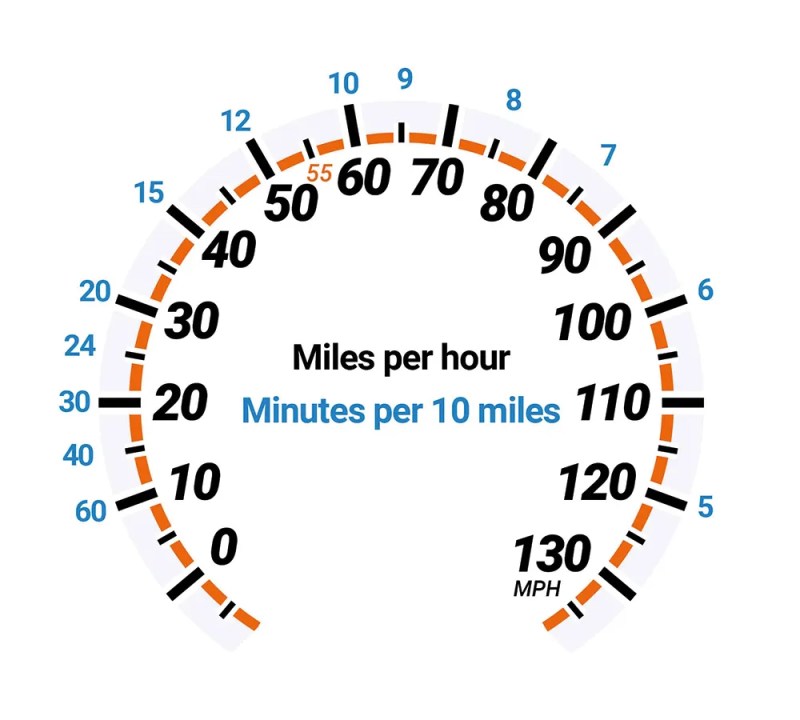


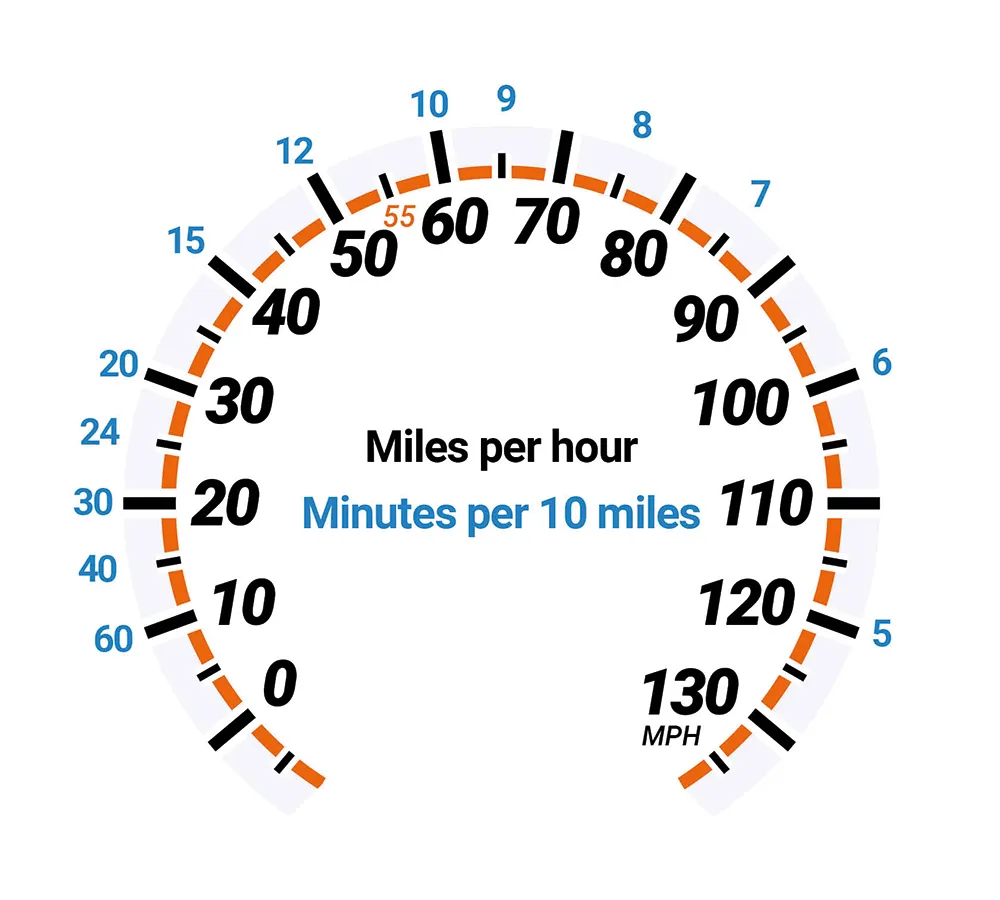
Regular readers of this column will be familiar with my promoting an idea called a ‘Paceometer’ (pictured). Rather than presenting speed in, say, miles per hour (distance/time), it presents speed the other way round, in minutes per ten miles (time/distance).
Created by the cognitive scientists Eyal Peer and Eyal Gamliel, the Paceometer shows something which is mathematically trivial but completely non-intuitive. Quite simply, the faster you are going already, the less time you save by going 10mph faster still. Accelerate from 20-30mph and you save ten minutes on a ten-mile journey. Accelerate from 70-80mph and you save just over a minute.
Upgrading to Concorde to fly across the Atlantic saved you less time than your great-grandfather saved in his first 20 miles riding a bike
Once you have seen a Paceometer, you will drive in a completely different way. Formula 1 drivers have learned the distinction intuitively: ‘It isn’t how fast you go, it’s how little you slow down.’
It was the Paceometer which finally revealed to me why the bicycle was such a world-changing invention. A bicycle isn’t all that fast in terms of mph, but a return journey of 20 miles that would take six hours and 40 minutes on foot takes about one hour and 40 minutes on a bicycle. Since the typical human journey is under ten miles, the aggregate time savings from cycling were immense. By contrast Concorde was very, very fast, but only really offered significant time savings to the few hundred people who crossed the Atlantic many times a year. Even then, it wasn’t that significant: upgrading to Concorde to fly across the Atlantic saved you less time than your great-grandfather saved in his first 20 miles riding a bike.

The Paceometer fascinates me because it forces you to ask a philosophical question which the use of conventional metrics typically leaves unasked: what do we really mean by fast? To say that the difference in speed between cycling and walking is greater than the difference between Concorde and a 747 sounds odd, yet at some level it is true.
Perhaps, in all kinds of fields, this need for quantification is making us unwittingly stupid. We glom onto metrics for ease of comparison, ease of aggregation and ease of argumentation. They lend us the appearance of objectivity. But in many cases they are causing us to seek simplicity in the wrong place – in the definition of a problem, not its solution. Oliver Wendell Holmes put it perfectly: ‘For the simplicity on this side of complexity, I wouldn’t give you a fig. But for the simplicity on the other side of complexity, for that I would give you anything I have.’
Look at UK energy policy and you’ll see at its heart a moronic metric, where burning gas bought from Norway does not count in the same way towards our emissions target, as burning gas we already possess does. (By this hand-washing logic, we should simply make all UK gas reserves the personal property of Ed Miliband, blame him for the resulting emissions and then sacrifice him on an altar; this approach worked in the Old Testament, after all.) A far more sensible suggestion would be to devote some of the additional taxes we could raise from using our own gas supplies towards research into alternative forms of energy, research which could benefit the wider world far more than any feeble contribution we can make by reducing our meagre 1 per cent of the world’s carbon emissions.
Many such metrics (think NHS waiting lists) are what you might call a ‘paradigm trap’, where problems become hard to solve because some arbitrary approach to quantifying the problem makes it impossible creatively to redefine it. This is perhaps the biggest difference between what we are taught at school and what we need to thrive in the real world. In school, it is cheating to rewrite the question; in real life, it’s the first thing to try.




Comments