It is one of the world’s most remote corners – but Greenland is playing an increasingly important role in global affairs. In January last year, the island’s 57,000 residents became an object of desire for Donald Trump. ‘I think Greenland we’ll get because it has to do with freedom of the world,’ declared the bombastic President. ‘I think the people want to be with us.’ Six weeks later, the people of Greenland duly gave their reply, crushing their pro-Trump party in an election centred on questions of independence.

The ongoing struggle for control of the Arctic motivated Trump’s demands. The British government believes that the Arctic Circle will be ice free each summer by 2040; some experts predict it will be sooner. Melting ice, caused by climate change, will mean new opportunities to access trade, critical minerals and fishing areas. Moscow now boasts more ice cutters than Washington; the Chinese want a new ‘Polar Silk Road.’ In the race for clean energy, Greenland’s rare earth deposits pose a potential gamechanger.
Strategy and commerce are not the only reasons for the new-found focus on Greenland. Tourism numbers have nearly doubled in a decade; the government wants overseas spending to triple by 2035. Cruise ships, increasingly at the upmarket end, are playing a major factor in this boom. Over 76,000 passengers arrived in 2023 – almost twice as many as pre-pandemic arrivals. A growing trend is for ‘expedition’ style adventures, in which a dozen experts in culture, nature and science share their knowledge with guests.
Politics may be a draw for some world leaders – but beauty is what attracts the bulk of outsiders here. In August, I was one of them, boarding a ten-day trip from Keflavík to Greenland. Through the still, blue waters of the Arctic Ocean we sailed, towering icebergs and humpback whales drifting around us. The occasional sighting of a polar bear sent the 120-odd passengers on board scurrying across the desks to gaze and admire. Onboard the SH Vega, our 115-metre craft weaved its course through icy obstacles that would have defeated larger vessels.
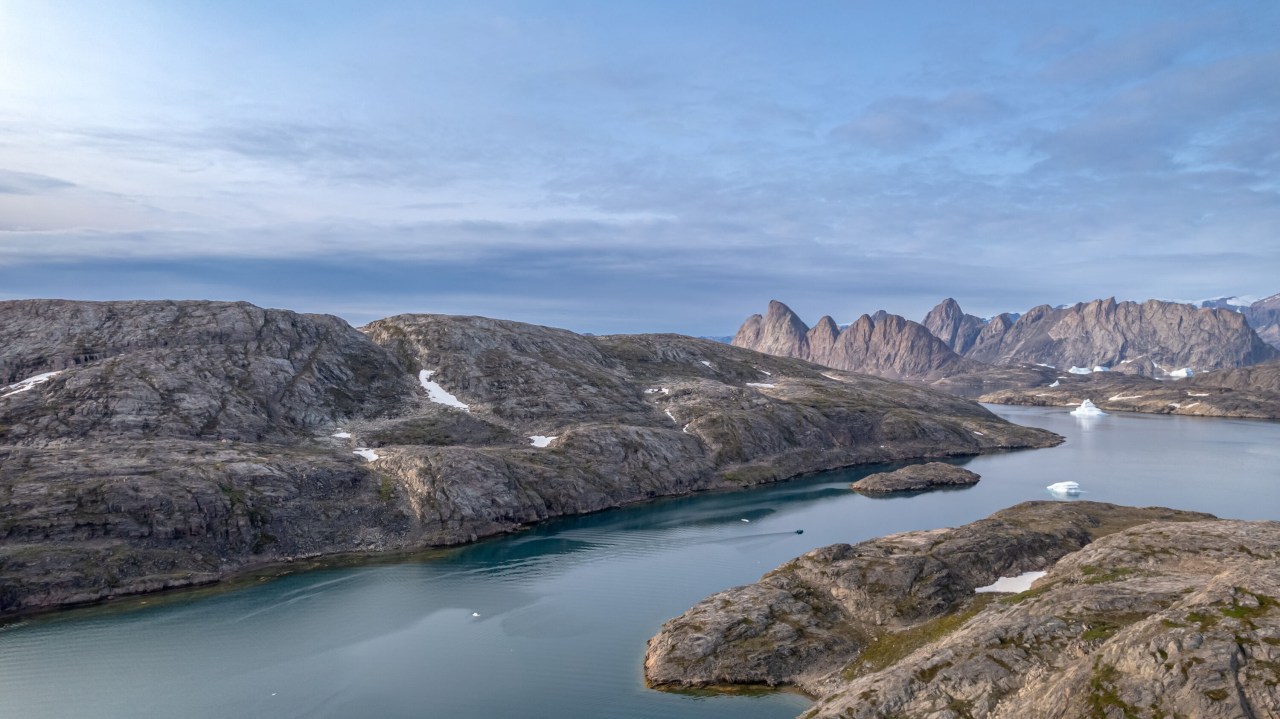
Greenland’s east flank is considerably less developed than its west, meaning vessels can travel hours without encountering another soul. In the King Oscar Fjord are striped cliffs of vivid red, yellow, orange and brown, standing proudly for hundreds of millions of years – part of the Scoresby Sund, a maze of inlets and ice. Mountains rise straight from the sea, black and jagged, as though sketched in charcoal. The seaway is closed to all ships when it freezes for nine months a year, meaning less than 1,000 people visit a year.
It is part of the paradox of Greenland: hostile yet dreamlike. Each day, we departed our expedition ship to explore the local terrain. On Bear Island, moss carpeted the ground in gold and green, Arctic hares darting between rocks, while musk oxen stood like shaggy sentinels on distant ridges. In kayaks, we sliced through the sea, marvelling at icebergs, crowned in their characteristic turquoise blue. At the Westfjords, we saw the power of the Dynjandi Waterfall; it cascades for 100 metres, yet resembles a beautiful bridal veil.
Mountains rise straight from the sea, black and jagged, as though sketched in charcoal.
The Greenlandic Innuit were as impressive as their landscape. In the century-old settlement of Ittoqqortoormiit, bright, painted houses pepper the face of stark Arctic rock. Here, in what has been dubbed ‘the world’s most remote town’, some 300 residents endure a tough, barren existence where temperatures plunge down to – 40 degrees in winter. Resourceful and cheery, we mingled in their local Lutheran church to listen to the strains of their jukebox organ, before stories of dogsledding and whale hunts, amid the howls of huskies outside.
Back on board, leisure was mixed with learning, with daily talks on geology, glaciology and ornithology. Aleqa Hammond, Greenland’s former premier and a staunch advocate of independence from Denmark, was the star of our sojourn. For her, Greenland’s global attention offers political opportunities too. ‘One country after the other are opening their consulates’, she says. ‘They are not doing it because they think we are cute – they are doing it only because it is important to be good friends.’
The new scramble for the Arctic offers Greenland the chance to receive what she and other leaders crave most: international recognition and respect. One group watching closely is the Scottish Nationalist government at Holyrood. ‘I’d love to have discussions with them’, says Hammond. ‘because Greenland has found its own path in new snow by itself… We have always felt very alone and nothing to look at and to be inspired by. So, I think Scotland and Greenland can inspire one another in how to do things.’
Since 1951, the US has had a key military base on Greenland. Trump, Hammond says, ‘just puts things in a stupid way – but he’s saying what America thinks.’ She hopes her country can exploit its territorial importance for security guarantees with the US, UK and other Nato allies. ‘Denmark has the best seats around the world because of the friendship with the Americans because of Greenland,’ she says. If independence is achieved, she predicts, ‘Denmark will lose its seat in [the] Arctic Council. Denmark will lose many, many seats, and they will no longer be one of the most powerful people in Nato.’
For many Greenlanders, the global debate currently playing out in public on their future status is deeply unsettling. But while the designs of foreign powers are not welcome, visitors to this rugged, yet arresting, island clearly are. We end the trip with a traditional cold plunge: a dive off Vega into the frozen Arctic sea, before being hauled rapidly back on board for hot showers and local vodka. With its rich resources and unique setting, Greenland looks set to only attract ever more overseas attention in the years and decades that lie ahead.
A 10-night cruise from Iceland to eastern Greenland with Swan Hellenic starts from £6,580 per person based on two sharing.




Comments