
Situation update
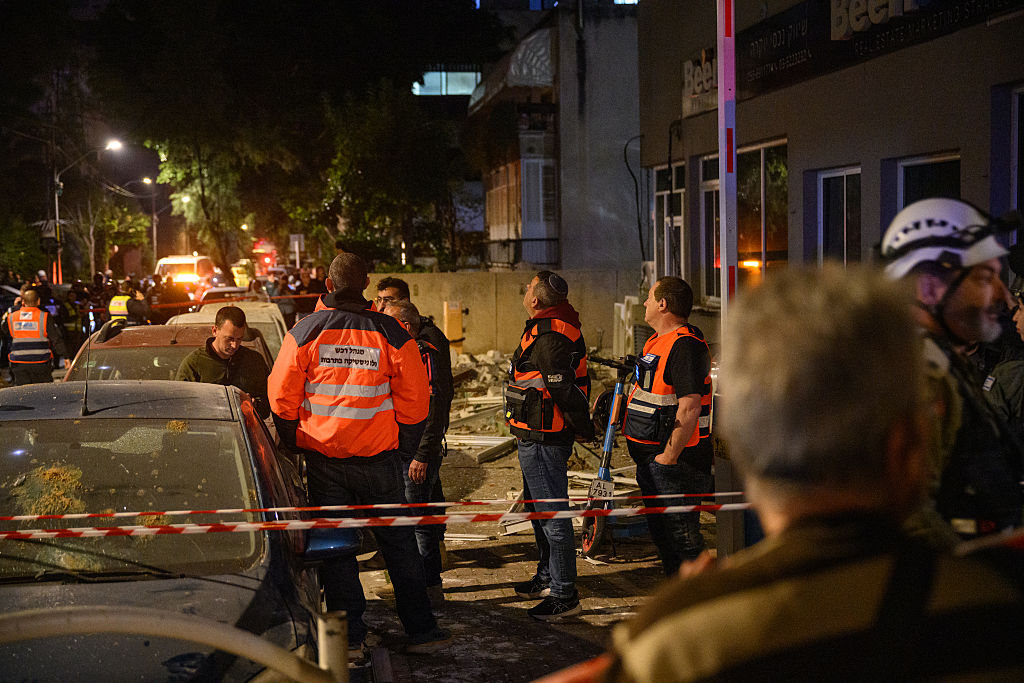
Missiles were launched from Iran toward Israel overnight, targeting its central and southern regions and triggering nationwide alerts that sent civilians into protected spaces. Israeli air defence systems intercepted multiple incoming threats, though several impacts were recorded across central Israel. In Ramat Gan, two civilians, a man and a woman in their seventies, were killed after reportedly failing to reach shelter in time. Search and rescue teams operated at multiple sites, while further damage was reported in cities including Holon, where debris fell in residential areas. Explosions were heard widely across the centre of the country. Some reports indicate that cluster-type munitions were used. Iranian-linked outlets described the attack as retaliation for the killing of senior Iranian figures and said it involved a combination of missile systems including the Khorramshahr-4, Qadr and Emad.
At the same time, Israel carried out a coordinated wave of strikes deep inside Tehran. The targets included headquarters of the IRGC security unit responsible for suppressing internal unrest, logistics and support facilities linked to internal security forces, ballistic missile command centres and elements of Iran’s air defence network. Israeli officials said the strikes were part of an ongoing campaign to damage the core systems of the Iranian regime and expand aerial freedom of operation over its territory.
Alongside the infrastructure strikes, Israeli intelligence conducted targeted killings of senior figures. Ali Larijani, the secretary of the Supreme National Security Council, was tracked to a meeting at a hideout on the outskirts of Tehran and killed in a missile strike, along with his son, his deputy and other associates. Gholamreza Soleimani, commander of the Basij militia, was also located after intelligence indicated he was sheltering in a temporary outdoor position and he was also killed. The targeting followed weeks of strikes on Basij facilities that has reportedly forced its personnel to disperse. A strike was also reported near the residence of former president Hassan Rouhani. Israeli leadership confirmed publicly that two senior figures had been eliminated within a 24 hour period.

There has also been an intensification of Israeli intelligence activity inside Iran. According to the Wall Street Journal, Israeli operatives have been contacting Iranian security officials directly, warning them by name and threatening consequences if they do not stand aside. One recorded exchange captures an Iranian police commander acknowledging that he was already ‘a dead man’ after being told he was on a targeting list. The same reporting describes a growing flow of intelligence from Iranian civilians and mounting pressure on security forces attempting to contain unrest while also responding to external strikes.
On Israel’s northern front, Hezbollah launched rocket fire toward Israeli territory, including central areas, in barrages of around 40 rockets. The group described the attacks as part of what it called ‘Khaybar Operations’. Israel responded with extensive strikes across southern Lebanon and Beirut, targeting launchers, launch teams and infrastructure. Evacuation warnings were issued in advance to civilians in areas including Tyre and specific neighbourhoods in Beirut. Reports from Lebanon indicate multiple simultaneous strikes in the capital and across the south, with at least four people killed and 17 injured in the Beirut area.
Israeli operations have continued simultaneously in other theatres. In Gaza, Israeli forces killed Younes Muhammad Hussein Alyan, the commander of Hamas’s northern naval brigade, who had been involved in rebuilding its capabilities and planning attacks. In the West Bank, operations in the Jenin area and elsewhere led to the arrest of more than ten wanted individuals, including members of Islamic Jihad, with clashes reported during the raids.
Iranian-linked militias launched suicide drones toward US targets in Iraq and Kuwait, and explosions were reported in the United Arab Emirates. A drone strike hit a Kurdish headquarters in Erbil, and a US base in Saudi Arabia was struck earlier. In Baghdad, a drone attack targeted the US embassy.
US Central Command confirmed that American forces used 5,000 pound deep penetrator munitions against hardened missile sites along Iran’s coastline near the Strait of Hormuz, targeting anti-ship cruise missile systems assessed as a threat to international shipping. At the same time, more than a dozen US MQ 9 Reaper drones were destroyed either by Iranian missiles or on the ground.
The war is also producing visible fractures within the US political establishment. Joe Kent, director of the National Counterterrorism Center, resigned from his post, stating that he could not support the war and arguing that Iran posed no imminent threat to the United States. Trump responded by welcoming the resignation and criticising Kent as weak on security, saying that those who did not view Iran as a threat were not competent. Kent is expected to elaborate on his position in an interview with Tucker Carlson, who has also criticised the war in strong terms and claims he may face a potential investigation related to contacts with individuals in Iran.






Comments