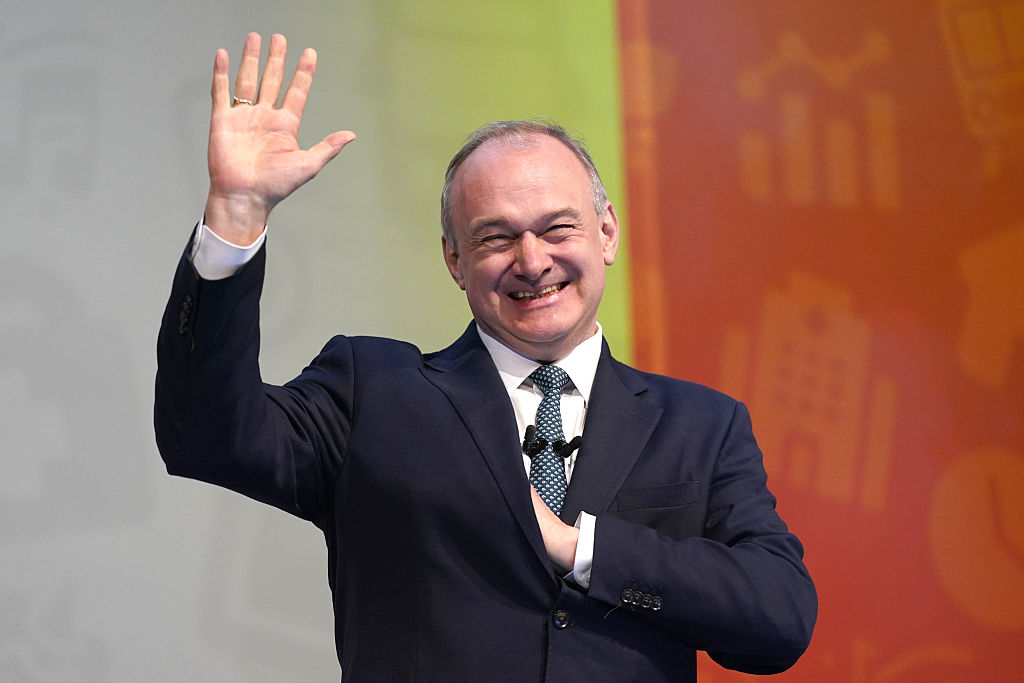
If Sir Ed Davey’s stunts were ever funny, the joke has long since worn off. At the Lib Dem spring conference this weekend, he strode onto stage wearing sunglasses to the tune of Boney M’s ‘Daddy Cool’ in a lame attempt to parody Emmanuel Macron’s recent appearance at Davos. After a typically forgettable speech, Davey was then filmed performing a choreographed dance routine to Chappell Roan’s Gen Z pop hit ‘Hot to Go!’. And to think this was the party of Gladstone and Lloyd George.
But the most embarrassing moment of all for the Lib Dem leader came on Sunday, when the latest Ipsos poll showed his party is now polling in single figures. Despite Labour being led by one of the most unpopular prime ministers on record and the Conservatives facing an existential crisis, the traditional third party of British politics has the support of just 9 per cent of the electorate. Instead, it’s Reform and the Greens who are capitalising on voters’ discontent. In a strong field, Ed Davey is perhapss the most underperforming party leader of them all.
The traditional third party of British politics has the support of just 9 per cent of the electorate
Take the recent Gorton and Denton by-election. Once upon a time, such a contest would have made rich pickings for the Winning Here brigade. During Charles Kennedy’s era the Lib Dem electoral coalition was made up of precisely the voters who handed the seat to the Greens: students, middle-class liberals and Muslims. In the constituency’s former incarnation as Manchester Gorton, the Lib Dems consistently finished a strong second – polling 33.2 per cent in 2005 and 32.6 per cent in 2010. And yet last month they won just 1.8 per cent, a mere 653 votes, losing their deposit and finishing fifth behind the Tories.

All of which raises a simple question: why haven’t the Lib Dems ditched Ed Davey yet? His defenders would point to the party’s impressive haul of 72 MPs at the last general election, which he rightly deserves some credit for. However, it’s also worth noting those numbers were achieved despite winning only 12.2 per cent of the vote – an improvement of just 0.6 per cent from Jo Swinson’s disastrous performance in 2019. Ironically given their historic support for electoral reform, the Lib Dems were major beneficiaries of first past the post. Their success owed more to the desire of middle-class voters in the Blue Wall to punish the Tories than to Davey’s campaign gimmicks.
There’s an argument that the stunts and pratfalls were effective in 2024, giving the Lib Dems a visibility they so often struggle to attract. But the problem for Ed Davey is that it increasingly appears that his desperate attempts to go viral are all he’s got. The Lib Dems do best when voters associate them with one or two simple, eye-catching policies. In Paddy Ashdown’s era, they campaigned to increase education funding, paid for by a 1p increase in income tax. Under Kennedy, their opposition to the Iraq war won them millions of new voters. Even under Nick Clegg, their pledge to scrap tuition fees paid dividends (at least, it did until their infamous U-turn in coalition).
What is the equivalent Lib Dem policy offering now? Party activists will happily talk at length about cleaning up Britain’s waterways and investing in social care, but how many voters could tell you these policies on the doorstep? And as important as both issues are, are they really enough to transform the party’s prospects? Zack Polanski has been the leader of the Green party for six months. He has achieved greater visibility and cut-through in that time than Ed Davey has in six years. Ironically, Polanski was himself a Lib Dem until as recently as 2017.
In a time of unprecedented political churn, there is an enormous electoral opportunity for a party of the moderate centre. With the Tories and Reform locked in a battle for supremacy on the right, a deeply unpopular Labour government devoid of ideological definition, and the rise of radical left-wing populism in the form of the Greens and Your Party, there must surely be more than 9 per cent of the electorate willing to vote for an effectively led Lib Dems? One can only assume voters have concluded that Ed Davey simply isn’t up to it.
There is genuine talent among the Lib Dem parliamentary party. Their deputy leader, Daisy Cooper, is a much stronger media performer than Davey, and carries none of the baggage of having served in the coalition government. Even some of the 2024 intake would make viable contenders for the leadership, including Calum Miller, Josh Babarinde and Mike Martin. Any of them would be an improvement over the incumbent.
Were Ed Davey to resign tomorrow, his party would thank him. He would rightly receive credit for reviving their parliamentary representation in 2024 and for providing a period of much-needed stability after the short and unsuccessful tenures of Tim Farron, Vince Cable and Jo Swinson. But if he stays on until the next general election, there is a real chance that the Lib Dems will have wasted a rare opportunity for a genuine political breakthrough. His MPs should grow a backbone and show him the door.


Comments