
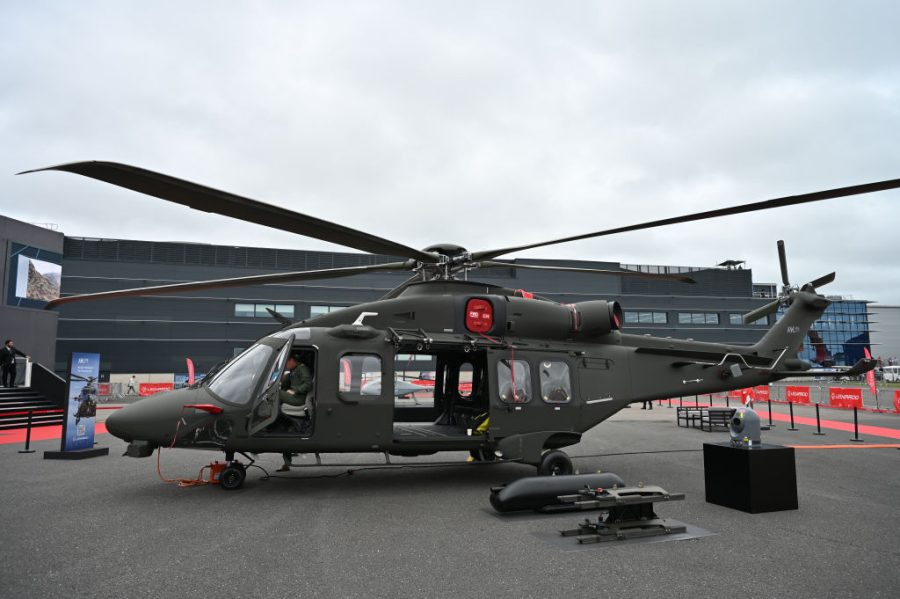
It was good news, albeit good news of the your-house-hasn’t-burned-down variety. Last week, the Ministry of Defence (MoD) announced that Leonardo UK had been selected for a £1 billion contract to provide the armed forces with a new medium helicopter, thereby securing the future of the company’s factory at Yeovil and 3,300 jobs dependent on it.
It had not been an easy journey to the awarding of the contract. Leonardo was the only bidder, with Airbus, Boeing and Lockheed Martin having dropped out between the announcement of the competition in 2022 and the end of the bidding process in 2024. The MoD had also dragged its feet after it was clear that Leonardo was the only bidder, much to the frustration of the company’s CEO, Roberto Cingolani. He warned first that the Yeovil facility’s future was dependent on winning the order, and then that Leonardo might have to close its entire UK operation if it did not find work soon. The company has other facilities in Edinburgh, Newcastle, Lincoln, Luton, Bristol, Basildon, London and Southampton, employing nearly 9,000 highly skilled workers.
Time and time again, the MoD denies that anything is seriously wrong
Nevertheless, the matter is now resolved and Leonardo will deliver the new medium helicopter requirement with its AW149 model. An accompanying written ministerial statement by Luke Pollard, Minister for Defence Readiness and Industry, packed in the corporate jargon and au courant political issues to make it sound like a red-letter day for defence procurement:
In an incredibly volatile and unpredictable world, characterised by emerging threats and shifting geopolitical dynamics, the importance of a robust and agile sovereign defence industry cannot be underestimated, and medium lift will remain an enduring requirement moving forward… The new deal delivers on the strategic defence review and defence industrial strategy – improving warfighting readiness and strengthening the UK’s defence industrial base.

Truly inspirational. Nevertheless, the minister’s breathless paean to ‘warfighting readiness’ glosses over the fact that 23 helicopters have been ordered, a significant reduction from the programme’s initial envisioned total of 44, while the value of the acquisition remains as it was in 2022 at around £1 billion. The same price for half as many helicopters is quite a rate of inflation.
A more worrying omission – though on a human level one can understand why ministers regard it as the elephant in the room – is any mention of the capability gap that has been created. Pollard also disclosed that the first helicopter would be delivered in the summer of 2030, with the model having a formal entry into service date of January 2031. The last aircraft are scheduled to be delivered in autumn 2033, two general elections away.
It is not the most egregious time span in recent defence procurement projects. Remember, though, how Pollard said that medium lift would ‘remain an enduring requirement moving forward’? By January 2031, Joint Aviation Command will have lacked any medium-lift capability for almost six years; the Westland Pumas HC2s which the new medium helicopter replaces were retired from service in March last year to avoid additional costs.
This has left the armed forces reliant on heavier (and ageing) helicopters, the RAF’s twin-rotor Boeing Chinook and the Fleet Air Arm’s AgustaWestland AW101 Merlin. Six years is a sizeable capability gap, and it is one wholly dictated by cost savings, not strategic or operational requirements.
This touches on a much broader and more profound issue. The strategic defence review, published in June last year, talks of defence and security now necessitating a ‘whole-of-society approach’, in support of which ‘a national conversation on how we do it is required’. As the reviewers argued:
Long-term success depends on reconnecting society with the armed forces and the purpose of defence, supported by a government-led national conversation.
Yet this is not happening. Last November, the House of Commons defence committee’s report, The UK contribution to European Security, regretted that the ‘national conversation on defence and security’ had ‘yet to start’ and lacked direction. It called for the government to set out expected timeframes and responsibilities for this ‘conversation’.
It is not just an issue of the government lacking commitment and direction. How can ministers and officials engage in any kind of meaningful dialogue with the electorate or with civil society if they are congenitally incapable of openness and honesty about the challenges the armed forces are facing? Time and time again, like some latter-day Black Knight, the MoD denies that anything is seriously wrong and instantly points to better days ahead, especially through the promised increases in the defence budget (now put firmly in the shade by many of our European partners).
Six-year capability gap in medium lift? Never mind, it’ll be fine. A nearly £30 billion shortfall in the equipment budget? Please don’t talk about it. Four out of five attack submarines unavailable for operations due to maintenance and repair? We’ll sort something out.
Creating armed forces equipped and trained to meet the full range of threats we are currently facing will be hard, and the voters must be persuaded at every step. The process will entertain sacrifices. It cannot be achieved by a government which cannot be honest with itself or others about how deep the problems are. For our part, we need to make a Cromwellian demand of ministers: tell us what is happening, warts and all. Otherwise the enterprise is doomed.





Comments