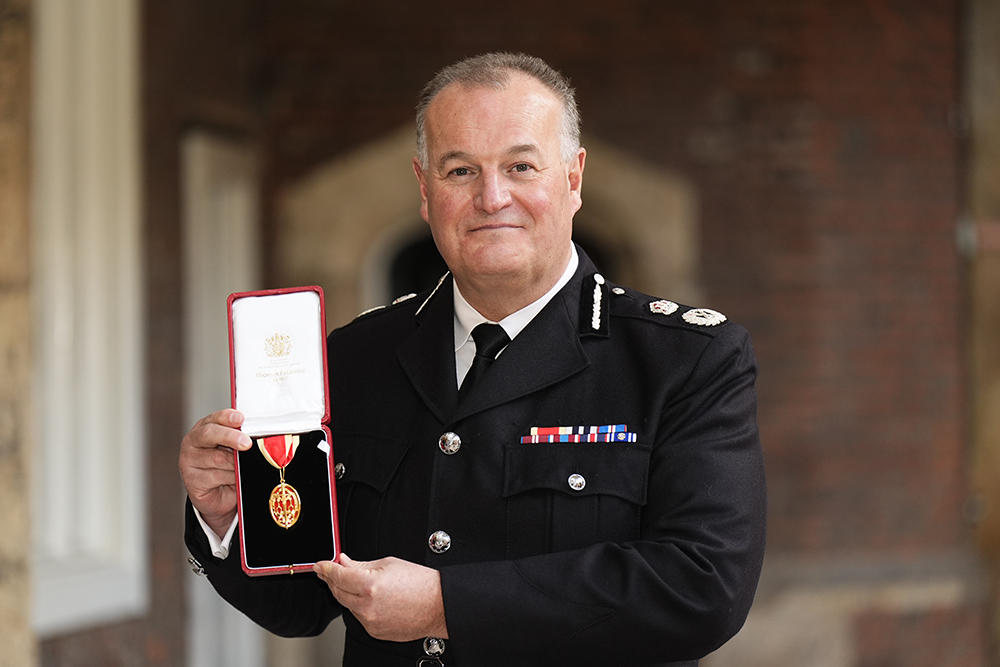
Sir Stephen Watson, Chief Constable of Greater Manchester Police (GMP), is Warrington-born, Rhodesia-raised. His father was an engineer in the Royal Navy and his work took the family to South Africa, South West Africa and then, when Sir Stephen was still a schoolboy, the breadbasket. The Watson family stayed in Rhodesia until Robert Mugabe became prime minister in 1980 and threw them out. ‘I saw the collapse of policing,’ Sir Stephen says. ‘I saw the collapse of the rule of law. I saw the collapse of health systems, of education systems, of legal systems.’
He also saw what Britain could lose. ‘I think there is a complacency in the UK. We take things for granted. I like to quote Kipling on this: “What should they know of England who only England know?” There’s an assumption on the part of people who have never left this country that everything [here] is terrible and everything abroad is great. Not true, I’m afraid.’
‘I have a major problem with any sergeant who allows himself to be called “mate” by the troops’
Sir Stephen is an atypical public servant: he quotes Kipling, he backed Brexit, he is running a large institution well. When he took over GMP in 2021, the second-largest police force in the country had just been placed into ‘special measures’ by the police inspectorate. More than 200 offences a day were not being recorded at all. Since then, GMP has doubled the number of suspects it arrests annually from 31,000 to 74,000 and lowered its average attendance time for ‘priority’ calls from 29 hours to 58 minutes.
Sir Stephen’s method is ‘back-to-basics’. ‘The public expects you to pick up the phone, make accurate records, get to them quickly, turn up looking like you can pull the skin off a rice pudding,’ he says. ‘Be compassionate, be diligent, look like you give a damn, record crime, investigate crime and – here’s a novel concept – arrest bad people.’
Nothing sums up the old GMP like the ‘Citizen’s Contract’ unveiled by Sir Stephen’s predecessor, Ian Hopkins, in 2018. It blamed dwindling resources for his force’s sinking record and made seven requests of the public. ‘We need you to protect yourself, your property, your family and communities,’ read one of them. The document was ditched on Sir Stephen’s first day as chief. ‘It was an approach which basically said: “Dear public, we can’t cope. We’re screwed. You’re screwed.”’ He then purged GMP’s top brass. Remaining staff were told to smarten their uniforms and to address their superiors more formally. ‘I have a major problem with any sergeant who allows himself to be called “mate” by the troops,’ he says. ‘They should have their stripes taken off them. You’re not there to be people’s mate.’ He has sacked 156 officers in his four years in charge.
He has also got officers to answer 999 calls faster, refocused GMP’s efforts on tackling minor crime (which the old leadership had decided it could no longer fight) and increased stop-and-search fivefold. ‘Back in 2021, there were only two forces in this country that were stopping and searching fewer people than GMP: Wiltshire and Dyfed-Powys. They are slightly different operating models to Greater Manchester…’

Simply put, his officers started putting away more criminals. ‘So much of it goes back to this defeatist idea,’ he says. ‘For example, if you find a Coke can outside of a burglary and you dust it and you get the fingerprint of a prolific burglar, that is not enough to get you a conviction. But it is enough to lock them up. It is enough to then use your powers to cross their threshold and mooch around in their house and see what else they’ve been up to. If nothing else, it takes a prolific burglar and has him in our traps for 24 hours, which means that he’s not burgling anybody else. At the level of forensics, all moveable object idents used to never get off the cutting-room floor, because “What’s the point, because you can’t get a conviction?”’
Sir Stephen says that being a modern chief constable is a ‘high-wire act’. Much of the job is not dealing with traditional crimes, but policing political expressions. In November, he said publicly that he would not have banned Maccabi Tel Aviv fans from attending a football match against a Manchester side, as West Midlands Police did for a game against Aston Villa. Today, he says to do so would be surrendering to ‘mob rule’.
He also believes there is ‘an element of anti-Semitism’ to pro-Palestine marches, particularly with the slogan ‘globalise the intifada’. Following the Heaton Park Synagogue attacks and Operation Catogenic, the counter-terrorism investigation which last month saw two Islamic State-inspired men convicted of planning the largest attack in British history against Jews, he has been ‘left with the view that if you are going to use language that you know causes fear and offence and you are genuinely not anti-Semitic, [then] why would you use it?’.
When asked if he supports the Human Rights Act, Sir Stephen indicates that parts of it are broken – especially Article 8, which enshrines protections for private life, family life, home and correspondence, and is often used by foreign criminals to stop their deportation. ‘Article 8 is increasingly applied in a way that was never intended,’ he says.
As well as preventing crime, Sir Stephen is trying to stop the public’s free-falling trust in the British state. He believes that the British people are ‘losing faith in institutions’, and that the police must accept they are partly at fault. ‘Loss of trust in policing really stems from a number of examples where frankly we’ve properly messed up,’ he says. ‘The child sexual exploitation scandals – Rotherham, Rochdale, Oldham. People don’t understand how it could have been that those things weren’t gripped at the time.’ He has opened eight investigations into historic grooming crimes.
Sir Stephen remembers when he joined Lancashire Constabulary in 1988. It was old-fashioned, hierarchical, stuck in an analogue age. Poorly written statements were thrown back at a constable by his sergeant. But back then, at least, ordinary people’s natural instinct was to assume the police were there to help. Today, that trust must be re-earned.





Comments