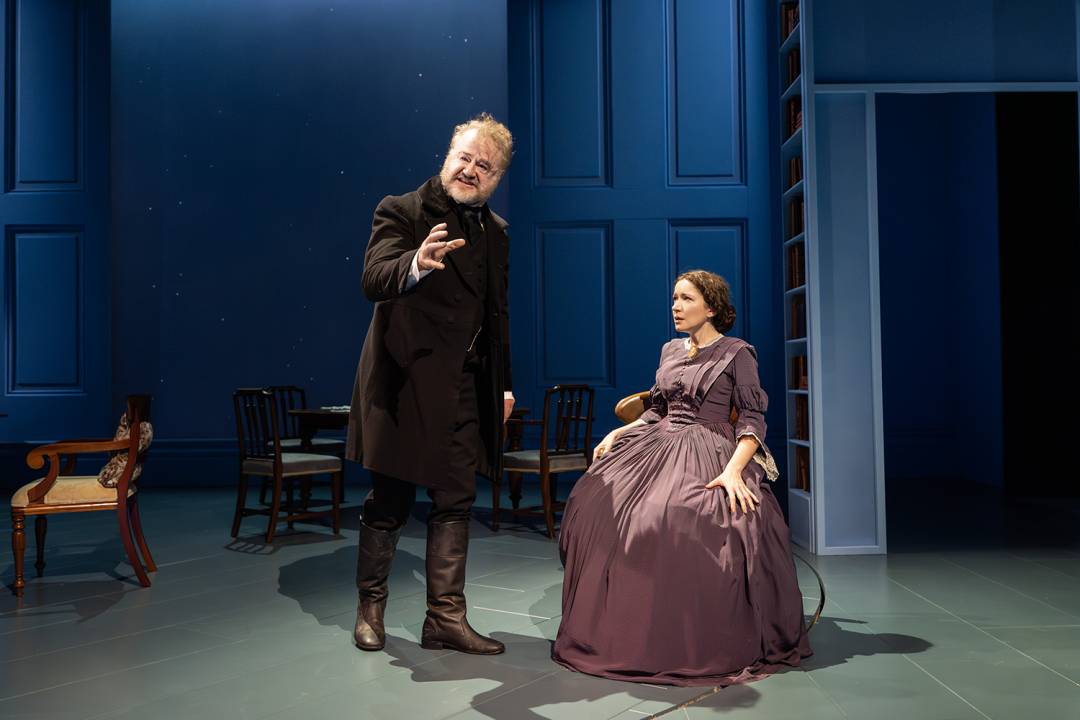


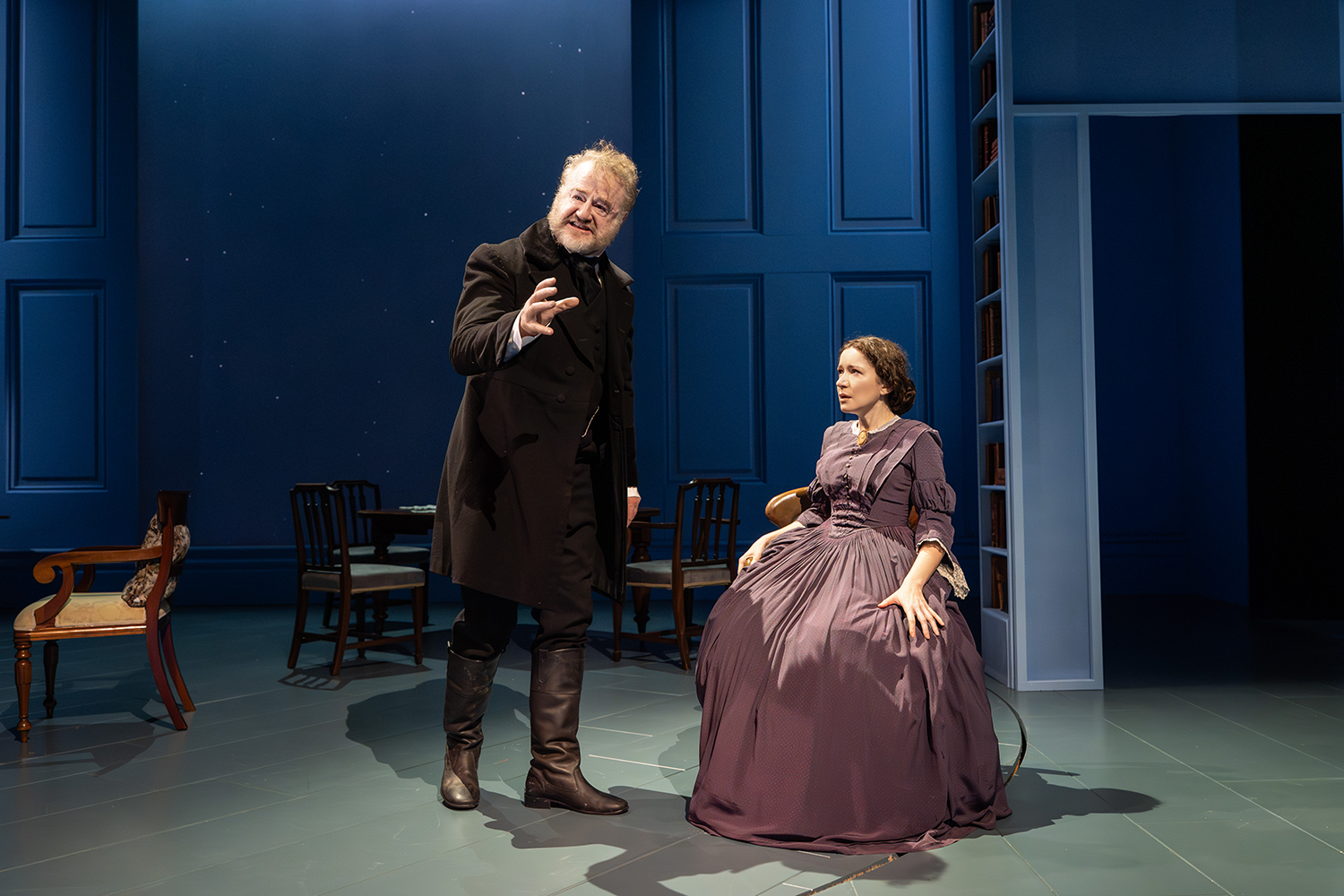
Bird Grove by Alexi Kaye Campbell is a comedy of manners set in 1841. A portly suitor, Horace, arrives at a respectable house intending to propose to a rebellious and brilliant 22-year-old, Mary Ann. Horace’s father is dying and he must find a bride before nightfall or lose a substantial legacy.
This ludicrous but very human situation starts the play. It’s instantly gripping. Mary Ann is in the drawing room being treated for headaches by a French mesmerist along with two wealthy radicals, Mr and Mrs Bray, who encourage her political activism. Her father, Robert, introduces his guests to each other and invites them to stay for tea.
This fascinating glimpse of her early life shows George Eliot as a surly, arrogant, spoilt and heartless pest
A hilariously awkward party ensues. Horace is desperate to get Mary Ann alone for a moment but the rules of etiquette are against him. When Mary Ann retreats to the kitchen to butter more bread, Horace makes his move but he’s intercepted by the formidable Mrs Bray, who dislikes and mistrusts him. It’s an agonisingly funny encounter. Horace leaves the house, rebuffed and alone.
In the next scene, Mary Ann informs her father that she has abandoned her Christian faith because she regards scripture as a tool of repression. Barely containing his anger, Robert informs her that he has spent his whole life creating a façade of prosperity in order to settle her with a suitable husband. He instructs her to accompany him to church. She refuses. He banishes her from the house. This scene, although not funny, is riveting to watch because the stakes are plainly set out and the dangers to both parties are enormous and very close at hand.
And it feels horribly familiar. Mary Ann is a Victorian Greta whose radicalism is a ploy to gain attention while inflicting pain on anyone who stands in her way. In later life, Mary Ann will become the novelist George Eliot and this fascinating glimpse of her early life shows her as a surly, arrogant, spoilt and heartless pest.
The play occasionally turns into a footnote on the predicament of women rather than a real drama. Mrs Bray has a habit of taking Mary Ann aside and urging her to seize the initiative from men and to write female stories. ‘Find your own voice,’ she says, like a tutor at a creative-writing seminar. This isn’t the strangest anachronism in the play. The prize goes to the doorbell at Robert’s home – which is electric.

The audience knows that Mary Ann has rare intellectual abilities because her friends and relatives talk constantly about her thirst for knowledge and her phenomenal memory, but these qualities don’t come across on stage. Her deeds are unexceptional. And her speeches are as banal as Baldrick’s.
Elizabeth Dulau portrays Mary Ann well enough. Owen Teale is magnificent as her wronged and broken father. Jonnie Broadbent does an excellent comic turn as the amorous fall guy Horace. (A shame we didn’t see Horace again in Act Two.)
When Robert dies, Mary Ann’s true character emerges. It’s all about money. Her married siblings inherit the bulk of the estate and Mary Ann reacts to the news with fury. Declaring herself destitute, she attacks the family library and destroys books by Swift, Defoe and Walpole. It’s all a front, of course. Despite her claims of penury, Mary Ann celebrates her father’s death by arranging a six-month tour of France and Italy funded by £2,000 from his will. Fans of George Eliot who see this excellent play are in for a shock.
The Red Prince is a timely satire about a depressed Labour MP. Craig Kitman, a public school socialist, won the seat of Bolton East in 2024 but his jubilation has turned into self-hatred and dejection. Alone in his constituency office, he slugs whisky and delivers a valedictory monologue while deciding whether to kill himself.
Many of the gags are pretty amusing. He says he was a perfect Labour candidate because he lacked personality, integrity or intellect. Arriving at Westminster, he expected sexual delights galore but the reality disappointed him. His greatest thrill came when he spotted Angela Rayner ‘retrieving a dropped earbud from inside her cleavage during business questions’. He doesn’t care for House of Commons whisky, which is overpriced at £30 a pop. ‘But this bottle has been signed by Rishi Sunak so it’s probably only worth a fiver.’
Some of his rhetoric seems inaccurate. He suggests that Reform is a homophobic party full of closeted gay men. And he describes the typical Tory MP as an overgrown schoolboy married to a buxom Shireswoman who spanks him and demands that he call her ‘Mummy’. Decades have passed since that caricature was apposite. The juiciest targets are left entirely untouched. There are no gags about Wes or Andy, Lammy or Mandy. He calls Rory Stewart a ‘posh skull’, which is brilliant. More like that are needed.



Comments