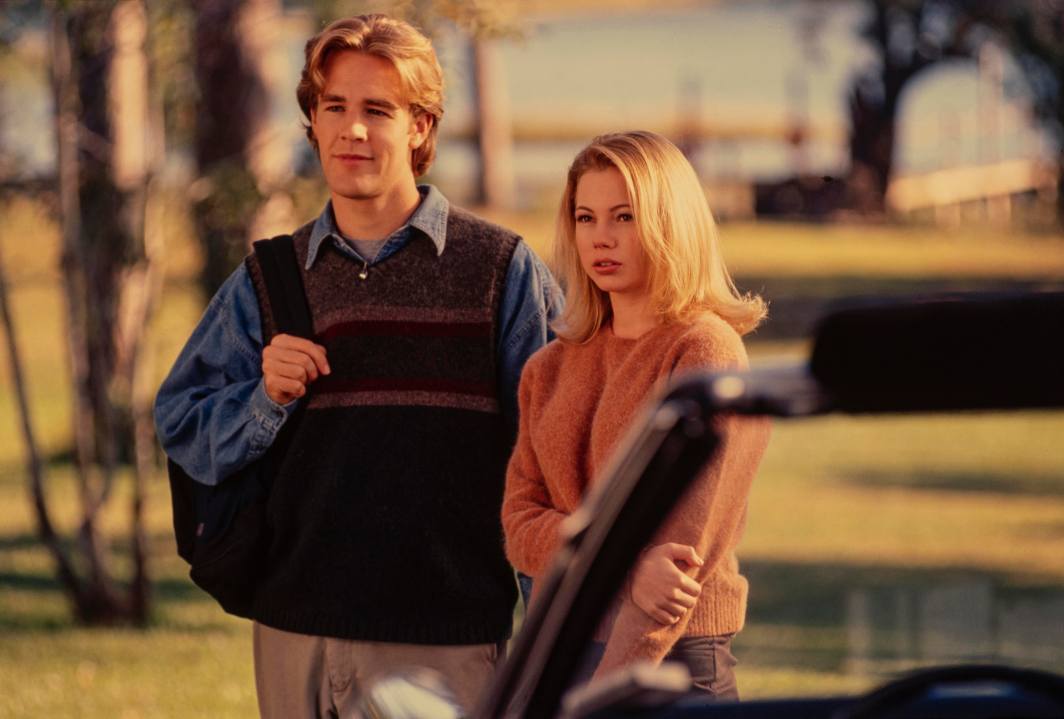
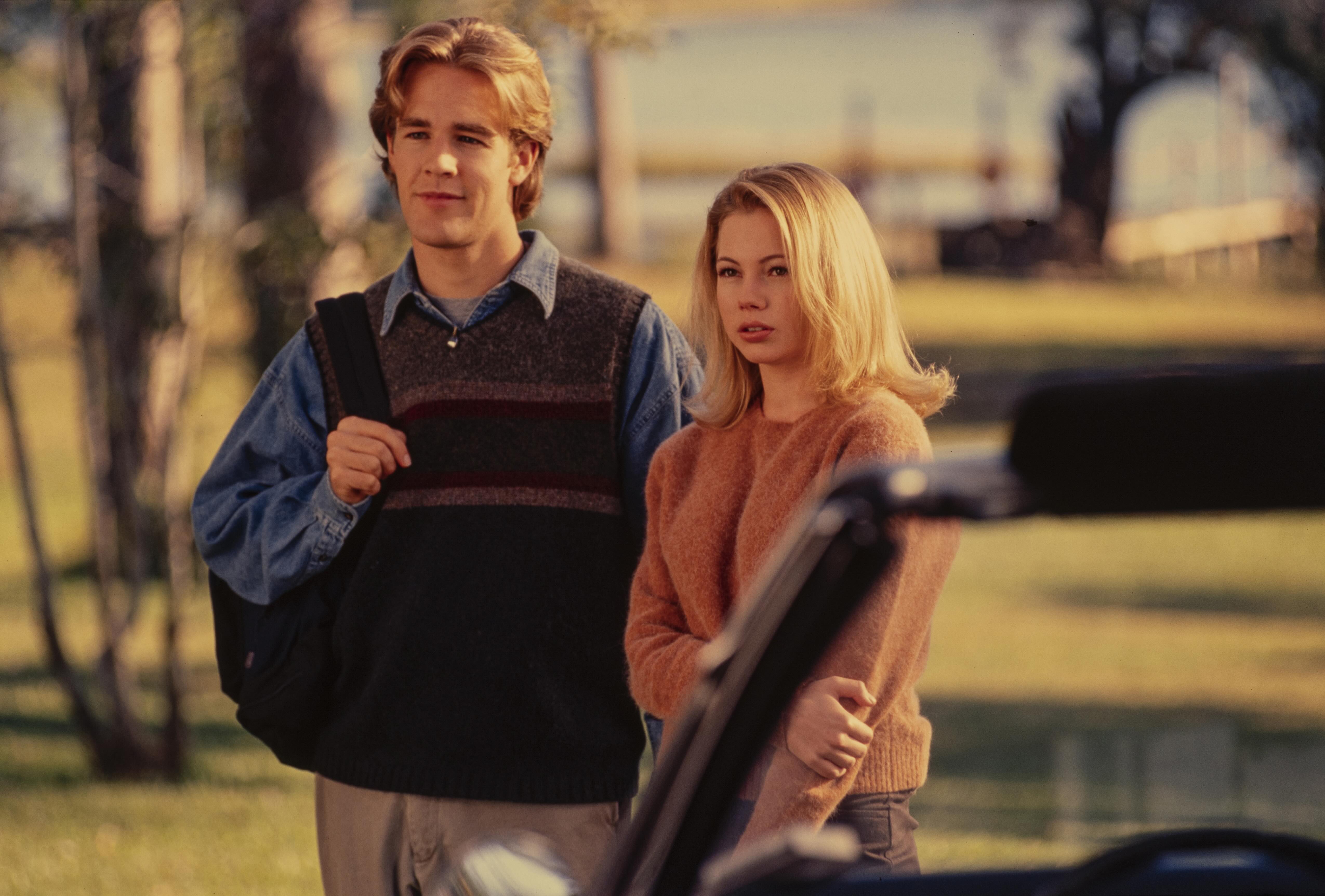
If you were a teenager anywhere in the vicinity of the late 1990s, the opening bars of Paula Cole’s ‘I Don’t Want to Wait’ will only ever mean one thing: Dawson’s Creek. Airing on The WB from 1998 to 2003, and broadcast in the UK on Channel 4’s teen-oriented T4 block, the adolescent angst fest starred James Van Der Beek, who died last month aged 48 from colorectal cancer. In a crowded field of literate pop culture, the smart, sexy soap opera stood out for its appeal to young adults who found in its storylines of mates, dates, and heartaches an echo of their own emotional turmoils.
Dawson’s Creek was to millennials as Fast Times at Ridgemont High and The Breakfast Club were to Gen-Xers: an attempt to capture the mood and experiences of a generation that, unlike the Boomers, did not announce its arrival with social movements or cultural upheavals. The Dawson’s Creek generation turned its alienation inwards, into self-effacing self-analysis, and it was this tendency the series played up and gently satirised.
The Dawson of the title was Dawson Leery (Van Der Beek) and the Creek the sun-shimmering tributary that weaved along the idyllic Massachusetts settlement of Capeside, one of those Hollywood small towns where everyone looks like a GAP model, middle-income families live in sprawling Queen Anne-style mansions, and the local economy mostly consists of quirky late-night coffee bars where teens go for midnight mochas and boys talk with nary a parental objection.
Dawson was earnest, ardent, and arrogant in a semi-endearing, semi-punchable way. His world was the movies, Spielberg his god, and his friends the involuntary performers in overly ambitious film projects. Dawson was both hero and anti-hero; a bard of turn-of-the-century teen turmoil whom the audience loved or hated but mostly loved to hate.
His best friend was Joey Potter (Katie Holmes), a clever, mousy girl from the wrong side of the tracks who longed to be a writer and longed to be with Dawson. But he was oblivious to her affections, as to so much else, and she had to settle for clambering up a ladder to his bedroom window to watch movies together. In time Dawson would find himself vying for Joey’s affections with Pacey Witter (Joshua Jackson), a wisecracking screw-up disowned by his family and coasting on his good looks and charm but sincere and loveable beneath it all. The core four was completed by Jen Lindley (Michelle Williams) a pretty girl with a past, whose parents sent her away from New York City to live in the more wholesome environs of Capeside.
The series emerged, as did much 1990s teen entertainment, from the mind of Kevin Williamson, writer of hit horror flicks Scream, I Know What You Did Last Summer and TV’s The Vampire Diaries. Despite these promising origins, Dawson’s Creek couldn’t help but fall into the issue-of-the-week trap and the writers were never happier than when they were educating us about mental illness, addiction, bullying, or homosexuality. (The series aired the first romantic kiss between two men on prime-time US television.) The politics were gently progressive in that easygoing 1990s way, heartfelt but not hectoring, optimistic rather than censorious. It might have been superficial Starbucks liberalism, but at least it was liberalism without a scowl.
The themes were those common to millennial teen drama: belonging and becoming. Jen’s parents neglected her, Pacey’s outright told him he was a loser, and Joey’s jailbird father cared more for himself than his motherless 15-year-old. For the children of the 1980s and 1990s, this was all too relatable. Baby Boomers scorned their square and conventional upbringing but their own parenting style – self-serving and permissive – produced miserable, dysfunctional offspring who might have benefited from a touch of the square and conventional.
Dawson was both hero and anti-hero; a bard of turn-of-the-century teen turmoil
Their love lives were elaborate and so too was their manner of speaking. They conversed in a high-strung argot drawn from 1980s psychobabble and the over-thumbed thesaurus of an overwrought undergrad. When Pacey is too horny to focus on schoolwork, Joey sighs: ‘So what you’re saying is you’re merely the innocent victim in some behavioural psychology experiment gone horribly awry and you’re desperately in need of some able-bodied female to help you provoke those preconditioned Pavlovian homework responses?’ Not long after being appointed head cheerleader, Jen pouts: ‘Ever since they elected me leader of their little junta, all they want to do are these nasty, sardonic, self-aware cheers. They’ve even started to dress like me. It’s like they’re genetically pre-disposed to having absolutely no identity.’
Critics scoffed at the pretentious wordplay: real teenagers didn’t speak like that. The real teenagers who brought the series between four and seven million US viewers every week, and many more internationally, were well aware of how unrealistic the dialogue was. But it was about aspiration, not realism. After the excesses of the 1980s, that decade of muscle and materialism, along came the 1990s to make smart sexy. Reagan, Rambo and rearmament were out and in were nerdy software designers, college-dorm dot-com millionaires, and brainiac scientists putting telescopes in space and cracking the human genome. Geek was good.
Dawson’s Creek connected with millennial teenagers lost and lonely and frightened amid the emotional maelstrom of adolescence and told us we were not alone. As Dawson Leery’s beloved film critic Pauline Kael once wrote: ‘When we feel defeated, when we imagine we could now perhaps settle for home and what it represents, that home no longer exists. But there are movie houses.’ When we feel down, when we imagine ourselves climbing back into our youth, we find there is no ladder and no open window. But there are streaming services, and old episodes of Dawson’s Creek, and that may be enough.





Comments