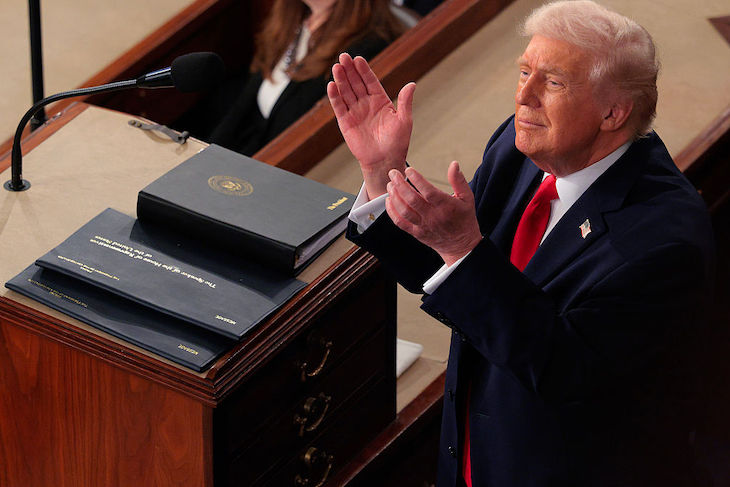
Donald Trump’s State of the Union address, the longest in history, served as a reminder of the relentless will and unstoppable energy he brings to the office of the presidency. In a coup de grâce he humiliated congressional Democrats, securing footage of them remaining seated en masse as they refused to accept that the role of the government is to prioritize American citizens. He gently chastised the Supreme Court judges, assembled in the front row, for declaring his tariff program unlawful last Friday.
Our political right should take heed: for all its roughness, this agenda isn’t going away
The President’s opponents may be celebrating the judgment, but the Donald is not known for bowing down easily to judicial lawfare; he has simply invoked his powers under the 1974 Trade Act which will reimpose tariffs until at least the summer. Contrary to his critics’ howling, this is not defiance of the SCOTUS – he is responding to their judgment.
This may come as bad news to the rest of the world. But despite defying every mainstream economic orthodoxy the tariff program has, in its own way, worked. Their negative impact on the US economy has been far less dramatic than many predicted. GDP slowdown in the final quarter of 2025 did not erase the productivity surge earlier in the year, and was due more to a reduction in federal spending than any real private sector downturn. Meanwhile the US trade deficit – the main target of the protectionist turn – is narrowing, tariff revenue has doubled and companies have announced more than $1.7 trillion in new manufacturing investment, from Texan semiconductor fabs to battery plants in Tennessee.
While the tariff program is totemic, both in its audacity and its violation of economic shibboleths, in the context of the Trump administration’s wider economic agenda it is far from the whole story. The MAGA movement’s drive to reshore supply chains and manufacturing jobs is partly about rebuilding national capacity in a fragmenting and more dangerous world, partly about reversing China’s global trade dominance and partly about restoring well-paid jobs to depressed regions. But it is also about a shift of Republican economic priorities towards production in the real economy, and away from the dominance of Wall Street.
Trump’s economic project, crafted primarily by J.D. Vance, Stephen Miran, Robert Lighthizer and Peter Navarro, is about a major internal pivot in America’s center of economic gravity as much as a reset with the global trading order. The overriding thesis is that for too long the American economy has incentivized talent to flock to financial services, rewarded speculation, extraction and rent-seeking, and returns to real estate investment over the growth of productive, long-termist companies.
American workers, the argument goes, have lost out not only from Chinese mercantilist aggression, stripping jobs out of the South and Rust Belt, but also from a set of economic conditions that places them at the bottom of the pecking order. While returns to capital have soared over the last 30 years, returns to labor have been small by comparison – America’s overall higher wages notwithstanding. In the US – unlike in Europe, where productivity itself is the problem – productivity growth of around 60 percent since 1980 has not been reflected in pay growth, which has been more like 15 percent. Output and compensation have been diverging sharply.
Trump is ensuring a cheap, domestic supply of energy to revive manufacturing, but also to fuel energy-hungry frontier industries like AI data centers, which can consume as much power as the most energy-intensive factories in the world. This is part of a strategy to ensure the US leads not only in technological innovation, but also in commercializing it locally rather than offshore.
The Trump administration is pursuing a surprisingly anti-usurious approach towards big creditors and speculators in real estate. Trump has moved to regulate consumer credit with a 10 percent retail debt interest cap. Given the average American owes more than $20,000 in non-mortgage consumer credit, “MAGA-nomics” is clearly favoring struggling families over banks. And he has banned institutional investment in single-family homes: for context, 25 percent of manufactured homes in Michigan are currently owned by private equity.
Anglosphere and European conservatives may find this egalitarian, antitrust streak in the Trump playbook as baffling as his attempt to apply a handbrake turn to the global trading system. But both reflect a new politics of the family, the factory and the worker over the financier, the rentier and the tech lord. Our political right should take heed: for all its roughness, this agenda isn’t going away.



Comments